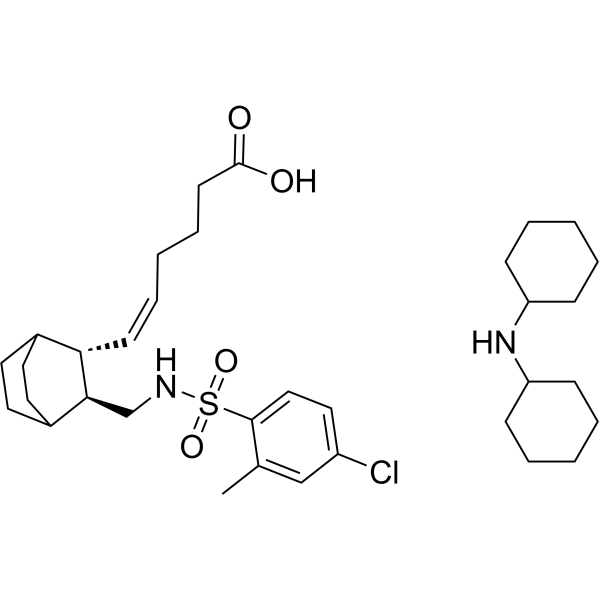
Physicochemical Properties
| Molecular Formula | C34H53CLN2O4S |
| Molecular Weight | 621.31 |
| Related CAS # | ONO-8711;216158-34-8 |
| Appearance | White to off-white solid powder |
| HS Tariff Code | 2934.99.9001 |
| Storage |
Powder-20°C 3 years 4°C 2 years In solvent -80°C 6 months -20°C 1 month Note: Please store this product in a sealed and protected environment, avoid exposure to moisture. |
| Shipping Condition | Room temperature (This product is stable at ambient temperature for a few days during ordinary shipping and time spent in Customs) |
Biological Activity
| Targets | Ki: 0.6 nM (human EP1), 1.7 nM (mouse EP1)[1] |
| ln Vitro | ONO-8711 (10 and 30 μM; 30 min) non-competitively inhibits sulprostone-induced pulmonary vein contractions in humans[2]. For the rat, mouse, and human receptors, ONO-8711 has IC50s of 0.22 μM, 0.05 μM, and 0.21 μM, respectively, and suppresses the PGE2-induced rise in cytosolic Ca2+ concentration[3]. |
| ln Vivo | ONO-8711 (400 or 800 ppm; po; for 20 weeks) inhibits the growth of breast tumors and reduces the incidence of cancer[3]. |
| Animal Protocol |
Animal/Disease Models: Female SD (Sprague-Dawley) rats (induced breast cancer by gavage of 85 mg/kg PhIP (HY -118716) 4 times for 2 weeks) Doses: 400 or 800 ppm Route of Administration: po; for 20 weeks Experimental Results: Did not induce any symptoms of toxicity at 800 ppm. Delayed occurrence of breast tumors for 2 or 4 weeks at 400 or 800 ppm , respectively. Dramatically suppressed cancer incidence compared with the control diet group at 800 ppm (56% versus 79%, P < 0.05). |
| References |
[1]. Role of the prostaglandin E receptor subtype EP1 in colon carcinogenesis. Cancer Res. 1999 Oct 15;59(20):5093-6. [2]. Vasoconstriction induced by activation of EP1 and EP3 receptors in human lung: effects of ONO-AE-248, ONO-DI-004, ONO-8711 or ONO-8713. Prostaglandins Other Lipid Mediat. 2004 Oct;74(1-4):101-12. [3]. Chemopreventive effects of ONO-8711, a selective prostaglandin E receptor EP(1) antagonist, on breast cancer development. Carcinogenesis. 2001 Dec;22(12):2001-4. |
Solubility Data
| Solubility (In Vitro) | DMSO :~33.33 mg/mL (~53.64 mM) |
| Solubility (In Vivo) |
Solubility in Formulation 1: ≥ 2.5 mg/mL (4.02 mM) (saturation unknown) in 10% DMSO + 40% PEG300 + 5% Tween80 + 45% Saline (add these co-solvents sequentially from left to right, and one by one), clear solution. For example, if 1 mL of working solution is to be prepared, you can add 100 μL of 25.0 mg/mL clear DMSO stock solution to 400 μL PEG300 and mix evenly; then add 50 μL Tween-80 to the above solution and mix evenly; then add 450 μL normal saline to adjust the volume to 1 mL. Preparation of saline: Dissolve 0.9 g of sodium chloride in 100 mL ddH₂ O to obtain a clear solution. Solubility in Formulation 2: ≥ 2.5 mg/mL (4.02 mM) (saturation unknown) in 10% DMSO + 90% (20% SBE-β-CD in Saline) (add these co-solvents sequentially from left to right, and one by one), clear solution. For example, if 1 mL of working solution is to be prepared, you can add 100 μL of 25.0 mg/mL clear DMSO stock solution to 900 μL of 20% SBE-β-CD physiological saline solution and mix evenly. Preparation of 20% SBE-β-CD in Saline (4°C,1 week): Dissolve 2 g SBE-β-CD in 10 mL saline to obtain a clear solution. (Please use freshly prepared in vivo formulations for optimal results.) |
| Preparing Stock Solutions | 1 mg | 5 mg | 10 mg | |
| 1 mM | 1.6095 mL | 8.0475 mL | 16.0950 mL | |
| 5 mM | 0.3219 mL | 1.6095 mL | 3.2190 mL | |
| 10 mM | 0.1610 mL | 0.8048 mL | 1.6095 mL |