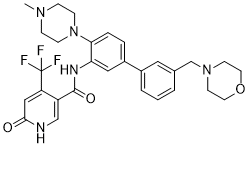
OICR-9429 (OICR9429) is a novel, potent and selective antagonist of the interaction between WDR5 and the peptide regions of MLL and Histone 3, disrupting Wdr5-MLL interaction with IC50 of 5 uM. OICR-9429 shows anticancer activity by inhibiting proliferation and inducing differentiation in p30-expressing human AML cells. It can cause a significant decrease in viability in the majority of patient cells with mutations in the N-terminal part of the CEBPA gene. OICR-9429 displays exquisite cellular selectivity and specificity in disrupting critical protein-protein interactions between WDR5. It reduces the viability of primary human AML cells with N-terminal C/EBPα mutations by about 50% (mean value, n = 8) at 5 μM.
Physicochemical Properties
| Molecular Formula | C29H32F3N5O3 | |
| Molecular Weight | 555.59 | |
| Exact Mass | 555.245 | |
| CAS # | 1801787-56-3 | |
| Related CAS # |
|
|
| PubChem CID | 91623360 | |
| Appearance | White to off-white solid powder | |
| Density | 1.3±0.1 g/cm3 | |
| Boiling Point | 693.0±55.0 °C at 760 mmHg | |
| Flash Point | 372.9±31.5 °C | |
| Vapour Pressure | 0.0±2.2 mmHg at 25°C | |
| Index of Refraction | 1.602 | |
| LogP | 1.84 | |
| Hydrogen Bond Donor Count | 2 | |
| Hydrogen Bond Acceptor Count | 9 | |
| Rotatable Bond Count | 6 | |
| Heavy Atom Count | 40 | |
| Complexity | 973 | |
| Defined Atom Stereocenter Count | 0 | |
| InChi Key | DJOVLOYCGXNVPI-UHFFFAOYSA-N | |
| InChi Code | InChI=1S/C29H32F3N5O3/c1-35-7-9-37(10-8-35)26-6-5-22(21-4-2-3-20(15-21)19-36-11-13-40-14-12-36)16-25(26)34-28(39)23-18-33-27(38)17-24(23)29(30,31)32/h2-6,15-18H,7-14,19H2,1H3,(H,33,38)(H,34,39) | |
| Chemical Name | N-[2-(4-methylpiperazin-1-yl)-5-[3-(morpholin-4-ylmethyl)phenyl]phenyl]-6-oxo-4-(trifluoromethyl)-1H-pyridine-3-carboxamide | |
| Synonyms |
|
|
| HS Tariff Code | 2934.99.9001 | |
| Storage |
Powder-20°C 3 years 4°C 2 years In solvent -80°C 6 months -20°C 1 month |
|
| Shipping Condition | Room temperature (This product is stable at ambient temperature for a few days during ordinary shipping and time spent in Customs) |
Biological Activity
| ln Vitro | T24 and UM-UC-3 exhibit strong sensitivity to OICR-9429 (0-10 μM, 48 h), with IC50 values of 67.74 μM and 70.41 μM, respectively[1]. With an IC50 value of 121.42 μM, OICR-9429 (0-10 μM, 48 hours) exhibits poor sensitivity to TCCSUP[1]. By inhibiting WDR5-mediated H3K4me3, OICR-9429 (70 μM, 120 μM, 140 μM, and 240 μM; 48 hours) lowers BCa cell viability[1]. By controlling the G1/S phase transition, OICR-9429 (70 μM, 120 μM, 140 μM, and 240 μM; 48 hours) prevents BCa cell proliferation [1]. OICR-9429 (70 μM, 120 μM, 140 μM, and 240 μM; 24 h) increases BCa cell apoptosis in a dose- and time-dependent manner while enhancing the cells' chemosensitivity to cisplatin [1]. OICR-9429 (70 μM, 120 μM, 140 μM, and 240 μM; 24 hours, 48 hours) prevents bladder cancer cells from spreading [1]. BCa cells' PD-L1 expression is inhibited by OICR-9429 (70 μM, 120 μM, 140 μM, and 240 μM; 48 h) in response to IFN-γ [1]. |
| ln Vivo | In addition to enhancing the effectiveness of cisplatin on BCa cells in vivo and inhibiting tumor proliferation, OICR-9429 (30 mg/kg or 60 mg/kg, ip) targets WDR5 and lessens the toxic side effects on normal tissues [1]. |
| Cell Assay |
Cell Proliferation Assay[1] Cell Types: BCa cell lines (T24, UM-UC-3 and TCCSUP) Tested Concentrations: 70 μM, 120 μM, 140 μM and 240 μM Incubation Duration: 5 days Experimental Results: Had a low proliferation rate and remarkably decreased the number of colonies formed by the three BCa cell lines in a dose-dependent manner. Cell Cytotoxicity Assay[1] Cell Types: BCa cell lines (T24, UM-UC-3 and TCCSUP) Tested Concentrations: 0-10 μM Incubation Duration: 48 h Experimental Results: Inhibited cell viability in a dose-dependent manner in BCa cell lines. Apoptosis Analysis[1] Cell Types: BCa cell lines (T24, UM-UC-3 and TCCSUP) Tested Concentrations: 70 μM, 120 μM, 140 μM and 240 μM Incubation Duration: 24 h Experimental Results: demonstrated no obvious apoptotic cells for 24 h but the apoptotic rate was Dramatically increased at 72 h and upregulated caspase 3/7 activity. Cell Migration Assay [1] Cell Types: BCa cell lines ( T24, UM-UC-3 and TCCSUP) Tested Concentrations: 70 μM, 120 μM, 140 μM and 240 μM Incubation Duration: 24 h, 48 h Experimental Results: decreased the migratory speed and diminished the |
| Animal Protocol |
Animal/Disease Models: xenograft mouse model[1] Doses: 30 mg/kg, 60 mg/kg Route of Administration: 30 mg/kg, 60 mg/kg, ip Experimental Results: Suppressed tumour growth, small tumours and enhanced tumour sensitivity. |
| References |
[1]. Targeting WD repeat domain 5 enhances chemosensitivity and inhibits proliferation and programmed death-ligand 1 expression in bladder cancer. J Exp Clin Cancer Res. 2021 Jun 21;40(1):203. |
Solubility Data
| Solubility (In Vitro) |
|
|||
| Solubility (In Vivo) |
Solubility in Formulation 1: ≥ 2.5 mg/mL (4.50 mM) (saturation unknown) in 10% DMSO + 40% PEG300 + 5% Tween80 + 45% Saline (add these co-solvents sequentially from left to right, and one by one), clear solution. For example, if 1 mL of working solution is to be prepared, you can add 100 μL of 25.0 mg/mL clear DMSO stock solution to 400 μL PEG300 and mix evenly; then add 50 μL Tween-80 to the above solution and mix evenly; then add 450 μL normal saline to adjust the volume to 1 mL. Preparation of saline: Dissolve 0.9 g of sodium chloride in 100 mL ddH₂ O to obtain a clear solution. Solubility in Formulation 2: ≥ 2.5 mg/mL (4.50 mM) (saturation unknown) in 10% DMSO + 90% (20% SBE-β-CD in Saline) (add these co-solvents sequentially from left to right, and one by one), clear solution. For example, if 1 mL of working solution is to be prepared, you can add 100 μL of 25.0 mg/mL clear DMSO stock solution to 900 μL of 20% SBE-β-CD physiological saline solution and mix evenly. Preparation of 20% SBE-β-CD in Saline (4°C,1 week): Dissolve 2 g SBE-β-CD in 10 mL saline to obtain a clear solution. Solubility in Formulation 3: ≥ 2.5 mg/mL (4.50 mM) (saturation unknown) in 10% DMSO + 90% Corn Oil (add these co-solvents sequentially from left to right, and one by one), clear solution. For example, if 1 mL of working solution is to be prepared, you can add 100 μL of 25.0 mg/mL clear DMSO stock solution to 900 μL of corn oil and mix evenly. (Please use freshly prepared in vivo formulations for optimal results.) |
| Preparing Stock Solutions | 1 mg | 5 mg | 10 mg | |
| 1 mM | 1.7999 mL | 8.9994 mL | 17.9989 mL | |
| 5 mM | 0.3600 mL | 1.7999 mL | 3.5998 mL | |
| 10 mM | 0.1800 mL | 0.8999 mL | 1.7999 mL |