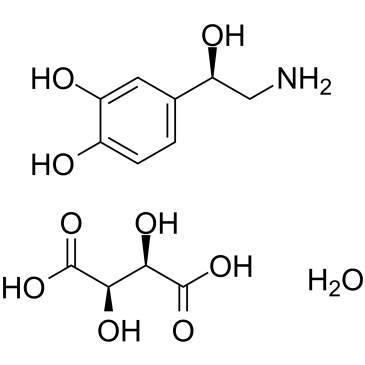
Noradrenaline bitartrate monohydrate (Levophed; NSC169106; Arterenol bitartrate; Noradrenalin bitartrate; NSC-169106; Levarterenol bitartrate monohydrate), the bitartrate salt and hydrated form of Noradrenaline, is a direct-acting alpha-adrenergic receptors agonist / stimulator. It is a catecholamine that has dual roles in the body and brain, acting as a neurotransmitter and hormone.
Physicochemical Properties
| Molecular Formula | C12H19NO10 | |
| Molecular Weight | 337.28 | |
| Exact Mass | 337.1 | |
| CAS # | 108341-18-0 | |
| Related CAS # | Norepinephrine; 51-41-2; Norepinephrine hydrochloride; 329-56-6; Norepinephrine tartrate; 51-40-1 | |
| PubChem CID | 3047796 | |
| Appearance | White to off-white solid powder | |
| Boiling Point | 442.6ºC at 760mmHg | |
| Melting Point | 100-104ºC(lit.) | |
| Flash Point | 221.5ºC | |
| Vapour Pressure | 1.3E-08mmHg at 25°C | |
| Index of Refraction | -11 ° (C=5, H2O) | |
| Hydrogen Bond Donor Count | 9 | |
| Hydrogen Bond Acceptor Count | 11 | |
| Rotatable Bond Count | 5 | |
| Heavy Atom Count | 23 | |
| Complexity | 276 | |
| Defined Atom Stereocenter Count | 3 | |
| SMILES | O([H])[C@@]([H])(C([H])([H])N([H])[H])C1C([H])=C([H])C(=C(C=1[H])O[H])O[H].O([H])[C@@]([H])(C(=O)O[H])[C@]([H])(C(=O)O[H])O[H].O([H])[H] |
|
| InChi Key | LNBCGLZYLJMGKP-LUDZCAPTSA-N | |
| InChi Code | InChI=1S/C8H11NO3.C4H6O6.H2O/c9-4-8(12)5-1-2-6(10)7(11)3-5;5-1(3(7)8)2(6)4(9)10;/h1-3,8,10-12H,4,9H2;1-2,5-6H,(H,7,8)(H,9,10);1H2/t8-;1-,2-;/m01./s1 | |
| Chemical Name | 4-[(1R)-2-amino-1-hydroxyethyl]benzene-1,2-diol;(2R,3R)-2,3-dihydroxybutanedioic acid;hydrate | |
| Synonyms |
|
|
| HS Tariff Code | 2934.99.9001 | |
| Storage |
Powder-20°C 3 years 4°C 2 years In solvent -80°C 6 months -20°C 1 month Note: (1). This product requires protection from light (avoid light exposure) during transportation and storage.(2). Please store this product in a sealed and protected environment (e.g. under nitrogen), avoid exposure to moisture. |
|
| Shipping Condition | Room temperature (This product is stable at ambient temperature for a few days during ordinary shipping and time spent in Customs) |
Biological Activity
| Targets | α1-adrenergic receptor; α2-adrenergic receptor; Beta-1 adrenergic receptor; Microbial Metabolite; Human Endogenous Metabolite | ||
| ln Vitro |
|
||
| ln Vivo |
|
||
| Animal Protocol |
|
||
| References |
[1]. Trends Neurosci . 2005 Nov;28(11):574-82. [2]. Int Clin Psychopharmacol . 2003 Jul;18(4):191-202. [3]. Auton Neurosci, 2006, 126-127, 320-331. |
||
| Additional Infomation |
Norepinephrine Bitartrate is a bitartrate salt of norepinephrine, a synthetic phenylethylamine that mimics the sympathomimetic actions of the endogenous norepinephrine. Norepinephrine bitartrate acts directly on the alpha- and beta-adrenergic receptors. Clinically, norepinephrine is used as a peripheral vasoconstrictor that causes constriction of arterial and venous beds via its alpha-adrenergic action. It is also used as a potent inotropic and chronotropic stimulator of the heart mediated through its beta-1 adrenergic action. Precursor of epinephrine that is secreted by the ADRENAL MEDULLA and is a widespread central and autonomic neurotransmitter. Norepinephrine is the principal transmitter of most postganglionic sympathetic fibers, and of the diffuse projection system in the brain that arises from the LOCUS CERULEUS. It is also found in plants and is used pharmacologically as a sympathomimetic. See also: Norepinephrine (has active moiety) ... View More ... |
Solubility Data
| Solubility (In Vitro) |
|
|||
| Solubility (In Vivo) |
Solubility in Formulation 1: ≥ 2.08 mg/mL (6.17 mM) (saturation unknown) in 10% DMSO + 40% PEG300 + 5% Tween80 + 45% Saline (add these co-solvents sequentially from left to right, and one by one), clear solution. For example, if 1 mL of working solution is to be prepared, you can add 100 μL of 20.8 mg/mL clear DMSO stock solution to 400 μL PEG300 and mix evenly; then add 50 μL Tween-80 to the above solution and mix evenly; then add 450 μL normal saline to adjust the volume to 1 mL. Preparation of saline: Dissolve 0.9 g of sodium chloride in 100 mL ddH₂ O to obtain a clear solution. Solubility in Formulation 2: ≥ 2.08 mg/mL (6.17 mM) (saturation unknown) in 10% DMSO + 90% (20% SBE-β-CD in Saline) (add these co-solvents sequentially from left to right, and one by one), clear solution. For example, if 1 mL of working solution is to be prepared, you can add 100 μL of 20.8 mg/mL clear DMSO stock solution to 900 μL of 20% SBE-β-CD physiological saline solution and mix evenly. Preparation of 20% SBE-β-CD in Saline (4°C,1 week): Dissolve 2 g SBE-β-CD in 10 mL saline to obtain a clear solution. Solubility in Formulation 3: ≥ 2.08 mg/mL (6.17 mM) (saturation unknown) in 10% DMSO + 90% Corn Oil (add these co-solvents sequentially from left to right, and one by one), clear solution. For example, if 1 mL of working solution is to be prepared, you can add 100 μL of 20.8 mg/mL clear DMSO stock solution to 900 μL of corn oil and mix evenly. Solubility in Formulation 4: 150 mg/mL (444.73 mM) in PBS (add these co-solvents sequentially from left to right, and one by one), clear solution; with ultrasonication. (Please use freshly prepared in vivo formulations for optimal results.) |
| Preparing Stock Solutions | 1 mg | 5 mg | 10 mg | |
| 1 mM | 2.9649 mL | 14.8245 mL | 29.6490 mL | |
| 5 mM | 0.5930 mL | 2.9649 mL | 5.9298 mL | |
| 10 mM | 0.2965 mL | 1.4824 mL | 2.9649 mL |