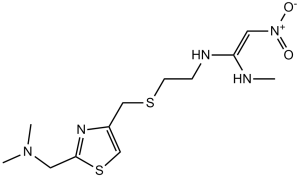
Nizatidine (Tazac, Axid, LY-139037, LY 139037, LY139037) is a potent histamine H2 receptor antagonist used in the treatment of peptic ulcer disease and gastroesophageal reflux disease. Its IC50 value for the histamine H2 receptor is 0.9 nM.
Physicochemical Properties
| Molecular Formula | C12H21N5O2S2 | |
| Molecular Weight | 331.46 | |
| Exact Mass | 331.113 | |
| Elemental Analysis | C, 43.48; H, 6.39; N, 21.13; O, 9.65; S, 19.35 | |
| CAS # | 76963-41-2 | |
| Related CAS # | Nizatidine-d3; 1246833-99-7 | |
| PubChem CID | 3033637 | |
| Appearance | Off-white to light yellow-brown solid powder | |
| Density | 1.2±0.1 g/cm3 | |
| Boiling Point | 478.2±45.0 °C at 760 mmHg | |
| Melting Point | 130-132ºC | |
| Flash Point | 243.0±28.7 °C | |
| Vapour Pressure | 0.0±1.2 mmHg at 25°C | |
| Index of Refraction | 1.592 | |
| LogP | 1.18 | |
| Hydrogen Bond Donor Count | 2 | |
| Hydrogen Bond Acceptor Count | 8 | |
| Rotatable Bond Count | 9 | |
| Heavy Atom Count | 21 | |
| Complexity | 349 | |
| Defined Atom Stereocenter Count | 0 | |
| SMILES | S(C([H])([H])C1=C([H])SC(C([H])([H])N(C([H])([H])[H])C([H])([H])[H])=N1)C([H])([H])C([H])([H])N([H])/C(=C(\[H])/[N+](=O)[O-])/N([H])C([H])([H])[H] |
|
| InChi Key | SGXXNSQHWDMGGP-IZZDOVSWSA-N | |
| InChi Code | InChI=1S/C12H21N5O2S2/c1-13-11(6-17(18)19)14-4-5-20-8-10-9-21-12(15-10)7-16(2)3/h6,9,13-14H,4-5,7-8H2,1-3H3/b11-6+ | |
| Chemical Name | (E)-1-N'-[2-[[2-[(dimethylamino)methyl]-1,3-thiazol-4-yl]methylsulfanyl]ethyl]-1-N-methyl-2-nitroethene-1,1-diamine | |
| Synonyms |
|
|
| HS Tariff Code | 2934.99.9001 | |
| Storage |
Powder-20°C 3 years 4°C 2 years In solvent -80°C 6 months -20°C 1 month |
|
| Shipping Condition | Room temperature (This product is stable at ambient temperature for a few days during ordinary shipping and time spent in Customs) |
Biological Activity
| Targets | Histamine H2 receptor ( IC50 = 0.9 nM ); AChE ( IC50 = 6.7 μM ) | ||
| ln Vitro |
|
||
| ln Vivo |
|
||
| Enzyme Assay | Nizatidine, a selective histamine H2-receptor antagonist, is a highly effective inhibitor of gastric acid secretion, with IC50 of 0.9 nM. Nizatidine has an EC50 of 1.383 μmol/kg and shows maximal inhibition of gastric acid in rats during the first hour of medication administration. Acetylcholinesterase (AChE) is likewise reversibly inhibited by nizatidine, with an IC50 of 6.7 μM and a noncompetitive inhibition with a Ki value of 7.4 μM. In a dose-dependent manner, nizatidine (0.3–3 mg/kg, intravenously) dramatically raises the motor index of gastrointestinal (GI) motility. With ED50 and ED90 values of 0.18 and 3.22 mg/kg in dogs and 2.94 and 19.6 mg/kg in rats, respectively, nizatidine suppresses the secretion of gastric acid. | ||
| Animal Protocol |
|
||
| Toxicity/Toxicokinetics |
Effects During Pregnancy and Lactation ◉ Summary of Use during Lactation Because of the low levels of nizatidine in breastmilk, amounts ingested by the infant are small and would not be expected to cause any adverse effects in breastfed infants. No special precautions are required. Histamine H2-antagonists with more extensive use might be preferred in newborns. ◉ Effects in Breastfed Infants Relevant published information was not found as of the revision date. ◉ Effects on Lactation and Breastmilk Histamine H2-receptor blockade is known to stimulate prolactin secretion. No reports of hyperprolactinemia, galactorrhea or effects on breastfeeding women caused by nizatidine were found as of the revision date. The maternal prolactin level in a mother with established lactation may not affect her ability to breastfeed. |
||
| References |
[1]. J Pharmacol Exp Ther . 1986 Nov;239(2):406-10. [2]. J Pharmacol Exp Ther . 1993 Jan;264(1):152-7. |
||
| Additional Infomation |
Nizatidine is a member of the class of 1,3-thiazoles having a dimethylaminomethyl substituent at position 2 and an alkylthiomethyl moiety at position 4. It has a role as an anti-ulcer drug, a H2-receptor antagonist and a cholinergic drug. It is a member of 1,3-thiazoles, a C-nitro compound, an organic sulfide, a tertiary amino compound and a carboxamidine. Nizatidine is a competitive and reversible histamine H2-receptor antagonist with antacid activity. Nizatidine inhibits the histamine H2-receptors located on the basolateral membrane of the gastric parietal cell, thereby reducing basal and nocturnal gastric acid secretion, resulting in a reduction in gastric volume, acidity, and amount of gastric acid released in response to stimuli. A histamine H2 receptor antagonist with low toxicity that inhibits gastric acid secretion. The drug is used for the treatment of duodenal ulcers. See also: Nizatidine (annotation moved to). |
Solubility Data
| Solubility (In Vitro) |
|
|||
| Solubility (In Vivo) |
Solubility in Formulation 1: ≥ 3.5 mg/mL (10.56 mM) (saturation unknown) in 10% DMSO + 40% PEG300 + 5% Tween80 + 45% Saline (add these co-solvents sequentially from left to right, and one by one), clear solution. For example, if 1 mL of working solution is to be prepared, you can add 100 μL of 35.0 mg/mL clear DMSO stock solution to 400 μL PEG300 and mix evenly; then add 50 μL Tween-80 to the above solution and mix evenly; then add 450 μL normal saline to adjust the volume to 1 mL. Preparation of saline: Dissolve 0.9 g of sodium chloride in 100 mL ddH₂ O to obtain a clear solution. Solubility in Formulation 2: ≥ 3.5 mg/mL (10.56 mM) (saturation unknown) in 10% DMSO + 90% (20% SBE-β-CD in Saline) (add these co-solvents sequentially from left to right, and one by one), clear solution. For example, if 1 mL of working solution is to be prepared, you can add 100 μL of 35.0 mg/mL clear DMSO stock solution to 900 μL of 20% SBE-β-CD physiological saline solution and mix evenly. Preparation of 20% SBE-β-CD in Saline (4°C,1 week): Dissolve 2 g SBE-β-CD in 10 mL saline to obtain a clear solution. Solubility in Formulation 3: ≥ 3.5 mg/mL (10.56 mM) (saturation unknown) in 10% DMSO + 90% Corn Oil (add these co-solvents sequentially from left to right, and one by one), clear solution. For example, if 1 mL of working solution is to be prepared, you can add 100 μL of 35.0 mg/mL clear DMSO stock solution to 900 μL of corn oil and mix evenly. Solubility in Formulation 4: Saline: 30 mg/mL Solubility in Formulation 5: 50 mg/mL (150.85 mM) in PBS (add these co-solvents sequentially from left to right, and one by one), clear solution; with ultrasonication. (Please use freshly prepared in vivo formulations for optimal results.) |
| Preparing Stock Solutions | 1 mg | 5 mg | 10 mg | |
| 1 mM | 3.0170 mL | 15.0848 mL | 30.1696 mL | |
| 5 mM | 0.6034 mL | 3.0170 mL | 6.0339 mL | |
| 10 mM | 0.3017 mL | 1.5085 mL | 3.0170 mL |