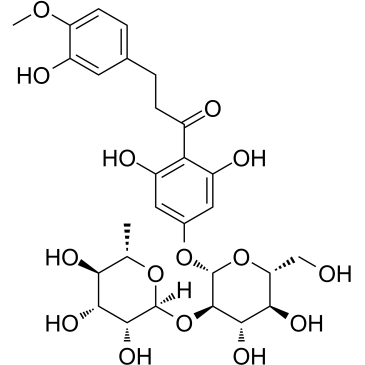
Neohesperidin dihydrochalcone (Neohesperidin DC; NHDC), an artificial sweetener and a synthetic glycoside chalcone, is added to various foods and beverages as a low caloric artificial sweetener.
Physicochemical Properties
| Molecular Formula | C₂₈H₃₆O₁₅ |
| Molecular Weight | 612.58 |
| Exact Mass | 612.205 |
| CAS # | 20702-77-6 |
| Related CAS # | Neohesperidin;13241-33-3 |
| PubChem CID | 30231 |
| Appearance | White to off-white solid powder |
| Density | 1.6±0.1 g/cm3 |
| Boiling Point | 927.1±65.0 °C at 760 mmHg |
| Melting Point | 156-158 °C(lit.) |
| Flash Point | 302.6±27.8 °C |
| Vapour Pressure | 0.0±0.3 mmHg at 25°C |
| Index of Refraction | 1.684 |
| LogP | 3.09 |
| Hydrogen Bond Donor Count | 9 |
| Hydrogen Bond Acceptor Count | 15 |
| Rotatable Bond Count | 10 |
| Heavy Atom Count | 43 |
| Complexity | 882 |
| Defined Atom Stereocenter Count | 10 |
| SMILES | C[C@H]1[C@@H]([C@H]([C@H]([C@@H](O1)O[C@@H]2[C@H]([C@@H]([C@H](O[C@H]2OC3=CC(=C(C(=C3)O)C(=O)CCC4=CC(=C(C=C4)OC)O)O)CO)O)O)O)O)O |
| InChi Key | ITVGXXMINPYUHD-CUVHLRMHSA-N |
| InChi Code | InChI=1S/C28H36O15/c1-11-21(34)23(36)25(38)27(40-11)43-26-24(37)22(35)19(10-29)42-28(26)41-13-8-16(32)20(17(33)9-13)14(30)5-3-12-4-6-18(39-2)15(31)7-12/h4,6-9,11,19,21-29,31-38H,3,5,10H2,1-2H3/t11-,19+,21-,22+,23+,24-,25+,26+,27-,28+/m0/s1 |
| Chemical Name | 1-[4-[(2S,3R,4S,5S,6R)-4,5-dihydroxy-6-(hydroxymethyl)-3-[(2S,3R,4R,5R,6S)-3,4,5-trihydroxy-6-methyloxan-2-yl]oxyoxan-2-yl]oxy-2,6-dihydroxyphenyl]-3-(3-hydroxy-4-methoxyphenyl)propan-1-one |
| Synonyms | Neohesperidin DC NHDC |
| HS Tariff Code | 2934.99.9001 |
| Storage |
Powder-20°C 3 years 4°C 2 years In solvent -80°C 6 months -20°C 1 month |
| Shipping Condition | Room temperature (This product is stable at ambient temperature for a few days during ordinary shipping and time spent in Customs) |
Biological Activity
| ln Vitro | Reactive oxygen species (ROS) and stable free radicals are both effectively scavenged by neohesperidin dihydrochalcone in a concentration-dependent manner. Particularly, the most potent H2O2 and HOCl inhibitor is neohesperidin dihydrochalcone. Neohesperidin dihydrochalcone has a 93.5% HOCl scavenging activity and a 73.5% H2O2 scavenging activity. Neohesperidin dihydrochalcone has IC50 values of 205.1 and 25.5 μM and exhibits broad inhibitory effects, particularly on non-radical ROS H2O2 and HOCl [1]. It was discovered that neohesperidin dihydrochalcone, with an IC50 of 389 μM, activates porcine pancreatic α-amylase (PPA) [2]. |
| ln Vivo | When neohesperidin dihydrochalcone was administered, the activity of two helpful indicators of liver impairment, AST and ALT, significantly decreased. The relative amounts of NF-κB, IL-6, IL-1β, and TNF-α proteins in the livers of mice treated with PQ can be inhibited by neohesperidin dihydrochalcone [3]. Neohesperidin dihydrochalcone's embryotoxicity and teratogenicity were investigated in Wistar Crl:(WI)WU BR rats. Neohesperidin dihydrochalcone did not cause any negative effects in rats when used at diet levels as high as 5% (about 3.3 g/kg body weight per day) [4]. |
| References |
[1]. Antioxidant properties of neohesperidin dihydrochalcone: inhibition of hypochlorous acid-induced DNA strand breakage, protein degradation, and cell death. Biol Pharm Bull. 2007 Feb;30(2):324-30. [2]. Neohesperidin dihydrochalcone: presentation of a small molecule activator of mammalian alpha-amylase as an allosteric effector. FEBS Lett. 2013 Mar 18;587(6):652-8. [3]. Artificial sweetener neohesperidin dihydrochalcone showed antioxidative, anti-inflammatory and anti-apoptosis effects against paraquat-induced liver injury in mice. Int Immunopharmacol. 2015 Dec;29(2):722-9. [4]. Embryotoxicity and teratogenicity study with neohesperidin dihydrochalcone in rats. Regul Toxicol Pharmacol. 2004 Aug;40(1):74-9. |
| Additional Infomation |
Neohesperidin dihydrochalcone appears as off-white crystals or powder. Insoluble in water. (NTP, 1992) Neohesperidin dihydrochalcone is a member of the dihydrochalcones that is 3,2',4',6'-tetrahydroxy-4-methoxydihydrochalcone attached to a neohesperidosyl residue at position 4' via glycosidic linkage. It is found in sweet orange. It has a role as an environmental contaminant, a xenobiotic, a plant metabolite and a sweetening agent. It is a neohesperidoside, a disaccharide derivative and a member of dihydrochalcones. Neohesperidin dihydrochalcone has been reported in Citrus reticulata, Vicia faba, and Citrus deliciosa with data available. |
Solubility Data
| Solubility (In Vitro) | DMSO : ~100 mg/mL (~163.24 mM) |
| Solubility (In Vivo) |
Solubility in Formulation 1: ≥ 2.5 mg/mL (4.08 mM) (saturation unknown) in 10% DMSO + 40% PEG300 + 5% Tween80 + 45% Saline (add these co-solvents sequentially from left to right, and one by one), clear solution. For example, if 1 mL of working solution is to be prepared, you can add 100 μL of 25.0 mg/mL clear DMSO stock solution to 400 μL PEG300 and mix evenly; then add 50 μL Tween-80 to the above solution and mix evenly; then add 450 μL normal saline to adjust the volume to 1 mL. Preparation of saline: Dissolve 0.9 g of sodium chloride in 100 mL ddH₂ O to obtain a clear solution. Solubility in Formulation 2: ≥ 2.5 mg/mL (4.08 mM) (saturation unknown) in 10% DMSO + 90% (20% SBE-β-CD in Saline) (add these co-solvents sequentially from left to right, and one by one), clear solution. For example, if 1 mL of working solution is to be prepared, you can add 100 μL of 25.0 mg/mL clear DMSO stock solution to 900 μL of 20% SBE-β-CD physiological saline solution and mix evenly. Preparation of 20% SBE-β-CD in Saline (4°C,1 week): Dissolve 2 g SBE-β-CD in 10 mL saline to obtain a clear solution. Solubility in Formulation 3: ≥ 2.5 mg/mL (4.08 mM) (saturation unknown) in 10% DMSO + 90% Corn Oil (add these co-solvents sequentially from left to right, and one by one), clear solution. For example, if 1 mL of working solution is to be prepared, you can add 100 μL of 25.0 mg/mL clear DMSO stock solution to 900 μL of corn oil and mix evenly. (Please use freshly prepared in vivo formulations for optimal results.) |
| Preparing Stock Solutions | 1 mg | 5 mg | 10 mg | |
| 1 mM | 1.6324 mL | 8.1622 mL | 16.3244 mL | |
| 5 mM | 0.3265 mL | 1.6324 mL | 3.2649 mL | |
| 10 mM | 0.1632 mL | 0.8162 mL | 1.6324 mL |