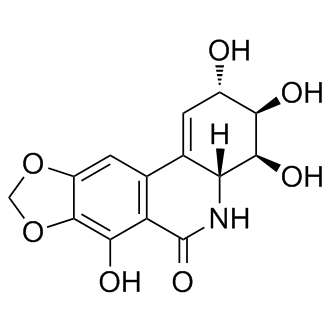
Physicochemical Properties
| Molecular Formula | C14H13NO7MOLECULARWEIGHT |
| Molecular Weight | 307.2555 |
| Exact Mass | 307.069 |
| CAS # | 29477-83-6 |
| PubChem CID | 72376 |
| Appearance | White to yellow solid powder |
| Density | 1.9±0.1 g/cm3 |
| Boiling Point | 733.8±60.0 °C at 760 mmHg |
| Flash Point | 397.6±32.9 °C |
| Vapour Pressure | 0.0±2.5 mmHg at 25°C |
| Index of Refraction | 1.797 |
| LogP | 0.59 |
| Hydrogen Bond Donor Count | 5 |
| Hydrogen Bond Acceptor Count | 7 |
| Rotatable Bond Count | 0 |
| Heavy Atom Count | 22 |
| Complexity | 523 |
| Defined Atom Stereocenter Count | 4 |
| SMILES | C1OC2=C(O1)C(=C3C(=C2)C4=C[C@@H]([C@H]([C@H]([C@@H]4NC3=O)O)O)O)O |
| InChi Key | LZAZURSABQIKGB-AEKGRLRDSA-N |
| InChi Code | InChI=1S/C14H13NO7/c16-6-1-5-4-2-7-13(22-3-21-7)11(18)8(4)14(20)15-9(5)12(19)10(6)17/h1-2,6,9-10,12,16-19H,3H2,(H,15,20)/t6-,9+,10+,12-/m0/s1 |
| Chemical Name | (2S,3R,4S,4aR)-2,3,4,7-tetrahydroxy-3,4,4a,5-tetrahydro-[1,3]dioxolo[4,5-j]phenanthridin-6(2H)-one |
| Synonyms | NSC 266535NSC-266535NSC266535 Lycoricidin-A Lycorcidinol Narciclasine. |
| HS Tariff Code | 2934.99.9001 |
| Storage |
Powder-20°C 3 years 4°C 2 years In solvent -80°C 6 months -20°C 1 month |
| Shipping Condition | Room temperature (This product is stable at ambient temperature for a few days during ordinary shipping and time spent in Customs) |
Biological Activity
| ln Vitro | Glioblastoma multiforme cells exhibit Rho and stress fiber activation upon exposure to nicocin. Six human glioblastoma multiforme tumors (U373, Hs683, GL19, GL5, GL16, and GL17) have an average IC50 of about 50 nM, while 60 cancer cell lines have an average IC50 of 47 nM for Narcissus clarinin[1]. Bioassay-guided fractionation of belladonna extract revealed lycorine to be a bioactive component. Narciclasine has an IC50 value of 0.1 μM for blocking radicle growth[2]. |
| ln Vivo | In mice with GL19 glioblastoma multiforme, the mg/kg intravenous regimen of naciclastine significantly (P=0.02) improved survival. Oral administration of the same amount of narcissus five times a week for five weeks also markedly improved animal survival in this model (P=0.008). The survival rate of mice with Hs683 glioblastoma multiforme was considerably increased (P=0.004) upon oral therapy of 1 mg/kg nicraclasine. These Hs683 glioblastoma multiforme-bearing mice did not survive any longer when the frequency of dosage was increased weekly. Although at far lower dosages and following oral and intravenous administration, narcissin seems to show a comparable increase in survival to temozolomide in these models [1]. |
| References |
[1]. Narciclasine, a plant growth modulator, activates Rho and stress fibers in glioblastoma cells. Mol Cancer Ther. 2009 Jul;8(7):1739-50. [2]. The use of bio-guided fractionation to explore the use of leftover biomass in Dutch flower bulb production as allelochemicals against weeds. Molecules. 2013 Apr 17;18(4):4510-25. |
| Additional Infomation |
Narciclasine is a member of phenanthridines. It has a role as a metabolite. Narciclasine has been reported in Brachystola magna, Hymenocallis littoralis, and other organisms with data available. |
Solubility Data
| Solubility (In Vitro) | DMSO : ≥ 26 mg/mL (~84.62 mM) |
| Solubility (In Vivo) |
Solubility in Formulation 1: ≥ 1.67 mg/mL (5.44 mM) (saturation unknown) in 10% DMSO + 40% PEG300 + 5% Tween80 + 45% Saline (add these co-solvents sequentially from left to right, and one by one), clear solution. For example, if 1 mL of working solution is to be prepared, you can add 100 μL of 16.7 mg/mL clear DMSO stock solution to 400 μL PEG300 and mix evenly; then add 50 μL Tween-80 to the above solution and mix evenly; then add 450 μL normal saline to adjust the volume to 1 mL. Preparation of saline: Dissolve 0.9 g of sodium chloride in 100 mL ddH₂ O to obtain a clear solution. Solubility in Formulation 2: ≥ 1.67 mg/mL (5.44 mM) (saturation unknown) in 10% DMSO + 90% (20% SBE-β-CD in Saline) (add these co-solvents sequentially from left to right, and one by one), clear solution. For example, if 1 mL of working solution is to be prepared, you can add 100 μL of 16.7 mg/mL clear DMSO stock solution to 900 μL of 20% SBE-β-CD physiological saline solution and mix evenly. Preparation of 20% SBE-β-CD in Saline (4°C,1 week): Dissolve 2 g SBE-β-CD in 10 mL saline to obtain a clear solution. Solubility in Formulation 3: ≥ 1.67 mg/mL (5.44 mM) (saturation unknown) in 10% DMSO + 90% Corn Oil (add these co-solvents sequentially from left to right, and one by one), clear solution. For example, if 1 mL of working solution is to be prepared, you can add 100 μL of 16.7 mg/mL clear DMSO stock solution to 900 μL of corn oil and mix evenly. (Please use freshly prepared in vivo formulations for optimal results.) |
| Preparing Stock Solutions | 1 mg | 5 mg | 10 mg | |
| 1 mM | 3.2546 mL | 16.2729 mL | 32.5457 mL | |
| 5 mM | 0.6509 mL | 3.2546 mL | 6.5091 mL | |
| 10 mM | 0.3255 mL | 1.6273 mL | 3.2546 mL |