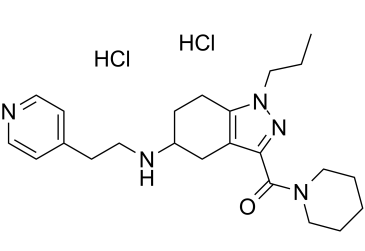
PD: NUCC-390 diHCl is a novel, potent, and specific small-molecule CXCR4 receptor agonist. NUCC-390 functions in opposition to AMD3100 by inducing the internalization of CXCR4 receptors. In vivo, NUCC-390 facilitates nerve function restoration following neurodegeneration.
Physicochemical Properties
| Molecular Formula | C??H??CL?N?O |
| Molecular Weight | 468.46 |
| Exact Mass | 467.22 |
| Appearance | Light yellow to yellow solid powder |
| InChi Key | RSYDQYPPGGIWOJ-UHFFFAOYSA-N |
| InChi Code | InChI=1S/C23H33N5O.2ClH/c1-2-14-28-21-7-6-19(25-13-10-18-8-11-24-12-9-18)17-20(21)22(26-28)23(29)27-15-4-3-5-16-27;;/h8-9,11-12,19,25H,2-7,10,13-17H2,1H3;2*1H |
| Chemical Name | piperidin-1-yl-[1-propyl-5-(2-pyridin-4-ylethylamino)-4,5,6,7-tetrahydroindazol-3-yl]methanone;dihydrochloride |
| Synonyms | NUCC-390 dihydrochloride; NUCC 390; NUCC390 diHCl |
| HS Tariff Code | 2934.99.9001 |
| Storage |
Powder-20°C 3 years 4°C 2 years In solvent -80°C 6 months -20°C 1 month Note: Please store this product in a sealed and protected environment (e.g. under nitrogen), avoid exposure to moisture. |
| Shipping Condition | Room temperature (This product is stable at ambient temperature for a few days during ordinary shipping and time spent in Customs) |
Biological Activity
| Targets | CXCR4 |
| ln Vitro |
NUCC-390 dihydrochloride (10 μM) generates a strong (Ca)i response, however AMD3100, a known powerful and selective CXCR4 antagonist, can block this effect[1]. NUCC-390 dihydrochloride (10 μM; pre-treatment 30 mins) can stimulate signaling activity downstream of CXCR4 receptors and raise pERK levels[1]. NUCC-390 dihydrochloride (10 μM; 2 hours) has the ability to cause CXCR4 receptor internalization. In HEK cells, CXCR4-YFP is clearly expressed in the cell membrane and diffusely expressed throughout the cytosol in non-treated cells[1]. NUCC-390 dihydrochloride (0-1.25 μM; 24 hours) increases axonal growth through CXCR4 in cultured cerebellar granule neurons (CGNs)[2]. |
| ln Vivo | NUCC-390 dihydrochloride (hind limb injection; 3.2 mg/kg; twice daily; 3 days) supports the neuromuscular junction's (NMJ) anatomical and functional recovery after α-LTx causes acute nerve terminal damage in CD-1 mice[2]. |
| Cell Assay |
Cell Line: C8161 cells Concentration: 10 μM Incubation Time: Pre-treated 30 mins Result: Increased the level of pERK. |
| Animal Protocol |
Six to eight-week-old CD1 mice 3.2 mg/kg Hind limb injection; twice daily; 3 days |
| References |
[1]. Discovery and characterization of novel small-molecule CXCR4 receptor agonists and antagonists.Sci Rep. 2016 Jul 26;6:30155. |
Solubility Data
| Solubility (In Vitro) |
DMSO: ~100 mg/mL (~213.5 mM) H2O: ~25 mg/mL (~53.4 mM) |
| Solubility (In Vivo) |
Solubility in Formulation 1: ≥ 2.5 mg/mL (5.34 mM) (saturation unknown) in 10% DMSO + 40% PEG300 + 5% Tween80 + 45% Saline (add these co-solvents sequentially from left to right, and one by one), clear solution. For example, if 1 mL of working solution is to be prepared, you can add 100 μL of 25.0 mg/mL clear DMSO stock solution to 400 μL PEG300 and mix evenly; then add 50 μL Tween-80 to the above solution and mix evenly; then add 450 μL normal saline to adjust the volume to 1 mL. Preparation of saline: Dissolve 0.9 g of sodium chloride in 100 mL ddH₂ O to obtain a clear solution. Solubility in Formulation 2: ≥ 2.5 mg/mL (5.34 mM) (saturation unknown) in 10% DMSO + 90% (20% SBE-β-CD in Saline) (add these co-solvents sequentially from left to right, and one by one), clear solution. For example, if 1 mL of working solution is to be prepared, you can add 100 μL of 25.0 mg/mL clear DMSO stock solution to 900 μL of 20% SBE-β-CD physiological saline solution and mix evenly. Preparation of 20% SBE-β-CD in Saline (4°C,1 week): Dissolve 2 g SBE-β-CD in 10 mL saline to obtain a clear solution. Solubility in Formulation 3: ≥ 2.5 mg/mL (5.34 mM) (saturation unknown) in 10% DMSO + 90% Corn Oil (add these co-solvents sequentially from left to right, and one by one), clear solution. For example, if 1 mL of working solution is to be prepared, you can add 100 μL of 25.0 mg/mL clear DMSO stock solution to 900 μL of corn oil and mix evenly. Solubility in Formulation 4: 20 mg/mL (42.69 mM) in PBS (add these co-solvents sequentially from left to right, and one by one), clear solution; with ultrasonication (<60°C). (Please use freshly prepared in vivo formulations for optimal results.) |
| Preparing Stock Solutions | 1 mg | 5 mg | 10 mg | |
| 1 mM | 2.1347 mL | 10.6733 mL | 21.3465 mL | |
| 5 mM | 0.4269 mL | 2.1347 mL | 4.2693 mL | |
| 10 mM | 0.2135 mL | 1.0673 mL | 2.1347 mL |