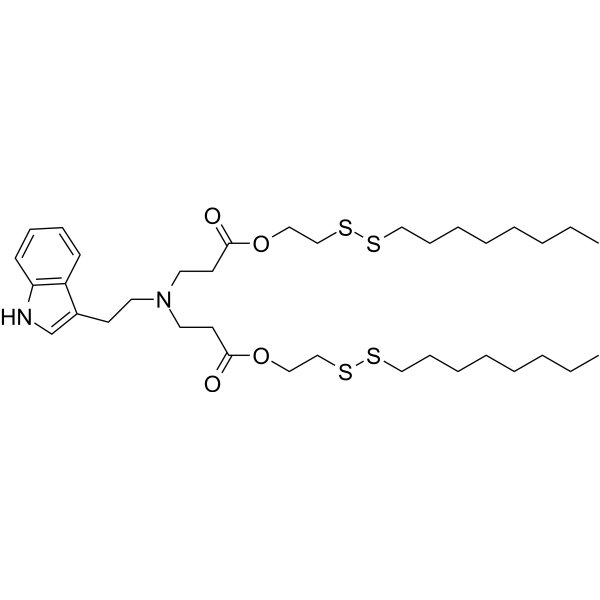
Physicochemical Properties
| CAS # | 2739805-63-9 |
| Appearance | Colorless to light yellow ointment |
| Density | 1.124±0.06 g/cm3(Predicted) |
| Boiling Point | 780.1±60.0 °C(Predicted) |
| LogP | 0 |
| HS Tariff Code | 2934.99.9001 |
| Storage |
Powder-20°C 3 years 4°C 2 years In solvent -80°C 6 months -20°C 1 month |
| Shipping Condition | Room temperature (This product is stable at ambient temperature for a few days during ordinary shipping and time spent in Customs) |
Biological Activity
| ln Vitro | A lipidoid with a tryptamine head group and a hydrophobic tail group with 12 carbon atoms is represented by the symbol NT1-O12B [1]. |
| ln Vivo | Using a process akin to DiR encapsulation, it encapsulates AmB in pure NT1-lipoids (i.e., NT1-O12B, NT1-O14B, NT1-O16B, and NT1-O18B). Among all NT-lipoids, NT1-O12B exhibits the highest DiR fluorescence intensity, making it a dopant that improves brain delivery. The BBB-impermeable lipidoid PBA-Q76-O16B can be doped with NT1-O12B to produce an AmB formulation that is able to pass through the BBB. By using this technique, AmB concentrations in brain tissue reached 300 ng/g (AmB/tissue) less than 24 hours after AmB (5 mg/kg) was given intravenously, with a delivery efficiency of roughly 0.135% of the dose that was injected [1]. |
| References |
[1]. Neurotransmitter-derived lipidoids (NT-lipidoids) for enhanced brain delivery through intravenous injection. Sci Adv. 2020;6(30):eabb4429. Published 2020 Jul 24. |
Solubility Data
| Solubility (In Vitro) | DMSO: 200 mg/mL (280.45 mM) |
| Solubility (In Vivo) |
Solubility in Formulation 1: ≥ 5 mg/mL (7.01 mM) (saturation unknown) in 10% DMSO + 40% PEG300 + 5% Tween80 + 45% Saline (add these co-solvents sequentially from left to right, and one by one), suspension solution. For example, if 1 mL of working solution is to be prepared, you can add 100 μL of 50.0 mg/mL clear DMSO stock solution to 400 μL PEG300 and mix evenly; then add 50 μL Tween-80 to the above solution and mix evenly; then add 450 μL normal saline to adjust the volume to 1 mL. Preparation of saline: Dissolve 0.9 g of sodium chloride in 100 mL ddH₂ O to obtain a clear solution. Solubility in Formulation 2: 5 mg/mL (7.01 mM) in 10% DMSO + 90% (20% SBE-β-CD in Saline) (add these co-solvents sequentially from left to right, and one by one), suspension solution; with ultrasonication. For example, if 1 mL of working solution is to be prepared, you can add 100 μL of 50.0 mg/mL clear DMSO stock solution to 900 μL of 20% SBE-β-CD physiological saline solution and mix evenly. Preparation of 20% SBE-β-CD in Saline (4°C,1 week): Dissolve 2 g SBE-β-CD in 10 mL saline to obtain a clear solution. Solubility in Formulation 3: ≥ 5 mg/mL (7.01 mM) (saturation unknown) in 10% DMSO + 90% Corn Oil (add these co-solvents sequentially from left to right, and one by one), clear solution. For example, if 1 mL of working solution is to be prepared, you can add 100 μL of 50.0 mg/mL clear DMSO stock solution to 900 μL of corn oil and mix evenly. (Please use freshly prepared in vivo formulations for optimal results.) |