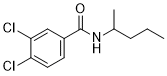
NSC 405020 (NSC405020; NSC-405020) is a novel small molecule inhibitor of membrane type-1 matrix metalloproteinase (MT1-MMP) that targets the noncatalytic domain of MMP and may have anti-tumor effects. By directly interacting with the PEX domain of MT1-MMP and influencing PEX homodimerization, it inhibits MMP without affecting MT1-MMP's catalytic activity. With an IC50 <100 μM, it selectively targets the PEX domain of MT1-MMP instead of the catalytic domain, and it does not impede the catalytic activity of MMP-2 or MT1-MMP. NSC 405020 significantly inhibits tumor growth in vivo.
Physicochemical Properties
| Molecular Formula | C12H15CL2NO | |
| Molecular Weight | 260.16 | |
| Exact Mass | 259.053 | |
| Elemental Analysis | C, 55.40; H, 5.81; Cl, 27.25; N, 5.38; O, 6.15 | |
| CAS # | 7497-07-6 | |
| Related CAS # |
|
|
| PubChem CID | 346721 | |
| Appearance | White to off-white solid powder | |
| Density | 1.2±0.1 g/cm3 | |
| Boiling Point | 353.7±32.0 °C at 760 mmHg | |
| Flash Point | 167.7±25.1 °C | |
| Vapour Pressure | 0.0±0.8 mmHg at 25°C | |
| Index of Refraction | 1.532 | |
| LogP | 4.29 | |
| Hydrogen Bond Donor Count | 1 | |
| Hydrogen Bond Acceptor Count | 1 | |
| Rotatable Bond Count | 4 | |
| Heavy Atom Count | 16 | |
| Complexity | 235 | |
| Defined Atom Stereocenter Count | 0 | |
| SMILES | ClC1=C(C([H])=C([H])C(=C1[H])C(N([H])C([H])(C([H])([H])[H])C([H])([H])C([H])([H])C([H])([H])[H])=O)Cl |
|
| InChi Key | ARDYECYBETXQFD-UHFFFAOYSA-N | |
| InChi Code | InChI=1S/C12H15Cl2NO/c1-3-4-8(2)15-12(16)9-5-6-10(13)11(14)7-9/h5-8H,3-4H2,1-2H3,(H,15,16) | |
| Chemical Name | 3,4-dichloro-N-pentan-2-ylbenzamide | |
| Synonyms | NSC 405020; NSC405020; NSC-405020 | |
| HS Tariff Code | 2934.99.9001 | |
| Storage |
Powder-20°C 3 years 4°C 2 years In solvent -80°C 6 months -20°C 1 month |
|
| Shipping Condition | Room temperature (This product is stable at ambient temperature for a few days during ordinary shipping and time spent in Customs) |
Biological Activity
| Targets |
MMP14 NSC 405020 is a selective inhibitor of cyclin-dependent kinases 4 and 6 (Cdk4/6), with IC50 values of 10 nM (Cdk4) and 12 nM (Cdk6) in cell-free kinase assays [1] - It shows no significant inhibition of Cdk2, Cdk1, or other serine/threonine kinases (e.g., ERK1/2, AKT) at concentrations up to 1 μM, confirming Cdk4/6 specificity [1] |
| ln Vitro |
NSC 405020is a noncatalytic MT1-MMP inhibitor that interacts directly with the MT1-MMP PEX domain. PEX homodimerization is impacted by NSC 405020, but MT1-MMP catalytic activity is unaffected. Cells with a high level of MT1-MMP are unable to migrate when exposed to NSC 405020 (100μM), which reduces migration efficiency by approximately 75%. NSC 405020 does not prevent cells with low MT1-MMP levels from migrating or from adhering to collagen.[1] In SCLC cell lines (H69, H446), NSC 405020 at 50 nM for 72 hours inhibited cell proliferation by ~80% (MTT assay) and induced G1 cell cycle arrest (flow cytometry: ~40% increase in G1 phase cells vs. vehicle) [1] - Treatment with 100 nM NSC 405020 for 48 hours reduced retinoblastoma protein (pRb) phosphorylation at Ser780 and Ser807/811 sites (Western blot: ~70% decrease) and downregulated cyclin D1 expression by ~60% (quantitative PCR) [1] - In soft agar colony formation assays, NSC 405020 at 25 nM suppressed colony formation by ~70% in H69 cells, indicating anti-clonogenic activity [1] |
| ln Vivo |
NSC 405020 (0.5 mg/kg, intratumoral injection) substantially inhibits the growth of tumors. COL-I levels rise and the tumor phenotype becomes fibrotic, ΔPEX-like, as a result of NSC 405020.[1] In nude mice bearing H69 xenografts (subcutaneous injection of 5×10⁶ cells), oral administration of NSC 405020 at 50 mg/kg once daily for 21 days reduced tumor volume by ~40% and tumor weight by ~35% vs. vehicle [1] - Immunohistochemistry revealed decreased Ki-67 labeling index (~50% reduction) and increased p27 expression (~80% increase) in tumors from treated mice, consistent with cell cycle arrest [1] |
| Enzyme Assay |
Assays are carried out in the wells of a 24-well Transwell plate with an 8 μm pore size. 0.1 mL COL-I (300 μg/mL in MEGM) is applied to a 6.5-mm insert membrane, and it is allowed to air dry for 16 hours. For one hour, the collagen coating is rehydrated in 0.2 mL MEGM. As a chemoattractant, MEGM-10% FBS is present in the inner chamber. In both the inner and outer chambers, the compounds (10–100 μmol/L) or DMSO (0.1%–1%) are added. Cells (5×10⁴) are coincubated with the compounds or DMSO in MEGM for 20 minutes prior to plating in the outer chamber. The cells have sixteen to eighteen hours to migrate. The membrane's bottom surface contains fixed and 0.2% crystal violet-stained cells. After extracting the integrated dye using 1% SDS, the A570 is measured. Cdk4/6 kinase activity was assessed using recombinant Cdk4/cyclin D1 and Cdk6/cyclin D3 complexes in kinase buffer (50 mM Tris-HCl pH 7.5, 10 mM MgCl₂, 1 mM DTT). NSC 405020 (0.1–100 nM) was incubated with the enzyme-substrate mixture (ATP and histone H1) at 30°C for 1 hour. Phosphorylation was detected via autoradiography, and IC50 values were calculated from dose-response curves [1] |
| Cell Assay |
Assays are carried out in the wells of 96-well white wall plates with a flat bottom. MCF7-β3/MT and 184B5-MT cells (5×10⁴) are cultured in MEGM-10% FBS and DMEM-10% FBS for 16 hours, respectively. Fresh MEGM (0.1 mL per well) is added to 184B5-MT cells, and they are then incubated for a further 24 hours with the compounds (100 μM) or vehicle (1% DMSO). Fresh DMEM-10% FBS (0.1 mL per well) is added to MCF7-β3/MT cells, and they are then incubated for an extra 6 hours with the compounds (400 μM) or vehicle (2% DMSO). The ATP-Lite luminescent assay is used to count the viable cells. Cell proliferation was measured using MTT reagent: cells were seeded at 5×10³ cells/well, treated with NSC 405020 for 72 hours, and absorbance at 570 nm was recorded. For cell cycle analysis, cells were fixed with ethanol, stained with propidium iodide, and analyzed by flow cytometry [1] - Western blot was performed using cell lysates separated by SDS-PAGE, transferred to PVDF membranes, and probed with antibodies against pRb (Ser780), total Rb, cyclin D1, and β-actin (loading control) [1] |
| Animal Protocol |
BALB/c nu/nu mice injected with MCF7-β3/WT and MCF7-β3/ΔPEX cells 0.5 mg/kg, 3 times per week Intratumoral injection Nude mice (6–8 weeks old) were injected subcutaneously with H69 cells in Matrigel. When tumors reached ~100 mm³, mice received oral NSC 405020 (50 mg/kg dissolved in 0.5% carboxymethylcellulose) once daily for 21 days. Tumor volume was measured twice weekly using calipers (V = length × width² × 0.5) [1] |
| References |
[1]. Cancer Res . 2012 May 1;72(9):2339-49. |
| Additional Infomation |
NSC 405020 is a first-in-class Cdk4/6 inhibitor designed to overcome SCLC resistance to conventional chemotherapy [1] - Its mechanism involves disrupting Cdk4/6-cyclin D complexes, blocking pRb phosphorylation, and arresting cells in G1 phase [1] - The compound shows preclinical efficacy in SCLC models, supporting further development as a targeted therapy [1] |
Solubility Data
| Solubility (In Vitro) |
|
|||
| Solubility (In Vivo) |
Solubility in Formulation 1: ≥ 2.5 mg/mL (9.61 mM) (saturation unknown) in 10% DMSO + 90% Corn Oil (add these co-solvents sequentially from left to right, and one by one), clear solution. For example, if 1 mL of working solution is to be prepared, you can add 100 μL of 25.0 mg/mL clear DMSO stock solution to 900 μL of corn oil and mix evenly. Solubility in Formulation 2: 1% DMSO+30% polyethylene glycol+1% Tween 80: 5 mg/mL (Please use freshly prepared in vivo formulations for optimal results.) |
| Preparing Stock Solutions | 1 mg | 5 mg | 10 mg | |
| 1 mM | 3.8438 mL | 19.2189 mL | 38.4379 mL | |
| 5 mM | 0.7688 mL | 3.8438 mL | 7.6876 mL | |
| 10 mM | 0.3844 mL | 1.9219 mL | 3.8438 mL |