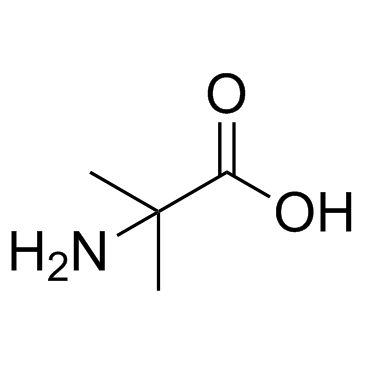
Physicochemical Properties
| Molecular Formula | C4H9NO2 |
| Molecular Weight | 103.11976 |
| Exact Mass | 103.063 |
| CAS # | 62-57-7 |
| Related CAS # | NSC 16590-d6;50348-93-1 |
| PubChem CID | 6119 |
| Appearance | White to off-white solid powder |
| Density | 1.1±0.1 g/cm3 |
| Boiling Point | 204.4±23.0 °C at 760 mmHg |
| Melting Point | ≥300 °C |
| Flash Point | 77.4±22.6 °C |
| Vapour Pressure | 0.1±0.8 mmHg at 25°C |
| Index of Refraction | 1.464 |
| LogP | -0.33 |
| Hydrogen Bond Donor Count | 2 |
| Hydrogen Bond Acceptor Count | 3 |
| Rotatable Bond Count | 1 |
| Heavy Atom Count | 7 |
| Complexity | 87.7 |
| Defined Atom Stereocenter Count | 0 |
| InChi Key | FUOOLUPWFVMBKG-UHFFFAOYSA-N |
| InChi Code | InChI=1S/C4H9NO2/c1-4(2,5)3(6)7/h5H2,1-2H3,(H,6,7) |
| Chemical Name | 2-amino-2-methylpropanoic acid |
| Synonyms | NSC 16590; NSC-16590 ; NSC16590 |
| HS Tariff Code | 2934.99.9001 |
| Storage |
Powder-20°C 3 years 4°C 2 years In solvent -80°C 6 months -20°C 1 month |
| Shipping Condition | Room temperature (This product is stable at ambient temperature for a few days during ordinary shipping and time spent in Customs) |
Biological Activity
| ln Vitro | In the cotyledon segments of Xanthium pennsylvanicum Wallr., NSC 16590 (α-aminoisobutyric acid, AIB) has the greatest inhibitory effect on endogenous ethylene synthesis. seeds. At 4 mM, NSC 16590 reduces ethylene production by around 50%, but even at 20 mM, the fragment's O2 absorption is unaffected. Additionally, NSC 16590 prevents the production of ethylene in the stem segments of seedlings of the etiolated pea (Pisum satiuum L. cv. Alaska). The conversion of ACC to ethylene is competitively inhibited by NSC 16590, according to kinetic study of cell-free extracts of etiolated pea shoots [1]. |
| References |
[1]. α-Aminoisobutyric acid: A probable competitive inhibitor of conversion of 1-aminocyclopropane-1-carboxylic acid to ethylene. Plant and Cell Physiology, Volume 21, Issue 6, 1 September 1980, Pages 939-949. |
| Additional Infomation |
2-aminoisobutyric acid is a rare, non-protein amino acid and end-product of pyrimidine metabolism, excreted in urine and found in some antibiotics of fungal origin. With the exception of a few bacteria, it is non-metabolisable, and therefore used in bioassays. It is functionally related to a propionic acid and an isobutyric acid. It is a tautomer of a 2-aminoisobutanoic acid zwitterion. 2-Aminoisobutyric acid is a metabolite found in or produced by Escherichia coli (strain K12, MG1655). 2-Aminoisobutyric acid has been reported in Garcinia mangostana, Apis cerana, and Caenorhabditis elegans with data available. |
Solubility Data
| Solubility (In Vitro) | H2O : ~33.33 mg/mL (~323.22 mM) |
| Solubility (In Vivo) |
Solubility in Formulation 1: 33.33 mg/mL (323.22 mM) in PBS (add these co-solvents sequentially from left to right, and one by one), clear solution; with sonication. (Please use freshly prepared in vivo formulations for optimal results.) |
| Preparing Stock Solutions | 1 mg | 5 mg | 10 mg | |
| 1 mM | 9.6974 mL | 48.4872 mL | 96.9744 mL | |
| 5 mM | 1.9395 mL | 9.6974 mL | 19.3949 mL | |
| 10 mM | 0.9697 mL | 4.8487 mL | 9.6974 mL |