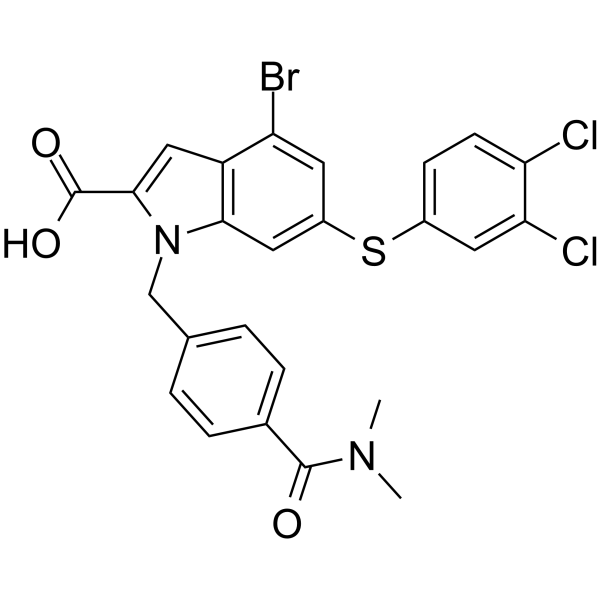
Physicochemical Properties
| Molecular Formula | C25H19BRCL2N2O3S |
| Molecular Weight | 578.304962396622 |
| Exact Mass | 575.967 |
| CAS # | 2216763-38-9 |
| PubChem CID | 132281917 |
| Appearance | White to off-white solid powder |
| LogP | 6.9 |
| Hydrogen Bond Donor Count | 1 |
| Hydrogen Bond Acceptor Count | 4 |
| Rotatable Bond Count | 6 |
| Heavy Atom Count | 34 |
| Complexity | 739 |
| Defined Atom Stereocenter Count | 0 |
| SMILES | BrC1=CC(=CC2=C1C=C(C(=O)O)N2CC1C=CC(C(N(C)C)=O)=CC=1)SC1C=CC(=C(C=1)Cl)Cl |
| InChi Key | MJYFVDNMTKLGTH-UHFFFAOYSA-N |
| InChi Code | InChI=1S/C25H19BrCl2N2O3S/c1-29(2)24(31)15-5-3-14(4-6-15)13-30-22-11-17(34-16-7-8-20(27)21(28)10-16)9-19(26)18(22)12-23(30)25(32)33/h3-12H,13H2,1-2H3,(H,32,33) |
| Chemical Name | 4-bromo-6-(3,4-dichlorophenyl)sulfanyl-1-[[4-(dimethylcarbamoyl)phenyl]methyl]indole-2-carboxylic acid |
| Synonyms | NR 1; NR-1; NR1 |
| HS Tariff Code | 2934.99.9001 |
| Storage |
Powder-20°C 3 years 4°C 2 years In solvent -80°C 6 months -20°C 1 month |
| Shipping Condition | Room temperature (This product is stable at ambient temperature for a few days during ordinary shipping and time spent in Customs) |
Biological Activity
| ln Vitro | The size of Jurkat cells is lowered by NR1 (1–10 μM; 48 hours) [1]. MCF-7, TRI102, and PC3 cells are exposed to NR1 (0.37-30 μM) for 90 minutes, which inhibits phosphorylation of T389pS6K1, and promotes phosphorylation of S473pAKT [1]. MCF-7 protein synthesis is decreased by NR1 (1-30 μM; 2.5 h)[1]. |
| ln Vivo | In kidney and skeletal muscle, NR1 (30 mg/kg; i.p.; single dosage) markedly decreased mTORC1 activity and in skeletal muscle, it demonstrated a substantial band shift of T37/464E-BP1 [1]. |
| Cell Assay |
Cell Viability Assay [1] Cell Types: Jurkat Cells Tested Concentrations: 1, 3 and 10 μM Incubation Duration: 48 hrs (hours) Experimental Results: Effectively diminished the size of Jurkat cells in a dose-dependent manner. Western Blot Analysis[1] Cell Types: MCF-7, TRI102 and PC3 Cell Tested Concentrations: 0.37, 1.1, 3.3, 10 and 30 μM Incubation Duration: MCF-7 and TRI102 90 minutes; 24 hrs (hours) PC3 Experimental Results: in a dose-dependent manner Inhibits the phosphorylation of T389pS6K1 and increases the phosphorylation of S473pAKT. Western Blot Analysis[1] Cell Types: MCF-7 Tested Concentrations: 1, 3, 10 and 30 μM Incubation Duration: 2.5 hrs (hours) (cells were then labeled with 35S-Met labeling mixture for 30 minutes) Experimental Results: Dose-dependent reduction in protein synthesis. |
| Animal Protocol |
Animal/Disease Models: Male C57BL/6 mice (6-7 weeks; 16 hrs (hrs (hours)) fasted) [1] Doses: 30 mg/kg Route of Administration: IP; Single Dose Experimental Results: Over 5 µM for 2 hrs (hrs (hours)). mTORC1 activity in kidney and skeletal muscle was Dramatically diminished, and T37/464E-BP1 in skeletal muscle demonstrated obvious band shifting. |
| References |
[1]. A small molecule inhibitor of Rheb selectively targets mTORC1 signaling. Nat Commun. 2018 Feb 7;9(1):548. |
Solubility Data
| Solubility (In Vitro) | DMSO : ~50 mg/mL (~86.46 mM) |
| Solubility (In Vivo) |
Solubility in Formulation 1: ≥ 2.5 mg/mL (4.32 mM) (saturation unknown) in 10% DMSO + 40% PEG300 +5% Tween-80 + 45% Saline (add these co-solvents sequentially from left to right, and one by one), clear solution. For example, if 1 mL of working solution is to be prepared, you can add 100 μL of 25.0 mg/mL clear DMSO stock solution to 400 μL PEG300 and mix evenly; then add 50 μL Tween-80 + to the above solution and mix evenly; then add 450 μL normal saline to adjust the volume to 1 mL. Preparation of saline: Dissolve 0.9 g of sodium chloride in 100 mL ddH₂ O to obtain a clear solution. (Please use freshly prepared in vivo formulations for optimal results.) |
| Preparing Stock Solutions | 1 mg | 5 mg | 10 mg | |
| 1 mM | 1.7292 mL | 8.6459 mL | 17.2918 mL | |
| 5 mM | 0.3458 mL | 1.7292 mL | 3.4584 mL | |
| 10 mM | 0.1729 mL | 0.8646 mL | 1.7292 mL |