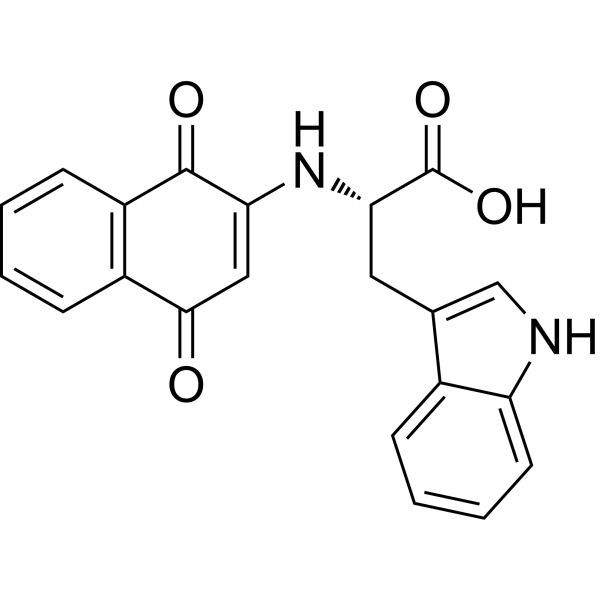
Physicochemical Properties
| Molecular Formula | C21H16N2O4 |
| Molecular Weight | 360.36 |
| Exact Mass | 360.111 |
| CAS # | 185351-19-3 |
| PubChem CID | 56605052 |
| Appearance | Brown to wine solid powder |
| LogP | 3.107 |
| Hydrogen Bond Donor Count | 3 |
| Hydrogen Bond Acceptor Count | 5 |
| Rotatable Bond Count | 5 |
| Heavy Atom Count | 27 |
| Complexity | 659 |
| Defined Atom Stereocenter Count | 1 |
| SMILES | C1=CC=C2C(=C1)C(=O)C=C(C2=O)N[C@@H](CC3=CNC4=CC=CC=C43)C(=O)O |
| InChi Key | DZZUYZXINNHEGM-SFHVURJKSA-N |
| InChi Code | InChI=1S/C21H16N2O4/c24-19-10-17(20(25)15-7-2-1-6-14(15)19)23-18(21(26)27)9-12-11-22-16-8-4-3-5-13(12)16/h1-8,10-11,18,22-23H,9H2,(H,26,27)/t18-/m0/s1 |
| Chemical Name | (2S)-2-[(1,4-dioxonaphthalen-2-yl)amino]-3-(1H-indol-3-yl)propanoic acid |
| Synonyms | NQ Trp; NQ-Trp; NQTrp |
| HS Tariff Code | 2934.99.9001 |
| Storage |
Powder-20°C 3 years 4°C 2 years In solvent -80°C 6 months -20°C 1 month Note: This product requires protection from light (avoid light exposure) during transportation and storage. |
| Shipping Condition | Room temperature (This product is stable at ambient temperature for a few days during ordinary shipping and time spent in Customs) |
Biological Activity
| ln Vitro | GDC6 peptide fibrils (50 μM) were observed in TEM examination when NQTrp was present in a 5:1, 1:1, or 1:5 ratio (GDC6: NQTrp). NQTrp blocks the production of elongated amyloid fibrils and, in a dose-dependent manner, efficiently suppresses fibrillation with GDC6 peptide (50 μM) [1]. NQTrp decreases the cytotoxicity caused by hexapeptide aggregates in ARPE-19 cells (IC50=70 μM) and has no harmful effects on retinal cell cultures [1]. |
| References |
[1]. An amyloidogenic hexapeptide from the cataract-associated γD-crystallin is a model for the full-length protein and is inhibited by naphthoquinone-tryptophan hybrids. Int J Biol Macromol. 2020 Aug 15;157:424-433. |
Solubility Data
| Solubility (In Vitro) | DMSO : ~125 mg/mL (~346.88 mM) |
| Solubility (In Vivo) |
Solubility in Formulation 1: ≥ 2.08 mg/mL (5.77 mM) (saturation unknown) in 10% DMSO + 40% PEG300 + 5% Tween80 + 45% Saline (add these co-solvents sequentially from left to right, and one by one), clear solution. For example, if 1 mL of working solution is to be prepared, you can add 100 μL of 20.8 mg/mL clear DMSO stock solution to 400 μL PEG300 and mix evenly; then add 50 μL Tween-80 to the above solution and mix evenly; then add 450 μL normal saline to adjust the volume to 1 mL. Preparation of saline: Dissolve 0.9 g of sodium chloride in 100 mL ddH₂ O to obtain a clear solution. Solubility in Formulation 2: ≥ 2.08 mg/mL (5.77 mM) (saturation unknown) in 10% DMSO + 90% (20% SBE-β-CD in Saline) (add these co-solvents sequentially from left to right, and one by one), clear solution. For example, if 1 mL of working solution is to be prepared, you can add 100 μL of 20.8 mg/mL clear DMSO stock solution to 900 μL of 20% SBE-β-CD physiological saline solution and mix evenly. Preparation of 20% SBE-β-CD in Saline (4°C,1 week): Dissolve 2 g SBE-β-CD in 10 mL saline to obtain a clear solution. (Please use freshly prepared in vivo formulations for optimal results.) |
| Preparing Stock Solutions | 1 mg | 5 mg | 10 mg | |
| 1 mM | 2.7750 mL | 13.8750 mL | 27.7500 mL | |
| 5 mM | 0.5550 mL | 2.7750 mL | 5.5500 mL | |
| 10 mM | 0.2775 mL | 1.3875 mL | 2.7750 mL |