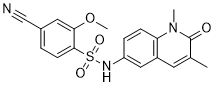
NI-57 is a potent inhibitor of the bromodomains of BRPF proteins that binds to BRPF1B, BRPF2, and BRPF3 with Kd values of 31, 108, and 408 nM, respectively
Physicochemical Properties
| Molecular Formula | C19H17N3O4S |
| Molecular Weight | 383.420983076096 |
| Exact Mass | 383.094 |
| CAS # | 1883548-89-7 |
| Related CAS # | 1883548-89-7; |
| PubChem CID | 91827373 |
| Appearance | White to off-white solid powder |
| LogP | 2.1 |
| Hydrogen Bond Donor Count | 1 |
| Hydrogen Bond Acceptor Count | 6 |
| Rotatable Bond Count | 4 |
| Heavy Atom Count | 27 |
| Complexity | 764 |
| Defined Atom Stereocenter Count | 0 |
| SMILES | C1(S(NC2C=CC3=C(C=2)C=C(C)C(=O)N3C)(=O)=O)=CC=C(C#N)C=C1OC |
| InChi Key | UEMQPCYDWCSVCU-UHFFFAOYSA-N |
| InChi Code | InChI=1S/C19H17N3O4S/c1-12-8-14-10-15(5-6-16(14)22(2)19(12)23)21-27(24,25)18-7-4-13(11-20)9-17(18)26-3/h4-10,21H,1-3H3 |
| Chemical Name | 4-cyano-N-(1,3-dimethyl-2-oxo-1,2-dihydroquinolin-6-yl)-2-methoxybenzenesulfonamide |
| Synonyms | NI-57 NI 57 NI57. |
| HS Tariff Code | 2934.99.9001 |
| Storage |
Powder-20°C 3 years 4°C 2 years In solvent -80°C 6 months -20°C 1 month |
| Shipping Condition | Room temperature (This product is stable at ambient temperature for a few days during ordinary shipping and time spent in Customs) |
Biological Activity
| ln Vitro | NI-57 is an inhibitor of the plant homeodomain finger domain (BRPF) and the bromodomain with IC50 values of 3.1, 46, and 140 nM for BRPF1, BRPF2 (BRD1), and BRPF3, respectively. NI-57 exhibits a Kd of 31 ± 2 nM for the BRD of BRPF1, 110 ± 13 nM for BRD1, and 410 ± 47 nM for BRPF3. In contrast, the binding to BRD9 is rather poor, with a Kd of 1000 ± 130 nM. Measurements with titration calorimeter. TRIM24 (IC50, 1600 nM), BRD9 (IC50, 520 nM), and BRD4 (BD1) (IC50, 3700 nM) were all targets of little activity for NI-57. With GI50 values of 10.4 μM (NCI-H1703 cells), 14.7 μM (DMS114), 15.6 μM (HRA-19), and 16.6 μM (RERF-LC-Sq1), NI-57 similarly suppresses BRPF BRD in the nucleus but has no effect on the proliferation of numerous cancer cell lines. Furthermore, CCL-22 gene expression was decreased by 27.7 ± 9.4% upon NI-57 (10 μM)-induced BRPF1 inhibition [1]. |
| ln Vivo | In mice, NI-57 exhibits a high oral bioavailability [1]. |
| References |
[1]. Design of a Chemical Probe for the Bromodomain and Plant Homeodomain Finger-Containing (BRPF) Family of Proteins. J Med Chem. 2017 Aug 24;60(16):6998-7011. |
Solubility Data
| Solubility (In Vitro) | DMSO : ~100 mg/mL (~260.81 mM) |
| Solubility (In Vivo) |
Solubility in Formulation 1: 2.5 mg/mL (6.52 mM) in 10% DMSO + 40% PEG300 + 5% Tween80 + 45% Saline (add these co-solvents sequentially from left to right, and one by one), suspension solution; with sonication. For example, if 1 mL of working solution is to be prepared, you can add 100 μL of 25.0 mg/mL clear DMSO stock solution to 400 μL PEG300 and mix evenly; then add 50 μL Tween-80 to the above solution and mix evenly; then add 450 μL normal saline to adjust the volume to 1 mL. Preparation of saline: Dissolve 0.9 g of sodium chloride in 100 mL ddH₂ O to obtain a clear solution. Solubility in Formulation 2: ≥ 2.5 mg/mL (6.52 mM) (saturation unknown) in 10% DMSO + 90% Corn Oil (add these co-solvents sequentially from left to right, and one by one), clear solution. For example, if 1 mL of working solution is to be prepared, you can add 100 μL of 25.0 mg/mL clear DMSO stock solution to 900 μL of corn oil and mix evenly. (Please use freshly prepared in vivo formulations for optimal results.) |
| Preparing Stock Solutions | 1 mg | 5 mg | 10 mg | |
| 1 mM | 2.6081 mL | 13.0405 mL | 26.0811 mL | |
| 5 mM | 0.5216 mL | 2.6081 mL | 5.2162 mL | |
| 10 mM | 0.2608 mL | 1.3041 mL | 2.6081 mL |