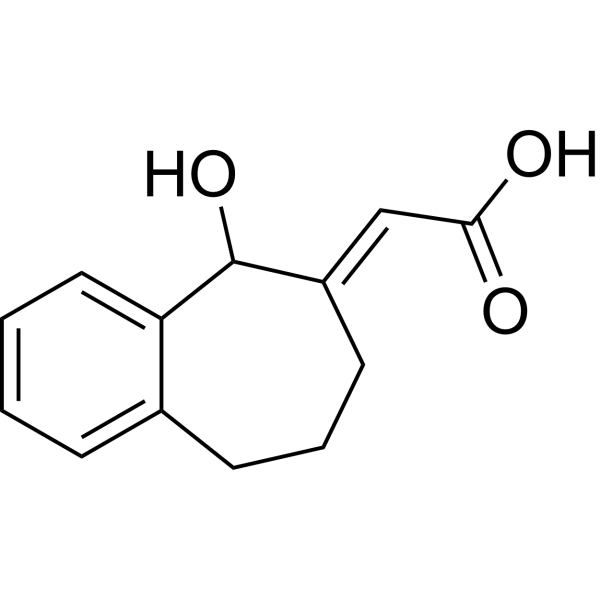
Physicochemical Properties
| Molecular Formula | C13H14O3 |
| Molecular Weight | 218.248464107513 |
| Exact Mass | 218.094 |
| CAS # | 520505-01-5 |
| Related CAS # | NCS-382 sodium;131733-92-1 |
| PubChem CID | 5875451 |
| Appearance | Typically exists as solid at room temperature |
| Density | 1.3±0.1 g/cm3 |
| Boiling Point | 460.8±30.0 °C at 760 mmHg |
| Flash Point | 246.6±21.1 °C |
| Vapour Pressure | 0.0±1.2 mmHg at 25°C |
| Index of Refraction | 1.682 |
| LogP | 2.17 |
| Hydrogen Bond Donor Count | 2 |
| Hydrogen Bond Acceptor Count | 3 |
| Rotatable Bond Count | 1 |
| Heavy Atom Count | 16 |
| Complexity | 296 |
| Defined Atom Stereocenter Count | 0 |
| SMILES | OC(/C=C1/CCCC2=CC=CC=C2[C@H]/1O)=O |
| InChi Key | UADPGHINQMWEAG-CSKARUKUSA-N |
| InChi Code | InChI=1S/C13H14O3/c14-12(15)8-10-6-3-5-9-4-1-2-7-11(9)13(10)16/h1-2,4,7-8,13,16H,3,5-6H2,(H,14,15)/b10-8+ |
| Chemical Name | (2E)-2-(5-hydroxy-5,7,8,9-tetrahydrobenzo[7]annulen-6-ylidene)acetic acid |
| HS Tariff Code | 2934.99.9001 |
| Storage |
Powder-20°C 3 years 4°C 2 years In solvent -80°C 6 months -20°C 1 month |
| Shipping Condition | Room temperature (This product is stable at ambient temperature for a few days during ordinary shipping and time spent in Customs) |
Biological Activity
| ln Vitro | HepG2 cells do not exhibit the capacity of NCS-382 (0.5 nM, 24 h) to inhibit microsomal CYPs (CYP1A2, 2B6, 2C8, 2C9, 2C19, 2D6, and 3A4) [2]. For HepG2 cells, NCS-382 (0.01-1000 μM, 24 h) exhibits minimal cytotoxicity [2]. The GHBR antagonist NCS-382 has IC50 values in isolated rat striatum and hippocampus membranes of 134.1 and 201.3 nM, respectively [4]. |
| ln Vivo | In mice models, at a dose of 100 mg/kg, the maximum serum concentration was four times that in brain tissue, ten times that in kidney tissue, and the greatest concentration in liver tissue was NCS-382 (100, 300, 500 mg/kg; i.p.). Serum concentrations are more than 700% greater[1]. In mice models, after intraperitoneal treatment at a dose of 100 mg/kg, it may reside more favorably in the liver but stay longer in the brain and kidneys. An increase in the brain-to-serum ratio in a mouse model indicated that the 500 mg/kg dose improved brain permeability. When given at doses of 1.66 mmol/kg and 2.08 mmol/kg, NCS-382 (0.83-2.08 mmol/kg/kg; i.p.) decreases GHB-induced stress in the forced swim test in mouse models. The longer amount of time spent at rest suggests anti-sedative action[3]. In a rat model of miniature epilepsy and in Swiss RB mice prone to audiogenic epilepsy, NCS-382 (2.3 mmol/kg/kg; i.p.) attenuates spike and wave discharges[4]. |
| Cell Assay |
Cell Cytotoxicity Assay[2] Cell Types: HepG2 cells Tested Concentrations: 0.01-1000 μM Incubation Duration: 24 h Experimental Results: diminished HepG2 cell viability at a concentration of 1 mM, and this same concentration did not induce apoptosis or cytotoxicity in HepG2 cells. |
| Animal Protocol |
Animal/Disease Models: GBL induced mouse model[1] Doses: 300 mg/kg(Combined with diclofenac (25 mg/kg)) Route of Administration: intraperitoneal (ip) injection (ip), Thirty minutes later, mice were given an ip injection of GBL (100 mg /kg diluted in PBS) Experimental Results: In the presence of diclofenac, it was highly protective against GBL mediated responses. Animal/Disease Models: GBL induced mouse model[3] Doses: 0.83, 1.25, 1.66, 2.08mmol/kg Route of Administration: intraperitoneal (ip) injection ( ip), 30 min before the test Experimental Results: At a dosage of 2.08 mmol/kg, completely blocked the effect of GHB when administered at 3.18 mmol/kg |
| References |
[1]. A pharmacokinetic evaluation and metabolite identification of the GHB receptor antagonist NCS-382 in mouse informs novel therapeutic strategies for the treatment of GHB intoxication. Pharmacol Res Perspect. 2016 Oct 18;4(6):e00265. [2]. In vitro toxicological evaluation of NCS-382, a high-affinity antagonist of γ-hydroxybutyrate (GHB) binding. Toxicol In Vitro. 2017 Apr;40:196-202. [3]. Anti-sedative and anti-cataleptic properties of NCS-382, a gamma-hydroxybutyrate receptor antagonist. Eur J Pharmacol. 1991 Oct 22;203(3):393-7. [4]. Maitre M, Hechler V, Vayer P, Gobaille S, Cash CD, Schmitt M, Bourguignon JJ. A specific gamma-hydroxybutyrate receptor ligand possesses both antagonistic and anticonvulsant properties. J Pharmacol Exp Ther. 1990 Nov;255(2):657-63. |
Solubility Data
| Solubility (In Vitro) | May dissolve in DMSO (in most cases), if not, try other solvents such as H2O, Ethanol, or DMF with a minute amount of products to avoid loss of samples |
| Solubility (In Vivo) |
Note: Listed below are some common formulations that may be used to formulate products with low water solubility (e.g. < 1 mg/mL), you may test these formulations using a minute amount of products to avoid loss of samples. Injection Formulations (e.g. IP/IV/IM/SC) Injection Formulation 1: DMSO : Tween 80: Saline = 10 : 5 : 85 (i.e. 100 μL DMSO stock solution → 50 μL Tween 80 → 850 μL Saline) *Preparation of saline: Dissolve 0.9 g of sodium chloride in 100 mL ddH ₂ O to obtain a clear solution. Injection Formulation 2: DMSO : PEG300 :Tween 80 : Saline = 10 : 40 : 5 : 45 (i.e. 100 μL DMSO → 400 μLPEG300 → 50 μL Tween 80 → 450 μL Saline) Injection Formulation 3: DMSO : Corn oil = 10 : 90 (i.e. 100 μL DMSO → 900 μL Corn oil) Example: Take the Injection Formulation 3 (DMSO : Corn oil = 10 : 90) as an example, if 1 mL of 2.5 mg/mL working solution is to be prepared, you can take 100 μL 25 mg/mL DMSO stock solution and add to 900 μL corn oil, mix well to obtain a clear or suspension solution (2.5 mg/mL, ready for use in animals). Injection Formulation 4: DMSO : 20% SBE-β-CD in saline = 10 : 90 [i.e. 100 μL DMSO → 900 μL (20% SBE-β-CD in saline)] *Preparation of 20% SBE-β-CD in Saline (4°C,1 week): Dissolve 2 g SBE-β-CD in 10 mL saline to obtain a clear solution. Injection Formulation 5: 2-Hydroxypropyl-β-cyclodextrin : Saline = 50 : 50 (i.e. 500 μL 2-Hydroxypropyl-β-cyclodextrin → 500 μL Saline) Injection Formulation 6: DMSO : PEG300 : castor oil : Saline = 5 : 10 : 20 : 65 (i.e. 50 μL DMSO → 100 μLPEG300 → 200 μL castor oil → 650 μL Saline) Injection Formulation 7: Ethanol : Cremophor : Saline = 10: 10 : 80 (i.e. 100 μL Ethanol → 100 μL Cremophor → 800 μL Saline) Injection Formulation 8: Dissolve in Cremophor/Ethanol (50 : 50), then diluted by Saline Injection Formulation 9: EtOH : Corn oil = 10 : 90 (i.e. 100 μL EtOH → 900 μL Corn oil) Injection Formulation 10: EtOH : PEG300:Tween 80 : Saline = 10 : 40 : 5 : 45 (i.e. 100 μL EtOH → 400 μLPEG300 → 50 μL Tween 80 → 450 μL Saline) Oral Formulations Oral Formulation 1: Suspend in 0.5% CMC Na (carboxymethylcellulose sodium) Oral Formulation 2: Suspend in 0.5% Carboxymethyl cellulose Example: Take the Oral Formulation 1 (Suspend in 0.5% CMC Na) as an example, if 100 mL of 2.5 mg/mL working solution is to be prepared, you can first prepare 0.5% CMC Na solution by measuring 0.5 g CMC Na and dissolve it in 100 mL ddH2O to obtain a clear solution; then add 250 mg of the product to 100 mL 0.5% CMC Na solution, to make the suspension solution (2.5 mg/mL, ready for use in animals). Oral Formulation 3: Dissolved in PEG400 Oral Formulation 4: Suspend in 0.2% Carboxymethyl cellulose Oral Formulation 5: Dissolve in 0.25% Tween 80 and 0.5% Carboxymethyl cellulose Oral Formulation 6: Mixing with food powders Note: Please be aware that the above formulations are for reference only. InvivoChem strongly recommends customers to read literature methods/protocols carefully before determining which formulation you should use for in vivo studies, as different compounds have different solubility properties and have to be formulated differently. (Please use freshly prepared in vivo formulations for optimal results.) |
| Preparing Stock Solutions | 1 mg | 5 mg | 10 mg | |
| 1 mM | 4.5819 mL | 22.9095 mL | 45.8190 mL | |
| 5 mM | 0.9164 mL | 4.5819 mL | 9.1638 mL | |
| 10 mM | 0.4582 mL | 2.2910 mL | 4.5819 mL |