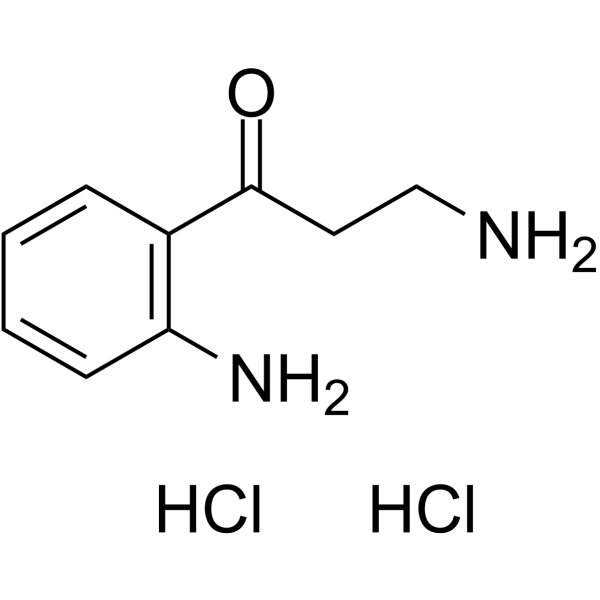
Physicochemical Properties
| Molecular Formula | C9H14CL2N2O |
| Molecular Weight | 237.13 |
| Exact Mass | 236.048 |
| CAS # | 36681-58-0 |
| Related CAS # | Kynuramine dihydrobromide;304-47-2 |
| PubChem CID | 12954979 |
| Appearance | Brown to black solid powder |
| Hydrogen Bond Donor Count | 4 |
| Hydrogen Bond Acceptor Count | 3 |
| Rotatable Bond Count | 3 |
| Heavy Atom Count | 14 |
| Complexity | 159 |
| Defined Atom Stereocenter Count | 0 |
| InChi Key | GIUIHRRGPBPUAO-UHFFFAOYSA-N |
| InChi Code | InChI=1S/C9H12N2O.2ClH/c10-6-5-9(12)7-3-1-2-4-8(7)11;;/h1-4H,5-6,10-11H2;2*1H |
| Chemical Name | 3-amino-1-(2-aminophenyl)propan-1-one;dihydrochloride |
| HS Tariff Code | 2934.99.9001 |
| Storage |
Powder-20°C 3 years 4°C 2 years In solvent -80°C 6 months -20°C 1 month Note: Please store this product in a sealed and protected environment, avoid exposure to moisture. |
| Shipping Condition | Room temperature (This product is stable at ambient temperature for a few days during ordinary shipping and time spent in Customs) |
Biological Activity
| ln Vitro | In vitro, kappamine inhibits alpha-adrenergic receptors on the postsynaptic and presynaptic levels [2]. It has been demonstrated that kynuramine partially agonistically interacts with serotonin receptors in canine cerebral arteries [2]. The ileum frequently contracts slightly when exposed to 20 μg/mL of kynuramine, but this does not change the twitching response to cholinergic stimulation [2]. |
| ln Vivo | It is possible that kynuramine (0.064, 0.32, 1.6, or 8 μg; intracerebroventricular; single dose) regulates female sexual behavior physiologically[3]. Kynuramine (1.25, 2.5, and 5.0 mg/kg; intravenously; single dose) raises heart rate and blood pressure in intramedullary rats[4]. |
| Animal Protocol |
Animal/Disease Models: Female rats[3]. Doses: 0.064-8 μg. Route of Administration: Intraventricular administration; single does. Experimental Results: Produced facilitation of lordosis behavior. Animal/Disease Models: Male rats (about 200g)[4]. Doses: 1.25-5.0 mg/kg. Route of Administration: iv; single does. Experimental Results: Promoted heart rate and blood pressure. |
| References |
[1]. Kynuramine, a fluorescent substrate and probe of plasma amine oxidase. J Biol Chem. 1977 Nov 25;252(22):8081-4. [2]. T D Johnson, An alpha-adrenoceptor inhibitory action of kynuramine. Eur J Pharmacol. 1981 Jul 10;72(4):351-6. [3]. Intraventricular administration of l-kynurenine and kynuramine facilitates lordosis in the female rat. Eur J Pharmacol. 1987 Oct 27;142(3):447-51. [4]. Blood pressure and heart rate effects of kynuramine in pithed rats. Eur J Pharmacol. 1983 Feb 18;87(2-3):323-6. |
Solubility Data
| Solubility (In Vitro) | DMSO: 125 mg/mL (527.14 mM) |
| Solubility (In Vivo) |
Solubility in Formulation 1: ≥ 2.08 mg/mL (8.77 mM) (saturation unknown) in 10% DMSO + 40% PEG300 + 5% Tween80 + 45% Saline (add these co-solvents sequentially from left to right, and one by one), clear solution. For example, if 1 mL of working solution is to be prepared, you can add 100 μL of 20.8 mg/mL clear DMSO stock solution to 400 μL PEG300 and mix evenly; then add 50 μL Tween-80 to the above solution and mix evenly; then add 450 μL normal saline to adjust the volume to 1 mL. Preparation of saline: Dissolve 0.9 g of sodium chloride in 100 mL ddH₂ O to obtain a clear solution. Solubility in Formulation 2: ≥ 2.08 mg/mL (8.77 mM) (saturation unknown) in 10% DMSO + 90% (20% SBE-β-CD in Saline) (add these co-solvents sequentially from left to right, and one by one), clear solution. For example, if 1 mL of working solution is to be prepared, you can add 100 μL of 20.8 mg/mL clear DMSO stock solution to 900 μL of 20% SBE-β-CD physiological saline solution and mix evenly. Preparation of 20% SBE-β-CD in Saline (4°C,1 week): Dissolve 2 g SBE-β-CD in 10 mL saline to obtain a clear solution. (Please use freshly prepared in vivo formulations for optimal results.) |
| Preparing Stock Solutions | 1 mg | 5 mg | 10 mg | |
| 1 mM | 4.2171 mL | 21.0855 mL | 42.1710 mL | |
| 5 mM | 0.8434 mL | 4.2171 mL | 8.4342 mL | |
| 10 mM | 0.4217 mL | 2.1085 mL | 4.2171 mL |