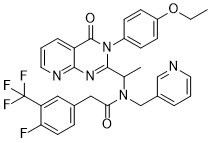
NBI-74330 (NBI74330) is a novel, potent and selective antagonist for CXCR3 (CXC chemokine receptor 3) with potential anticancer, immunomodulatory and antiinflammatory activities. It shows strong inhibition of (125I)CXCL10 and (125I)CXCL11 specific binding with Ki of 1.5 and 3.2 nM, respectively, and inhibits CXCR3 with IC50 values ranging from 7 to 18 nM. In mice lacking the LDL receptor, NBI-74330 reduces the development of atherosclerotic plaque. Glioma growth is stimulated by the chemokine receptor CXCR3. Since CXCR3 antagonism directly inhibits gliomas, treating human GBM may benefit from targeting this receptor as a therapeutic target.
Physicochemical Properties
| Molecular Formula | C32H27F4N5O3 |
| Molecular Weight | 605.5821 |
| Exact Mass | 605.205 |
| Elemental Analysis | C, 63.47; H, 4.49; F, 12.55; N, 11.56; O, 7.93 |
| CAS # | 855527-92-3 |
| Related CAS # | 473722-68-8 (racemate);855527-92-3 (R-isomer) |
| PubChem CID | 45784923 |
| Appearance | Light yellow to yellow solid powder |
| LogP | 6.064 |
| Hydrogen Bond Donor Count | 0 |
| Hydrogen Bond Acceptor Count | 10 |
| Rotatable Bond Count | 9 |
| Heavy Atom Count | 44 |
| Complexity | 1020 |
| Defined Atom Stereocenter Count | 1 |
| SMILES | [C@H](C1=NC2N=CC=CC=2C(=O)N1C1C=CC(OCC)=CC=1)(C)N(C(=O)CC1C=CC(F)=C(C(F)(F)F)C=1)CC1C=NC=CC=1 |
| InChi Key | XMRGQUDUVGRCBS-UHFFFAOYSA-N |
| InChi Code | InChI=1S/C32H27F4N5O3/c1-3-44-24-11-9-23(10-12-24)41-30(39-29-25(31(41)43)7-5-15-38-29)20(2)40(19-22-6-4-14-37-18-22)28(42)17-21-8-13-27(33)26(16-21)32(34,35)36/h4-16,18,20H,3,17,19H2,1-2H3 |
| Chemical Name | N-[1-[3-(4-ethoxyphenyl)-4-oxopyrido[2,3-d]pyrimidin-2-yl]ethyl]-2-[4-fluoro-3-(trifluoromethyl)phenyl]-N-(pyridin-3-ylmethyl)acetamide |
| Synonyms | NBI74330; NBI 74330; NBI-74330. |
| HS Tariff Code | 2934.99.9001 |
| Storage |
Powder-20°C 3 years 4°C 2 years In solvent -80°C 6 months -20°C 1 month |
| Shipping Condition | Room temperature (This product is stable at ambient temperature for a few days during ordinary shipping and time spent in Customs) |
Biological Activity
| Targets | [125I]CXCL10-CXCR3 ( Ki = 1.5 nM ); [125I]CXCL11-CXCR3 ( Ki = 3.2 nM ) | |
| ln Vitro |
|
|
| ln Vivo |
|
|
| Enzyme Assay |
|
|
| Animal Protocol |
|
|
| References |
[1]. Pharmacological characterization of CXC chemokine receptor 3 ligands and a small molecule antagonist. J Pharmacol Exp Ther. 2005 Jun;313(3):1263-71. [2]. Analysis of the pharmacokinetic/pharmacodynamic relationship of a small molecule CXCR3 antagonist, NBI-74330, using a murine CXCR3 internalization assay. Br J Pharmacol. 2007 Dec;152(8):1260-71. [3]. CXCR3 antagonist NBI-74330 attenuates atherosclerotic plaque formation in LDL receptor-deficient mice. Arterioscler Thromb Vasc Biol. 2008 Feb;28(2):251-7. |
|
| Additional Infomation | See also: Nbi-74330 (annotation moved to). |
Solubility Data
| Solubility (In Vitro) | DMSO: ~100 mg/mL (~165.1 mM) |
| Solubility (In Vivo) |
Solubility in Formulation 1: 2.5 mg/mL (4.13 mM) in 10% DMSO + 40% PEG300 + 5% Tween80 + 45% Saline (add these co-solvents sequentially from left to right, and one by one), suspension solution; with sonication. For example, if 1 mL of working solution is to be prepared, you can add 100 μL of 25.0 mg/mL clear DMSO stock solution to 400 μL PEG300 and mix evenly; then add 50 μL Tween-80 to the above solution and mix evenly; then add 450 μL normal saline to adjust the volume to 1 mL. Preparation of saline: Dissolve 0.9 g of sodium chloride in 100 mL ddH₂ O to obtain a clear solution. Solubility in Formulation 2: 2.5 mg/mL (4.13 mM) in 10% DMSO + 90% (20% SBE-β-CD in Saline) (add these co-solvents sequentially from left to right, and one by one), suspension solution; with ultrasonication. For example, if 1 mL of working solution is to be prepared, you can add 100 μL of 25.0 mg/mL clear DMSO stock solution to 900 μL of 20% SBE-β-CD physiological saline solution and mix evenly. Preparation of 20% SBE-β-CD in Saline (4°C,1 week): Dissolve 2 g SBE-β-CD in 10 mL saline to obtain a clear solution. Solubility in Formulation 3: ≥ 2.5 mg/mL (4.13 mM) (saturation unknown) in 10% DMSO + 90% Corn Oil (add these co-solvents sequentially from left to right, and one by one), clear solution. For example, if 1 mL of working solution is to be prepared, you can add 100 μL of 25.0 mg/mL clear DMSO stock solution to 900 μL of corn oil and mix evenly. (Please use freshly prepared in vivo formulations for optimal results.) |
| Preparing Stock Solutions | 1 mg | 5 mg | 10 mg | |
| 1 mM | 1.6513 mL | 8.2565 mL | 16.5131 mL | |
| 5 mM | 0.3303 mL | 1.6513 mL | 3.3026 mL | |
| 10 mM | 0.1651 mL | 0.8257 mL | 1.6513 mL |