Physicochemical Properties
| Molecular Formula | C11H13NO4 |
| Molecular Weight | 223.2252 |
| Exact Mass | 223.084 |
| CAS # | 537-55-3 |
| Related CAS # | N-Acetyl-L-tyrosine-d3 |
| PubChem CID | 68310 |
| Appearance | White to off-white solid powder |
| Density | 1.3±0.1 g/cm3 |
| Boiling Point | 531.3±45.0 °C at 760 mmHg |
| Melting Point | 149-152 °C(lit.) |
| Flash Point | 275.1±28.7 °C |
| Vapour Pressure | 0.0±1.5 mmHg at 25°C |
| Index of Refraction | 1.577 |
| LogP | 0.04 |
| Hydrogen Bond Donor Count | 3 |
| Hydrogen Bond Acceptor Count | 4 |
| Rotatable Bond Count | 4 |
| Heavy Atom Count | 16 |
| Complexity | 259 |
| Defined Atom Stereocenter Count | 1 |
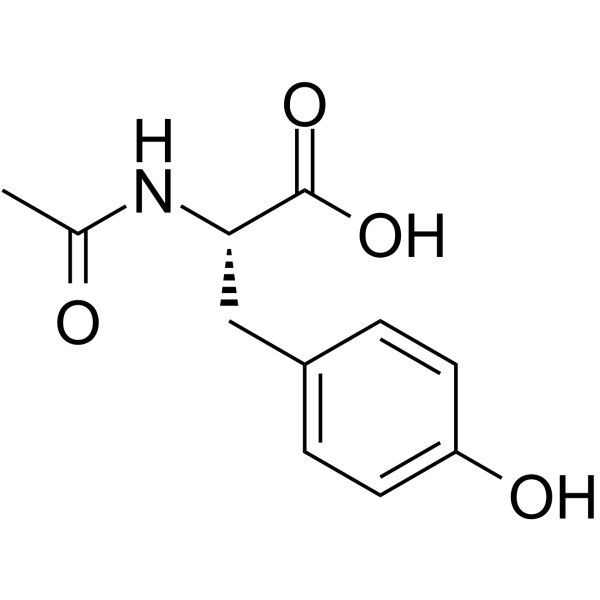
| SMILES | CC(=O)N[C@@H](CC1=CC=C(C=C1)O)C(=O)O |
| InChi Key | CAHKINHBCWCHCF-JTQLQIEISA-N |
| InChi Code | InChI=1S/C11H13NO4/c1-7(13)12-10(11(15)16)6-8-2-4-9(14)5-3-8/h2-5,10,14H,6H2,1H3,(H,12,13)(H,15,16)/t10-/m0/s1 |
| Chemical Name | (2S)-2-acetamido-3-(4-hydroxyphenyl)propanoic acid |
| HS Tariff Code | 2934.99.9001 |
| Storage |
Powder-20°C 3 years 4°C 2 years In solvent -80°C 6 months -20°C 1 month |
| Shipping Condition | Room temperature (This product is stable at ambient temperature for a few days during ordinary shipping and time spent in Customs) |
Biological Activity
| ADME/Pharmacokinetics |
Absorption, Distribution and Excretion N-acetyltyrosine is eliminated in the urine. The extent of urinary elimination versus utilization in the tissues appears to be related to the rapidity of infusion. When infused slowly in standard doses as in the clinical setting, about 35% is excreted unchanged in the urine. When larger doses are infused rapidly, much higher amounts are excreted reaching values up to 56%. In rat studies it was found that of the drug eliminated in the urine about 74% is present as unchanged N-acetyltyrosine and 23% is present as tyrosine. |
| References |
[1]. Aromatic l-aminoacid decarboxylase deficiency: unusual neonatal presentation and additional findings in organic acid analysis. Mol Genet Metab. 2006 Jan;87(1):48-53. |
| Additional Infomation |
N-acetyl-L-tyrosine is an N-acetyltyrosine in which the chiral centre has L configuration. It has a role as an EC 2.1.1.4 (acetylserotonin O-methyltransferase) inhibitor, a biomarker and a human urinary metabolite. It is a N-acyl-L-tyrosine and a N-acetyltyrosine. It is a conjugate acid of a N-acetyl-L-tyrosinate. N-acetyltyrosine, also referred to as N-acetyl-L-tyrosine, is used in place of as a tyrosine precursor. [DB00135] is a non-essential amino acid with a polar side group. N-acetyltyrosine is administered as parenteral nutrition or intravenous infusion due to its enhanced solubility compared to tyrosine. It is typically administered as a source of nutritional support where oral nutrition is inadequate or cannot be tolerated. N-Acetyl-L-tyrosine has been reported in Caenorhabditis elegans with data available. Drug Indication N-acetyltyrosine is indicated, in combination with several other amino acids and dextrose, as a peripherally administered source of nitrogen for nutritional support in patients with adequate stores of body fat in whom, for short periods, oral administration cannot be tolerated, is undesirable, or inadequate. It is also indicated, with other amino acids, 5-10% dextrose, and fat emulsion, for parenteral nutrition to preserve protein and reduce catabolism in stress conditions where oral administration is inadequate. When administered with other amino acids and concentrated dextrose, it is indicated for central vein infusion to prevent or reverse negative nitrogen balance in patients where the alimentary tract by the oral, gastrostomy, or jejestomy routes cannot or should not be used or in patients in which gastrointestinal absorption of protein is impaired, metabolic requirements for protein are substantially increased, or morbidity and mortality may be reduced by replacing amino acids lost from tissue breakdown FDA Label Mechanism of Action Used as a source of [DB00135]. See [DB00135] for more information on its role and pharmacology. Pharmacodynamics N-acetyltyrosine is used as a high solubility precursor to [DB00135] used due to [DB00135]'s poor solubility. It is deacetylated to form [DB00135]. |
Solubility Data
| Solubility (In Vitro) |
DMSO : ~100 mg/mL (~447.97 mM) H2O : ~100 mg/mL (~447.97 mM) |
| Solubility (In Vivo) |
Solubility in Formulation 1: ≥ 2.5 mg/mL (11.20 mM) (saturation unknown) in 10% DMSO + 40% PEG300 + 5% Tween80 + 45% Saline (add these co-solvents sequentially from left to right, and one by one), clear solution. For example, if 1 mL of working solution is to be prepared, you can add 100 μL of 25.0 mg/mL clear DMSO stock solution to 400 μL PEG300 and mix evenly; then add 50 μL Tween-80 to the above solution and mix evenly; then add 450 μL normal saline to adjust the volume to 1 mL. Preparation of saline: Dissolve 0.9 g of sodium chloride in 100 mL ddH₂ O to obtain a clear solution. Solubility in Formulation 2: ≥ 2.5 mg/mL (11.20 mM) (saturation unknown) in 10% DMSO + 90% (20% SBE-β-CD in Saline) (add these co-solvents sequentially from left to right, and one by one), clear solution. For example, if 1 mL of working solution is to be prepared, you can add 100 μL of 25.0 mg/mL clear DMSO stock solution to 900 μL of 20% SBE-β-CD physiological saline solution and mix evenly. Preparation of 20% SBE-β-CD in Saline (4°C,1 week): Dissolve 2 g SBE-β-CD in 10 mL saline to obtain a clear solution. Solubility in Formulation 3: ≥ 2.5 mg/mL (11.20 mM) (saturation unknown) in 10% DMSO + 90% Corn Oil (add these co-solvents sequentially from left to right, and one by one), clear solution. For example, if 1 mL of working solution is to be prepared, you can add 100 μL of 25.0 mg/mL clear DMSO stock solution to 900 μL of corn oil and mix evenly. Solubility in Formulation 4: 50 mg/mL (223.98 mM) in PBS (add these co-solvents sequentially from left to right, and one by one), clear solution; with ultrasonication. (Please use freshly prepared in vivo formulations for optimal results.) |
| Preparing Stock Solutions | 1 mg | 5 mg | 10 mg | |
| 1 mM | 4.4797 mL | 22.3984 mL | 44.7968 mL | |
| 5 mM | 0.8959 mL | 4.4797 mL | 8.9594 mL | |
| 10 mM | 0.4480 mL | 2.2398 mL | 4.4797 mL |