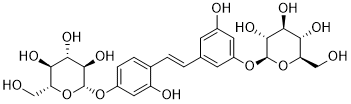
Mulberroside A is a novel, naturally occurring and potent anti-tyrosinase agent ( IC50 = 53.6 μM) isolated from mulberry (Morus alba L.). It exhibits anti-inflammatory activity by inhibiting TNF-α, IL-1β, and IL-6 and the activation of NALP3, caspase-1, and NF-κB and the phosphorylation of ERK, JNK, and p38.
Physicochemical Properties
| Molecular Formula | C26H32O14 |
| Molecular Weight | 568.5239 |
| Exact Mass | 568.179 |
| CAS # | 102841-42-9 |
| Related CAS # | cis-Mulberroside A;166734-06-1 |
| PubChem CID | 6443484 |
| Appearance | White to off-white solid powder |
| Density | 1.7±0.1 g/cm3 |
| Boiling Point | 954.7±65.0 °C at 760 mmHg |
| Flash Point | 531.2±34.3 °C |
| Vapour Pressure | 0.0±0.3 mmHg at 25°C |
| Index of Refraction | 1.742 |
| LogP | -1.16 |
| Hydrogen Bond Donor Count | 10 |
| Hydrogen Bond Acceptor Count | 14 |
| Rotatable Bond Count | 8 |
| Heavy Atom Count | 40 |
| Complexity | 816 |
| Defined Atom Stereocenter Count | 10 |
| SMILES | C1=CC(=C(C=C1O[C@H]2[C@@H]([C@H]([C@@H]([C@H](O2)CO)O)O)O)O)/C=C/C3=CC(=CC(=C3)O[C@H]4[C@@H]([C@H]([C@@H]([C@H](O4)CO)O)O)O)O |
| InChi Key | HPSWAEGGWLOOKT-VUNDNAJOSA-N |
| InChi Code | InChI=1S/C26H32O14/c27-9-17-19(31)21(33)23(35)25(39-17)37-14-4-3-12(16(30)8-14)2-1-11-5-13(29)7-15(6-11)38-26-24(36)22(34)20(32)18(10-28)40-26/h1-8,17-36H,9-10H2/b2-1+/t17-,18-,19-,20-,21+,22+,23-,24-,25-,26-/m1/s1 |
| Chemical Name | (2S,3R,4S,5S,6R)-2-[3-hydroxy-4-[(E)-2-[3-hydroxy-5-[(2S,3R,4S,5S,6R)-3,4,5-trihydroxy-6-(hydroxymethyl)oxan-2-yl]oxyphenyl]ethenyl]phenoxy]-6-(hydroxymethyl)oxane-3,4,5-triol |
| HS Tariff Code | 2934.99.9001 |
| Storage |
Powder-20°C 3 years 4°C 2 years In solvent -80°C 6 months -20°C 1 month |
| Shipping Condition | Room temperature (This product is stable at ambient temperature for a few days during ordinary shipping and time spent in Customs) |
Biological Activity
| ln Vivo | Mulberroside A (10, 20 and 40 mg/kg) reduces serum uric acid levels and increases uric acid excretion and fractional uric acid excretion in hyperuricemic mice [4]. |
| Animal Protocol |
Animal/Disease Models: Male Kunming mouse (20±2 g) [4] Doses: 5, 10, 20, 40 mg/kg; dose volume 10 mL/kg Body weight Route of Administration: 9:00 am Oral start Experimental Results: 10, 20 and 40 mg/kg Dramatically increased urate excretion within 24 hrs (hrs (hours)), resulting in a significant increase in fractional uric acid excretion (FEUA), and the highest dose completely reversed the FEUA changes in hyperuricemic mice to normal. |
| References |
[1]. In vitro pharmacokinetic characterization of mulberroside A, the main polyhydroxylated stilbene in mulberry (Morus alba L.), and its bacterial metabolite oxyresveratrol in traditional oral use. J Agric Food Chem. 2012 Mar 7;60(9):2299-308. [2]. Mulberroside A protects against ischemic impairment in primary culture of rat cortical neurons after oxygen-glucose deprivation followed by reperfusion. J Neurosci Res. 2014 Jul;92(7):944-54. [3]. Biotransformation of mulberroside A from Morus alba results in enhancement of tyrosinase inhibition. J Ind Microbiol Biotechnol. 2010 Jun;37(6):631-7. [4]. Mulberroside a possesses potent uricosuric and nephroprotective effects in hyperuricemic mice. Planta Med. 2011 May;77(8):786-94. |
| Additional Infomation |
Cis-Mulberroside A is a glycoside and a stilbenoid. Mulberroside A has been reported in Morus lhou, Veratrum dahuricum, and other organisms with data available. |
Solubility Data
| Solubility (In Vitro) | DMSO : ≥ 100 mg/mL (~175.90 mM) |
| Solubility (In Vivo) |
Solubility in Formulation 1: ≥ 2.5 mg/mL (4.40 mM) (saturation unknown) in 10% DMSO + 40% PEG300 + 5% Tween80 + 45% Saline (add these co-solvents sequentially from left to right, and one by one), clear solution. For example, if 1 mL of working solution is to be prepared, you can add 100 μL of 25.0 mg/mL clear DMSO stock solution to 400 μL PEG300 and mix evenly; then add 50 μL Tween-80 to the above solution and mix evenly; then add 450 μL normal saline to adjust the volume to 1 mL. Preparation of saline: Dissolve 0.9 g of sodium chloride in 100 mL ddH₂ O to obtain a clear solution. Solubility in Formulation 2: ≥ 2.5 mg/mL (4.40 mM) (saturation unknown) in 10% DMSO + 90% (20% SBE-β-CD in Saline) (add these co-solvents sequentially from left to right, and one by one), clear solution. For example, if 1 mL of working solution is to be prepared, you can add 100 μL of 25.0 mg/mL clear DMSO stock solution to 900 μL of 20% SBE-β-CD physiological saline solution and mix evenly. Preparation of 20% SBE-β-CD in Saline (4°C,1 week): Dissolve 2 g SBE-β-CD in 10 mL saline to obtain a clear solution. Solubility in Formulation 3: ≥ 2.5 mg/mL (4.40 mM) (saturation unknown) in 10% DMSO + 90% Corn Oil (add these co-solvents sequentially from left to right, and one by one), clear solution. For example, if 1 mL of working solution is to be prepared, you can add 100 μL of 25.0 mg/mL clear DMSO stock solution to 900 μL of corn oil and mix evenly. Solubility in Formulation 4: 10 mg/mL (17.59 mM) in 0.5% CMC-Na/saline water (add these co-solvents sequentially from left to right, and one by one), suspension solution; with ultrasonication. Preparation of saline: Dissolve 0.9 g of sodium chloride in 100 mL ddH₂ O to obtain a clear solution. (Please use freshly prepared in vivo formulations for optimal results.) |
| Preparing Stock Solutions | 1 mg | 5 mg | 10 mg | |
| 1 mM | 1.7590 mL | 8.7948 mL | 17.5895 mL | |
| 5 mM | 0.3518 mL | 1.7590 mL | 3.5179 mL | |
| 10 mM | 0.1759 mL | 0.8795 mL | 1.7590 mL |