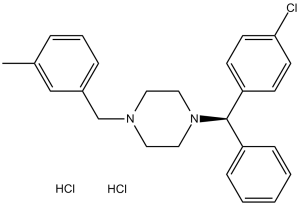
Meclizine 2HCl (Ru Vert M; Ru-Vert-M; RuVertM; NSC28728; NSC-28728), the dihydrochloride salt of meclizine, is a potent histamine H1 receptor antagonist used to treat nausea and motion sickness, and has anti-histamine, anti-muscarinic and anti-oxidative phosphorylation properties. Meclizine also functions as an inverse agonist for hCAR and an agonist ligand for mCAR. Meclizine stimulates the binding of steroid receptor coactivator 1 to the murine receptor in vitro and increases mCAR transactivation in a dose-dependent manner.
Physicochemical Properties
| Molecular Formula | C25H29CL3N2 | |
| Molecular Weight | 463.87 | |
| Exact Mass | 462.139 | |
| Elemental Analysis | C, 64.73; H, 6.30; Cl, 22.93; N, 6.04 | |
| CAS # | 1104-22-9 | |
| Related CAS # | Meclizine-d8 dihydrochloride; 1432062-16-2; Meclizine; 569-65-3; 31884-77-2 (HCl hydrate); 36236-67-6 (HCl); 189298-48-4 (R-isomer) | |
| PubChem CID | 64713 | |
| Appearance | White to light yellow crystalline powder | |
| Density | 1.159g/cm3 | |
| Boiling Point | 495.3ºC at 760mmHg | |
| Melting Point | 212 °C | |
| Flash Point | 253.3ºC | |
| Vapour Pressure | 6E-10mmHg at 25°C | |
| LogP | 7.035 | |
| Hydrogen Bond Donor Count | 2 | |
| Hydrogen Bond Acceptor Count | 2 | |
| Rotatable Bond Count | 5 | |
| Heavy Atom Count | 30 | |
| Complexity | 448 | |
| Defined Atom Stereocenter Count | 0 | |
| SMILES | CC1=CC(CN2CCN(C(C3=CC=C(Cl)C=C3)C4=CC=CC=C4)CC2)=CC=C1.Cl.Cl |
|
| InChi Key | VCTHNOIYJIXQLV-UHFFFAOYSA-N | |
| InChi Code | InChI=1S/C25H27ClN2.2ClH/c1-20-6-5-7-21(18-20)19-27-14-16-28(17-15-27)25(22-8-3-2-4-9-22)23-10-12-24(26)13-11-23;;/h2-13,18,25H,14-17,19H2,1H3;2*1H | |
| Chemical Name | 1-[(4-chlorophenyl)-phenylmethyl]-4-[(3-methylphenyl)methyl]piperazine;dihydrochloride | |
| Synonyms |
|
|
| HS Tariff Code | 2934.99.9001 | |
| Storage |
Powder-20°C 3 years 4°C 2 years In solvent -80°C 6 months -20°C 1 month Note: Please store this product in a sealed and protected environment, avoid exposure to moisture. |
|
| Shipping Condition | Room temperature (This product is stable at ambient temperature for a few days during ordinary shipping and time spent in Customs) |
Biological Activity
| Targets | H1 Receptor | ||
| ln Vitro |
|
||
| ln Vivo |
|
||
| Enzyme Assay | The constitutive androstane receptor (CAR, NR1I3) is a key regulator of xenobiotic and endobiotic metabolism. The ligand-binding domains of murine (m) and human (h) CAR are divergent relative to other nuclear hormone receptors, resulting in species-specific differences in xenobiotic responses. Here we identify the widely used antiemetic meclizine (Antivert; Bonine) as both an agonist ligand for mCAR and an inverse agonist for hCAR. Meclizine increases mCAR transactivation in a dose-dependent manner. Like the mCAR agonist 1,4-bis[2-(3,5-dichloropyridyloxy)]benzene, meclizine stimulates binding of steroid receptor coactivator 1 to the murine receptor in vitro. Meclizine administration to mice increases expression of CAR target genes in a CAR-dependent manner. In contrast, meclizine suppresses hCAR transactivation and inhibits the phenobarbital-induced expression of the CAR target genes, cytochrome p450 monooxygenase (CYP)2B10, CYP3A11, and CYP1A2, in primary hepatocytes derived from mice expressing hCAR, but not mCAR. The inhibitory effect of meclizine also suppresses acetaminophen-induced liver toxicity in humanized CAR mice. These results demonstrate that a single compound can induce opposite xenobiotic responses via orthologous receptors in rodents and humans[3]. | ||
| Cell Assay | In 24-well plates, HepG2 cells are grown in DMEM supplemented with 10% calf serum that has been stripped of its charcoal. 100 ng of receptor expression vectors, 300 ng of luciferase reporter plasmids, and 100 ng of pSV2-β-galactosidase are used to transfect cells using calcium phosphate, with the latter serving as an internal transfection efficiency control. After transfection, drugs are added and cells are incubated for a further twenty-four hours. The luciferase activity of the cell lysate is measured and compared to that of β-galactosidase activity. | ||
| Animal Protocol |
|
||
| References |
[1]. Safety and Efficacy in the Treatment and Prevention of Motion Sickness. [2]. Meclizine is neuroprotective in models of Huntington's disease. Hum Mol Genet. 2011 Jan 15;20(2):294-300. [3]. Meclizine Is an Agonist Ligand for Mouse Constitutive Androstane Receptor (CAR) and an Inverse Agonist for Human CAR. Mol Endocrinol . 2004 Oct;18(10):2402-8. [4]. Meclizine Preconditioning Protects the Kidney Against Ischemia-Reperfusion Injury. EBioMedicine. 2015 Jul 29;2(9):1090-101. |
||
| Additional Infomation |
Meclizine Hydrochloride is the hydrochloride salt form of meclizine, a synthetic piperazine with anti-emetic, sedative and histamine H1 antagonistic properties. Meclizine hydrochloride blocks the H1 histamine receptor and prevents the symptoms that are caused by histamine activity on capillaries, bronchial and gastrointestinal smooth muscles, including vasodilation, increased capillary permeability, bronchoconstriction, and spasmodic contraction of gastrointestinal smooth muscles. Meclizine hydrochloride may exert its antiemetic effects by its anticholinergic actions or due to a direct effect on the medullary chemoreceptive trigger zone. A histamine H1 antagonist used in the treatment of motion sickness, vertigo, and nausea during pregnancy and radiation sickness. See also: Meclizine Hydrochloride (annotation moved to). |
Solubility Data
| Solubility (In Vitro) |
|
|||
| Solubility (In Vivo) |
Solubility in Formulation 1: 10 mg/mL (21.56 mM) in 15% Cremophor EL + 85% Saline (add these co-solvents sequentially from left to right, and one by one), clear solution; with sonication. Preparation of saline: Dissolve 0.9 g of sodium chloride in 100 mL ddH₂ O to obtain a clear solution. Solubility in Formulation 2: ≥ 2.5 mg/mL (5.39 mM) (saturation unknown) in 10% DMSO + 40% PEG300 + 5% Tween80 + 45% Saline (add these co-solvents sequentially from left to right, and one by one), clear solution. For example, if 1 mL of working solution is to be prepared, you can add 100 μL of 25.0 mg/mL clear DMSO stock solution to 400 μL PEG300 and mix evenly; then add 50 μL Tween-80 to the above solution and mix evenly; then add 450 μL normal saline to adjust the volume to 1 mL. Preparation of saline: Dissolve 0.9 g of sodium chloride in 100 mL ddH₂ O to obtain a clear solution. Solubility in Formulation 3: ≥ 2.5 mg/mL (5.39 mM) (saturation unknown) in 10% DMSO + 90% (20% SBE-β-CD in Saline) (add these co-solvents sequentially from left to right, and one by one), clear solution. For example, if 1 mL of working solution is to be prepared, you can add 100 μL of 25.0 mg/mL clear DMSO stock solution to 900 μL of 20% SBE-β-CD physiological saline solution and mix evenly. Preparation of 20% SBE-β-CD in Saline (4°C,1 week): Dissolve 2 g SBE-β-CD in 10 mL saline to obtain a clear solution. Solubility in Formulation 4: ≥ 2.5 mg/mL (5.39 mM) (saturation unknown) in 10% DMSO + 90% Corn Oil (add these co-solvents sequentially from left to right, and one by one), clear solution. For example, if 1 mL of working solution is to be prepared, you can add 100 μL of 25.0 mg/mL clear DMSO stock solution to 900 μL corn oil and mix evenly. Solubility in Formulation 5: 5% DMSO +95%Corn oil : 10mg/mL Solubility in Formulation 6: 5 mg/mL (10.78 mM) in Cremophor EL (add these co-solvents sequentially from left to right, and one by one), clear solution; with heating and sonication. (Please use freshly prepared in vivo formulations for optimal results.) |
| Preparing Stock Solutions | 1 mg | 5 mg | 10 mg | |
| 1 mM | 2.1558 mL | 10.7789 mL | 21.5578 mL | |
| 5 mM | 0.4312 mL | 2.1558 mL | 4.3116 mL | |
| 10 mM | 0.2156 mL | 1.0779 mL | 2.1558 mL |