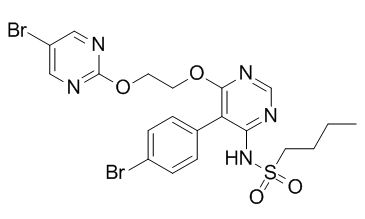
Macitentan n-butyl analogue, an n-butyl derivative of Macitentan, is an ETA/ETB endothelin (ET) receptor dual antagonist that has potential usefulness in the treatment of idiopathic pulmonary fibrosis (IPF) and pulmonary arterial hypertension (PAH).
Physicochemical Properties
| Molecular Formula | C20H21BR2N5O4S |
| Molecular Weight | 587.2848 |
| Exact Mass | 584.968 |
| CAS # | 556797-16-1 |
| Related CAS # | Macitentan; 441798-33-0 |
| PubChem CID | 71449713 |
| Appearance | White to yellow solid powder |
| Density | 1.6±0.1 g/cm3 |
| Boiling Point | 687.3±65.0 °C at 760 mmHg |
| Flash Point | 369.5±34.3 °C |
| Vapour Pressure | 0.0±2.1 mmHg at 25°C |
| Index of Refraction | 1.623 |
| LogP | 5.91 |
| Hydrogen Bond Donor Count | 1 |
| Hydrogen Bond Acceptor Count | 9 |
| Rotatable Bond Count | 11 |
| Heavy Atom Count | 32 |
| Complexity | 640 |
| Defined Atom Stereocenter Count | 0 |
| InChi Key | OZBDTKLWBSATSN-UHFFFAOYSA-N |
| InChi Code | InChI=1S/C20H21Br2N5O4S/c1-2-3-10-32(28,29)27-18-17(14-4-6-15(21)7-5-14)19(26-13-25-18)30-8-9-31-20-23-11-16(22)12-24-20/h4-7,11-13H,2-3,8-10H2,1H3,(H,25,26,27) |
| Chemical Name | N-[5-(4-bromophenyl)-6-[2-(5-bromopyrimidin-2-yl)oxyethoxy]pyrimidin-4-yl]butane-1-sulfonamide |
| Synonyms | Macitentan n-butyl analogue |
| HS Tariff Code | 2934.99.9001 |
| Storage |
Powder-20°C 3 years 4°C 2 years In solvent -80°C 6 months -20°C 1 month |
| Shipping Condition | Room temperature (This product is stable at ambient temperature for a few days during ordinary shipping and time spent in Customs) |
Biological Activity
| ln Vitro | Risperidone has a Kis of 4.8 and 5.9 nM for the 5-HT2A and D2 dopamine receptors, respectively, making it a strong antagonist of the dopamine receptor, a P-Glycoprotein inhibitor, and a blocker of the serotonin 5-HT2 receptor. In contrast to its dose-dependent induction of IL-10 production, risperidone inhibited the release of IL-12 in mature DCs. Maturated DCs may release TNF-α when given a high dose of risperidone[3]. |
| ln Vivo | In the first experiment, the body weight of the rats treated with risperidone was found to be progressively but slightly lower as a function of age. In the second locomotor experiment, age-dependent variations in body weight are also noted among the three treatment groups. On postnatal days 35, 38, and 41, rats given a 3.0 mg/kg dose of risperidone weighed less than rats given a vehicle treatment. Unlike the smaller, single-sex litters used in the first two locomotor experiments, larger, mixed-sex litters are used in the third experiment. In the third experiment, rats treated with risperidone gained less weight in an age-dependent manner, as was observed in the previous two[4]. |
| Animal Protocol | Rats: There are 211 Long-Evans rats in total—156 males and 56 females. In every study, injections of 1.0 mg/kg of risperidone, 3.0 mg/kg of risperidone, or the vehicle used to deliver the risperidone solution as a control are given to three groups of approximately equal numbers of rats. In the first experiment, twenty-six male rats are tested for locomotor activity for twenty minutes per day starting at postnatal day 49 and continuing daily until postnatal day 53 (n = 9 in the vehicle and 3.0 mg/kg Risperidone group; n = 8 in the 1.0 mg/kg Risperidone group). An additional study examined whether the effects of early-life Risperidone treatment on locomotion continued into adulthood. In a third experiment, the effects of sex on early-life Risperidone's locomotor effects in young adult rats are investigated. Sixty male (n = 20 per treatment group) and fifty-six female (n = 19 rats in the vehicle and 3.0 mg/kg dose group, n = 18 in the 1.0 mg/kg dose group) rats are treated in this experiment. In a fourth experiment, rats given risperidone early in life were evaluated for reversal learning during adulthood. Treatment is given to 42 male rats (n=14 per treatment group)[4]. |
| References |
[1]. 5-HT2 and D2 dopamine receptor occupancy in the living human brain. A PET study with risperidone. Psychopharmacology (Berl). 1993;110(3):265-72. [2]. Risperidone modulates the cytokine and chemokine release of dendritic cells and induces TNF-α-directed cellapoptosis in neutrophils. Int Immunopharmacol. 2012 Jan;12(1):197-204. [3]. Adult rats treated with risperidone during development are hyperactive. Exp Clin Psychopharmacol. 2013 Jun;21(3):259-67. [4]. Risperidone and paliperidone inhibit p-glycoprotein activity in vitro. Neuropsychopharmacology. 2007 Apr;32(4):757-64. |
Solubility Data
| Solubility (In Vitro) | May dissolve in DMSO (in most cases), if not, try other solvents such as H2O, Ethanol, or DMF with a minute amount of products to avoid loss of samples |
| Solubility (In Vivo) |
Note: Listed below are some common formulations that may be used to formulate products with low water solubility (e.g. < 1 mg/mL), you may test these formulations using a minute amount of products to avoid loss of samples. Injection Formulations (e.g. IP/IV/IM/SC) Injection Formulation 1: DMSO : Tween 80: Saline = 10 : 5 : 85 (i.e. 100 μL DMSO stock solution → 50 μL Tween 80 → 850 μL Saline) *Preparation of saline: Dissolve 0.9 g of sodium chloride in 100 mL ddH ₂ O to obtain a clear solution. Injection Formulation 2: DMSO : PEG300 :Tween 80 : Saline = 10 : 40 : 5 : 45 (i.e. 100 μL DMSO → 400 μLPEG300 → 50 μL Tween 80 → 450 μL Saline) Injection Formulation 3: DMSO : Corn oil = 10 : 90 (i.e. 100 μL DMSO → 900 μL Corn oil) Example: Take the Injection Formulation 3 (DMSO : Corn oil = 10 : 90) as an example, if 1 mL of 2.5 mg/mL working solution is to be prepared, you can take 100 μL 25 mg/mL DMSO stock solution and add to 900 μL corn oil, mix well to obtain a clear or suspension solution (2.5 mg/mL, ready for use in animals). Injection Formulation 4: DMSO : 20% SBE-β-CD in saline = 10 : 90 [i.e. 100 μL DMSO → 900 μL (20% SBE-β-CD in saline)] *Preparation of 20% SBE-β-CD in Saline (4°C,1 week): Dissolve 2 g SBE-β-CD in 10 mL saline to obtain a clear solution. Injection Formulation 5: 2-Hydroxypropyl-β-cyclodextrin : Saline = 50 : 50 (i.e. 500 μL 2-Hydroxypropyl-β-cyclodextrin → 500 μL Saline) Injection Formulation 6: DMSO : PEG300 : castor oil : Saline = 5 : 10 : 20 : 65 (i.e. 50 μL DMSO → 100 μLPEG300 → 200 μL castor oil → 650 μL Saline) Injection Formulation 7: Ethanol : Cremophor : Saline = 10: 10 : 80 (i.e. 100 μL Ethanol → 100 μL Cremophor → 800 μL Saline) Injection Formulation 8: Dissolve in Cremophor/Ethanol (50 : 50), then diluted by Saline Injection Formulation 9: EtOH : Corn oil = 10 : 90 (i.e. 100 μL EtOH → 900 μL Corn oil) Injection Formulation 10: EtOH : PEG300:Tween 80 : Saline = 10 : 40 : 5 : 45 (i.e. 100 μL EtOH → 400 μLPEG300 → 50 μL Tween 80 → 450 μL Saline) Oral Formulations Oral Formulation 1: Suspend in 0.5% CMC Na (carboxymethylcellulose sodium) Oral Formulation 2: Suspend in 0.5% Carboxymethyl cellulose Example: Take the Oral Formulation 1 (Suspend in 0.5% CMC Na) as an example, if 100 mL of 2.5 mg/mL working solution is to be prepared, you can first prepare 0.5% CMC Na solution by measuring 0.5 g CMC Na and dissolve it in 100 mL ddH2O to obtain a clear solution; then add 250 mg of the product to 100 mL 0.5% CMC Na solution, to make the suspension solution (2.5 mg/mL, ready for use in animals). Oral Formulation 3: Dissolved in PEG400 Oral Formulation 4: Suspend in 0.2% Carboxymethyl cellulose Oral Formulation 5: Dissolve in 0.25% Tween 80 and 0.5% Carboxymethyl cellulose Oral Formulation 6: Mixing with food powders Note: Please be aware that the above formulations are for reference only. InvivoChem strongly recommends customers to read literature methods/protocols carefully before determining which formulation you should use for in vivo studies, as different compounds have different solubility properties and have to be formulated differently. (Please use freshly prepared in vivo formulations for optimal results.) |
| Preparing Stock Solutions | 1 mg | 5 mg | 10 mg | |
| 1 mM | 1.7028 mL | 8.5138 mL | 17.0277 mL | |
| 5 mM | 0.3406 mL | 1.7028 mL | 3.4055 mL | |
| 10 mM | 0.1703 mL | 0.8514 mL | 1.7028 mL |