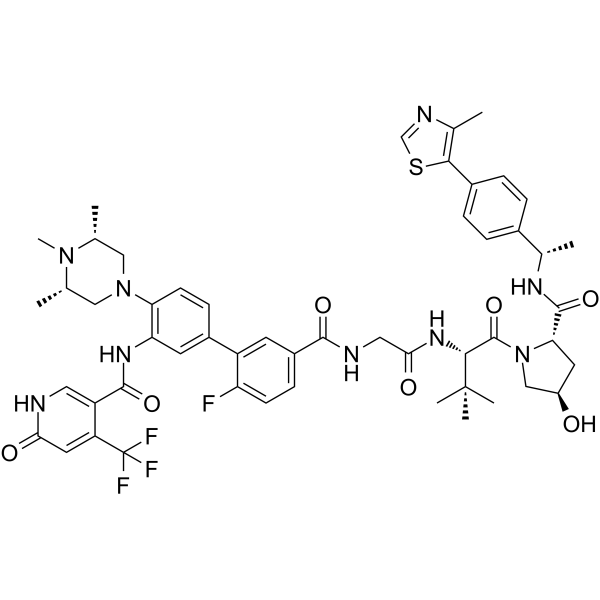
Physicochemical Properties
| Molecular Formula | C52H59F4N9O7S |
| Molecular Weight | 1030.14 |
| Exact Mass | 1029.419 |
| CAS # | 2407452-77-9 |
| PubChem CID | 153379992 |
| Appearance | White to off-white solid powder |
| LogP | 5.5 |
| Hydrogen Bond Donor Count | 6 |
| Hydrogen Bond Acceptor Count | 15 |
| Rotatable Bond Count | 14 |
| Heavy Atom Count | 73 |
| Complexity | 2090 |
| Defined Atom Stereocenter Count | 6 |
| SMILES | N(C1C=C(C2C(=CC=C(C(=O)NCC(=O)N[C@@H](C(C)(C)C)C(N3C[C@H](O)C[C@H]3C(=O)N[C@H](C3C=CC(C4SC=NC=4C)=CC=3)C)=O)C=2)F)C=CC=1N1C[C@H](C)N(C)[C@H](C)C1)C(C1=CNC(=O)C=C1C(F)(F)F)=O |
| InChi Key | HBHSDSLZXDASLT-FLKKWHKHSA-N |
| InChi Code | InChI=1S/C52H59F4N9O7S/c1-27-23-64(24-28(2)63(27)8)41-16-14-33(18-40(41)61-48(70)37-21-57-43(67)20-38(37)52(54,55)56)36-17-34(13-15-39(36)53)47(69)58-22-44(68)62-46(51(5,6)7)50(72)65-25-35(66)19-42(65)49(71)60-29(3)31-9-11-32(12-10-31)45-30(4)59-26-73-45/h9-18,20-21,26-29,35,42,46,66H,19,22-25H2,1-8H3,(H,57,67)(H,58,69)(H,60,71)(H,61,70)(H,62,68)/t27-,28+,29-,35+,42-,46+/m0/s1 |
| Chemical Name | N-[5-[2-fluoro-5-[[2-[[(2S)-1-[(2S,4R)-4-hydroxy-2-[[(1S)-1-[4-(4-methyl-1,3-thiazol-5-yl)phenyl]ethyl]carbamoyl]pyrrolidin-1-yl]-3,3-dimethyl-1-oxobutan-2-yl]amino]-2-oxoethyl]carbamoyl]phenyl]-2-[(3R,5S)-3,4,5-trimethylpiperazin-1-yl]phenyl]-6-oxo-4-(trifluoromethyl)-1H-pyridine-3-carboxamide |
| HS Tariff Code | 2934.99.9001 |
| Storage |
Powder-20°C 3 years 4°C 2 years In solvent -80°C 6 months -20°C 1 month Note: Please store this product in a sealed and protected environment, avoid exposure to moisture. |
| Shipping Condition | Room temperature (This product is stable at ambient temperature for a few days during ordinary shipping and time spent in Customs) |
Biological Activity
| ln Vitro | WDR5 degradation is induced by MS67 (0.001-1 μM) at a dose of 1 nM. In all six mixed lineage leukemia (MLL)-r acute myeloid leukemia (AML) and four pancreatic ductal adenocarcinoma (PDAC) cell lines, MS67 significantly more effectively induces WDR5 depletion without a hook effect and in a concentration-dependent manner in PDAC cells[1]. In MV4;11 and MIA PaCa-2 cells, MS67 reduces H3K4me2/3, but has no effect on other histone methylation marks that have been studied, including H3K9me3, H3K27me3, and H3K36me3. WDR5/MLL-induced H3K4 methylations on chromatin and WDR5-related gene expression programs are both effectively suppressed by MS67[1]. The two most sensitive AML lines, MV4;11 and EOL-1, have GI50 values of MS67 of 15 nM and 38 nM, respectively. Leukemia cell lines that did not harbor MLL-r (such as K562, HL60, and a murine AML line transformed by Hoxa9 plus Meis1) are insensitive to MS67, whereas MLL-r acute leukemia cell lines, such as MV4;11, EOL-1, MOLM13, KOPN8, RS4;11, and THP-1, are sensitive to it[1]... With a Kd of 140 nM, MS67 binds to the VHL-Elongin C-Elongin B ternary complex (VCB)[1]. |
| ln Vivo | MS67 (ip; twice daily, five days a week; 75 mg/kg) dramatically suppresses tumor growth in vivo and increases the length of time that treated mice survive[1]. Following a single 75 mg/kg intraperitoneal (ip) injection, the Cmax was approximately 4.2 μM, and the concentration of MS67 remained above 0.5 μM for a duration of 12 hours[1]. |
| Cell Assay |
Western Blot Analysis[1] Cell Types: MV4;11 cells Tested Concentrations: 0.001 μM, 0.005 μM, 0.01 μM, 0.05 μM, 0.1 μM, 0.5 μM, 1 μM Incubation Duration: 18 hrs (hours) Experimental Results: Induced WDR5 degradation at a concentration as low as 1 nM with DC50 of 3.7 nM. |
| Animal Protocol |
Animal/Disease Models: MV4;11 MLL-r AML xenograft mouse[1] Doses: 75 mg /kg Route of Administration: ip; twice (two times) daily; 5 days a week; for 20 days Experimental Results: Inhibited tumor growth in vivo. |
| References |
[1]. A selective WDR5 degrader inhibits acute myeloid leukemia in patient-derived mouse models. Sci Transl Med. 2021 Sep 29;13(613):eabj1578. |
Solubility Data
| Solubility (In Vitro) | DMSO : ~100 mg/mL (~97.07 mM) |
| Solubility (In Vivo) |
Note: Listed below are some common formulations that may be used to formulate products with low water solubility (e.g. < 1 mg/mL), you may test these formulations using a minute amount of products to avoid loss of samples. Injection Formulations (e.g. IP/IV/IM/SC) Injection Formulation 1: DMSO : Tween 80: Saline = 10 : 5 : 85 (i.e. 100 μL DMSO stock solution → 50 μL Tween 80 → 850 μL Saline) *Preparation of saline: Dissolve 0.9 g of sodium chloride in 100 mL ddH ₂ O to obtain a clear solution. Injection Formulation 2: DMSO : PEG300 :Tween 80 : Saline = 10 : 40 : 5 : 45 (i.e. 100 μL DMSO → 400 μLPEG300 → 50 μL Tween 80 → 450 μL Saline) Injection Formulation 3: DMSO : Corn oil = 10 : 90 (i.e. 100 μL DMSO → 900 μL Corn oil) Example: Take the Injection Formulation 3 (DMSO : Corn oil = 10 : 90) as an example, if 1 mL of 2.5 mg/mL working solution is to be prepared, you can take 100 μL 25 mg/mL DMSO stock solution and add to 900 μL corn oil, mix well to obtain a clear or suspension solution (2.5 mg/mL, ready for use in animals). Injection Formulation 4: DMSO : 20% SBE-β-CD in saline = 10 : 90 [i.e. 100 μL DMSO → 900 μL (20% SBE-β-CD in saline)] *Preparation of 20% SBE-β-CD in Saline (4°C,1 week): Dissolve 2 g SBE-β-CD in 10 mL saline to obtain a clear solution. Injection Formulation 5: 2-Hydroxypropyl-β-cyclodextrin : Saline = 50 : 50 (i.e. 500 μL 2-Hydroxypropyl-β-cyclodextrin → 500 μL Saline) Injection Formulation 6: DMSO : PEG300 : castor oil : Saline = 5 : 10 : 20 : 65 (i.e. 50 μL DMSO → 100 μLPEG300 → 200 μL castor oil → 650 μL Saline) Injection Formulation 7: Ethanol : Cremophor : Saline = 10: 10 : 80 (i.e. 100 μL Ethanol → 100 μL Cremophor → 800 μL Saline) Injection Formulation 8: Dissolve in Cremophor/Ethanol (50 : 50), then diluted by Saline Injection Formulation 9: EtOH : Corn oil = 10 : 90 (i.e. 100 μL EtOH → 900 μL Corn oil) Injection Formulation 10: EtOH : PEG300:Tween 80 : Saline = 10 : 40 : 5 : 45 (i.e. 100 μL EtOH → 400 μLPEG300 → 50 μL Tween 80 → 450 μL Saline) Oral Formulations Oral Formulation 1: Suspend in 0.5% CMC Na (carboxymethylcellulose sodium) Oral Formulation 2: Suspend in 0.5% Carboxymethyl cellulose Example: Take the Oral Formulation 1 (Suspend in 0.5% CMC Na) as an example, if 100 mL of 2.5 mg/mL working solution is to be prepared, you can first prepare 0.5% CMC Na solution by measuring 0.5 g CMC Na and dissolve it in 100 mL ddH2O to obtain a clear solution; then add 250 mg of the product to 100 mL 0.5% CMC Na solution, to make the suspension solution (2.5 mg/mL, ready for use in animals). Oral Formulation 3: Dissolved in PEG400 Oral Formulation 4: Suspend in 0.2% Carboxymethyl cellulose Oral Formulation 5: Dissolve in 0.25% Tween 80 and 0.5% Carboxymethyl cellulose Oral Formulation 6: Mixing with food powders Note: Please be aware that the above formulations are for reference only. InvivoChem strongly recommends customers to read literature methods/protocols carefully before determining which formulation you should use for in vivo studies, as different compounds have different solubility properties and have to be formulated differently. (Please use freshly prepared in vivo formulations for optimal results.) |
| Preparing Stock Solutions | 1 mg | 5 mg | 10 mg | |
| 1 mM | 0.9707 mL | 4.8537 mL | 9.7074 mL | |
| 5 mM | 0.1941 mL | 0.9707 mL | 1.9415 mL | |
| 10 mM | 0.0971 mL | 0.4854 mL | 0.9707 mL |