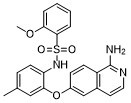
MRGPRX1 agonist 1 is a novel and highly potent agonist of MRGPRX1 (Mas-related G-protein-coupled receptor X1) (EC50 = 50 nM) with analgesic effects. MRGPRX1 is a receptor specific to human sensory neurons that is being actively studied as a potential therapeutic target for the management of pain..
Physicochemical Properties
| Molecular Formula | C23H21N3O4S |
| Molecular Weight | 435.495544195175 |
| Exact Mass | 435.13 |
| Elemental Analysis | C, 63.43; H, 4.86; N, 9.65; O, 14.69; S, 7.36 |
| CAS # | 2377379-39-8 |
| Related CAS # | 2377379-39-8 |
| PubChem CID | 139030531 |
| Appearance | White to yellow solid powder |
| LogP | 4.1 |
| Hydrogen Bond Donor Count | 2 |
| Hydrogen Bond Acceptor Count | 7 |
| Rotatable Bond Count | 6 |
| Heavy Atom Count | 31 |
| Complexity | 685 |
| Defined Atom Stereocenter Count | 0 |
| InChi Key | BWEJNHRMGZUMNU-UHFFFAOYSA-N |
| InChi Code | InChI=1S/C23H21N3O4S/c1-15-7-10-19(26-31(27,28)22-6-4-3-5-20(22)29-2)21(13-15)30-17-8-9-18-16(14-17)11-12-25-23(18)24/h3-14,26H,1-2H3,(H2,24,25) |
| Chemical Name | N-[2-(1-aminoisoquinolin-6-yl)oxy-4-methylphenyl]-2-methoxybenzenesulfonamide |
| Synonyms | BUN-79398; BUN 79398; BUN79398; MRGPRX1 agonist 1 |
| HS Tariff Code | 2934.99.9001 |
| Storage |
Powder-20°C 3 years 4°C 2 years In solvent -80°C 6 months -20°C 1 month |
| Shipping Condition | Room temperature (This product is stable at ambient temperature for a few days during ordinary shipping and time spent in Customs) |
Biological Activity
| Targets | MRGPRX1 ( EC50 = 50 nM ) |
| ln Vivo | Human homologue MRGPRX1 has gained increased interest as a promising therapeutic target partly owing to the analgesic effects of BAM8-22.A proteolytic product derived from proenkephalin A with full agonist activity at human MRGPRX1 and its closest rodent orthologues, mouse MRGPRC11 and rat MRGPRC. For example, intrathecal (spinal cord) injection of BAM8-22 was found to attenuate both mechanical and thermal hyperalgesia in mice4 and rats.We have also found that JHU-58 , an Arg-Phe-NH2 peptidomimetic with full agonist activity at mouse MRGPRC11 and rat MRGPRC,6 exhibits analgesic effects in rodent models of neuropathic pain.5 JHU-58, however, displayed negligible agonist activity at human MRGPRX1, hindering its ability to serve as a molecular template for further structural optimization efforts aimed at clinical translation. Human MRGPRX1 agonists 1 and 2 reported by GSK7 and ACADIA,8 respectively, may have a potential to be explored as new leads though their high molecular weight (>500) likely contributes to unfavorable CNS drug-like molecular properties and solubility. Indeed, compound 1 could not be tested in vitro at concentrations above 2 μM due to its limited solubility. |
| Cell Assay |
In Vitro MrgV1 receptor assay. HEK293 cells stably transfected with human MrgprX1 were plated in 96 well plates at 25,000 cell/well and incubated 2 days before imaging. On the day of imaging cells were incubated in 100 μL HBSS with 2 μM Fluo 4AM and 1% Trypan Red for 50 minutes at 37°C. The cells were then equilibrated for 10 minutes at room temperature before imaging. Test compounds were dissolved in HBSS and diluted in a serial dilution. Test compounds, BAM 8–22 (positive control) or HBSS (negative control) were added (50 μL into 100 μL) and cells were imaged on the FLIPR for 2 minutes. Data was exported as maximum – minimum fluorescent signal.[1] Whole-cell recordings of cultured DRG neurons. Whole cell currents of cultured DRG neurons from MrgprX1 mice with MrgprA3-GFP marker were recorded with an Axon 700B amplifier and pCLAMP 9.2 software. Extracellular solution contained (in mM) 130 N-methyl-D-glucamine chloride (NMDG-Cl), 5 BaCl2, 1 MgCl2, 10 HEPES, and 10 glucose, with pH of 7.4 adjusted with 1 M NMDG. Osmolality was adjusted to 310 mOsm/kg with sucrose. Electrodes were pulled from borosilicate glass with resistances of 2–4 MΩ. Pipette solution contained (in mM) 140 tetraethylammonium chloride, 10 EGTA, 1 MgCl2, 10 HEPES, 0.5 GTP, and 3 ATP, with pH of 7.4 and osmolality of approximately 300 mOsm/kg. The voltage protocol was modified from a previously published method.3 Briefly, cells were held at −80 mV and evoked to −40 mV for 20 milliseconds (ms) to activate low-voltage Ca2+ channels, and then held to −60 mV for 20 ms and evoked to −10 mV for 40 ms to activate HVA Ca2+ channels. Leak currents were subtracted with P/4 protocol. Liquid junction potentials and whole cell capacitances were offset, and series resistances were compensated by 70%. All experiments were performed at room temperature (21–23°C).[1] |
| Animal Protocol |
DRG sensory neuronal cultures. DRGs from 3–4-week-old MrgprX1 mice were collected in cold DH10 medium (DMEM/F-12 with 10% fetal bovine serum and 1% penicillin/streptomycin, Gibco) and treated with enzyme solution (5 mg/mL dispase and 1 mg/mL collagenase Type I in HBSS without Ca2+ and Mg2+, Gibco) at 37°C. After trituration and centrifugation, cells were re-suspended in DH10 with nerve growth factor (50 ng/mL, Upstate Biotechnology, Lake Placid, NY) and glial cell line-derived neurotrophic factor (25 ng/mL, R&D Systems), plated on glass coverslips coated with poly-D-lysine (100 μg/mL, Biomedical Technologies) and laminin (10 μg/mL, Invitrogen), cultured at 37°C, and used after 20–40 hours.[1] |
| References |
[1]. Discovery of Benzamidine- and 1-Aminoisoquinoline-Based Human MAS-Related G-Protein-Coupled Receptor X1 (MRGPRX1) Agonists. J Med Chem. 2019 Sep 26;62(18):8631-8641. |
Solubility Data
| Solubility (In Vitro) | DMSO: ~125 mg/mL (~287.0 mM) |
| Solubility (In Vivo) |
Solubility in Formulation 1: ≥ 2.08 mg/mL (4.78 mM) (saturation unknown) in 10% DMSO + 40% PEG300 + 5% Tween80 + 45% Saline (add these co-solvents sequentially from left to right, and one by one), clear solution. For example, if 1 mL of working solution is to be prepared, you can add 100 μL of 20.8 mg/mL clear DMSO stock solution to 400 μL PEG300 and mix evenly; then add 50 μL Tween-80 to the above solution and mix evenly; then add 450 μL normal saline to adjust the volume to 1 mL. Preparation of saline: Dissolve 0.9 g of sodium chloride in 100 mL ddH₂ O to obtain a clear solution. Solubility in Formulation 2: ≥ 2.08 mg/mL (4.78 mM) (saturation unknown) in 10% DMSO + 90% (20% SBE-β-CD in Saline) (add these co-solvents sequentially from left to right, and one by one), clear solution. For example, if 1 mL of working solution is to be prepared, you can add 100 μL of 20.8 mg/mL clear DMSO stock solution to 900 μL of 20% SBE-β-CD physiological saline solution and mix evenly. Preparation of 20% SBE-β-CD in Saline (4°C,1 week): Dissolve 2 g SBE-β-CD in 10 mL saline to obtain a clear solution. Solubility in Formulation 3: ≥ 2.08 mg/mL (4.78 mM) (saturation unknown) in 10% DMSO + 90% Corn Oil (add these co-solvents sequentially from left to right, and one by one), clear solution. For example, if 1 mL of working solution is to be prepared, you can add 100 μL of 20.8 mg/mL clear DMSO stock solution to 900 μL of corn oil and mix evenly. (Please use freshly prepared in vivo formulations for optimal results.) |
| Preparing Stock Solutions | 1 mg | 5 mg | 10 mg | |
| 1 mM | 2.2962 mL | 11.4811 mL | 22.9621 mL | |
| 5 mM | 0.4592 mL | 2.2962 mL | 4.5924 mL | |
| 10 mM | 0.2296 mL | 1.1481 mL | 2.2962 mL |