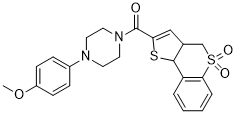
ML349 (ML-349) is a novel, potent, reversible, highly selective and specific acyl protein thioesterase 2 (APT-2) inhibitor with a Ki of 120 nM. ML349 is also an inhibitor of LYPLA2 with an IC50 of 144 nM. Although ML349 is highly selective within the serine hydrolase enzyme family, it could still interact with other cellular targets. In human cell lysates, biotinylated-ML349 enriches a recurring set of proteins, including metabolite kinases and flavin-dependent oxidoreductases that are potentially enhanced by avidity-driven multimeric interactions. ML349 achieves target engagement and hydrolase selectivity in living mice.
Physicochemical Properties
| Molecular Formula | C23H22N2O4S2 |
| Molecular Weight | 454.561783313751 |
| Exact Mass | 454.102 |
| CAS # | 890819-86-0 |
| PubChem CID | 16193817 |
| Appearance | White to yellow solid powder |
| LogP | 3.4 |
| Hydrogen Bond Donor Count | 0 |
| Hydrogen Bond Acceptor Count | 6 |
| Rotatable Bond Count | 3 |
| Heavy Atom Count | 31 |
| Complexity | 754 |
| Defined Atom Stereocenter Count | 0 |
| SMILES | C1(=CC2=C(C3=CC=CC=C3S(=O)(C2)=O)S1)C(N1CCN(C2C=CC(=CC=2)OC)CC1)=O |
| InChi Key | JIFSCAIWCCQTRF-UHFFFAOYSA-N |
| InChi Code | InChI=1S/C23H24N2O4S2/c1-29-18-8-6-17(7-9-18)24-10-12-25(13-11-24)23(26)20-14-16-15-31(27,28)21-5-3-2-4-19(21)22(16)30-20/h2-9,14,16,22H,10-13,15H2,1H3 |
| Chemical Name | (5,5-dioxido-3a,9b-dihydro-4H-thieno[3,2-c]thiochromen-2-yl)(4-(4-methoxyphenyl)piperazin-1-yl)methanone |
| Synonyms | ML-349; ML349; ML 349. |
| HS Tariff Code | 2934.99.9001 |
| Storage |
Powder-20°C 3 years 4°C 2 years In solvent -80°C 6 months -20°C 1 month |
| Shipping Condition | Room temperature (This product is stable at ambient temperature for a few days during ordinary shipping and time spent in Customs) |
Biological Activity
| Targets |
Ki: 120 nM (APT-2)[1] IC50: 144 nM (LYPLA2)[2] ML349 inhibits acyl protein thioesterase 1 and 2 (APT-1 and APT-2) with a Kis of >10000 and 120±20 nM, in that order[1]. Additionally, ML349 inhibits LYPLA1 and LYPLA2, with IC50 values of > 3000 and 144 nM, respectively[2]. ML348 and ML349 cause a slight activation of AKT in NRAS mutant cells, but they do not reduce cell viability[3]. |
| ln Vitro | ML349 inhibits acyl protein thioesterase 1 and 2 (APT-1 and APT-2) with a Kis of >10000 and 120±20 nM, in that order[1]. Additionally, ML349 inhibits LYPLA1 and LYPLA2, with IC50 values of > 3000 and 144 nM, respectively[2]. ML348 and ML349 cause a slight activation of AKT in NRAS mutant cells, but they do not reduce cell viability[3]. |
| Enzyme Assay |
Steady-state kinetic assays were performed to determine inhibition constants (Ki). The fluorogenic substrate resorufin acetate (ResOAc) was used. Reactions were conducted in assay buffer, and hydrolysis was monitored by measuring the increase in fluorescence (excitation/emission) over time. Initial velocities were determined, and data were fit to appropriate inhibition models to calculate Ki values for ML349 and its analogs against wild-type and mutant APT2 enzymes [1]. Fluorescence polarization assays were conducted to measure direct binding of the ML349-FL conjugate to APT2. Increasing concentrations of APT2 were incubated with a fixed concentration of ML349-FL. Polarization values were measured, and data were fit to a binding isotherm to determine the dissociation constant (Kd). Competition experiments were performed by pre-incubating APT2 with unlabeled inhibitors (e.g., ML349, HDFP, or analogs) before adding ML349-FL to assess displacement [1]. Acyl-binding assays utilized the environmentally sensitive fluorophore BODIPY-FL-C16. A sub-micellar concentration of BODIPY-FL-C16 was incubated with increasing concentrations of APT1 or APT2. The increase in fluorescence intensity upon binding to the hydrophobic pocket was monitored. Saturation curves were generated to determine the Kd for lipid binding. For competition, enzymes were pre-incubated with inhibitors like ML349 before adding BODIPY-FL-C16 [1] |
| Cell Assay |
Cells are plated in 96-well plates with a density of 4000 to 8000 cells per well and incubated for 24 h at 37°C with 5% CO2. Then cells are treated with increasing drug (including ML349) concentrations and their combinations. Cell viability is measured with the cell viability assay according to the manufacturers protocol.
|
| References |
[1]. Molecular Mechanism for Isoform-Selective Inhibition of Acyl Protein Thioesterases 1 and 2 (APT1 and APT2). ACS Chem Biol. 2016 Dec 16;11(12):3374-3382. [2]. Characterization of a Selective, Reversible Inhibitor of Lysophospholipase 2 (LYPLA2). [3]. Acyl protein thioesterase 1 and 2 (APT-1, APT-2) inhibitors palmostatin B, ML348 and ML349 have different effects on NRAS mutant melanoma cells. Oncotarget. 2016 Feb 9;7(6):7297-306. |
| Additional Infomation |
ML349 is a piperazine amide-based inhibitor incorporating a thiochromene sulfone heterocycle [1]. Its molecular mechanism involves occupying a hydrophobic acyl-binding channel adjacent to the catalytic triad (Ser122, His210, Asp176) in APT2, thereby blocking substrate access [1]. Unlike classical transition-state analogs, the sulfonyl group of ML349 does not directly coordinate catalytic residues but instead forms a network of indirect, water-mediated hydrogen bonds with the oxyanion hole (backbone amides of Gln123 and Leu33) and the catalytic histidine (His210) [1]. Inhibitor selectivity is governed by specific residues in the β5-α2 loop (e.g., Leu78, Ala85, Pro86 in APT2) and the G3 helix (e.g., His152, Arg153) of APT2, which create a distinct binding environment compared to APT1. Reciprocal mutagenesis of these residues can swap inhibitor selectivity between the two isoforms [1]. The structure of the APT2-ML349 complex was solved by X-ray crystallography at 1.64 Å resolution (PDB code: 5SYN) [1]. |
Solubility Data
| Solubility (In Vitro) |
DMSO : ~20 mg/mL (~44.00 mM) H2O : < 0.1 mg/mL |
| Solubility (In Vivo) |
Solubility in Formulation 1: 2 mg/mL (4.40 mM) in 10% DMSO + 40% PEG300 +5% Tween-80 + 45% Saline (add these co-solvents sequentially from left to right, and one by one), suspension solution; with sonication. For example, if 1 mL of working solution is to be prepared, you can add 100 μL of 20.0 mg/mL clear DMSO stock solution to 400 μL PEG300 and mix evenly; then add 50 μL Tween-80 + to the above solution and mix evenly; then add 450 μL normal saline to adjust the volume to 1 mL. Preparation of saline: Dissolve 0.9 g of sodium chloride in 100 mL ddH₂ O to obtain a clear solution. (Please use freshly prepared in vivo formulations for optimal results.) |
| Preparing Stock Solutions | 1 mg | 5 mg | 10 mg | |
| 1 mM | 2.1999 mL | 10.9996 mL | 21.9993 mL | |
| 5 mM | 0.4400 mL | 2.1999 mL | 4.3999 mL | |
| 10 mM | 0.2200 mL | 1.1000 mL | 2.1999 mL |