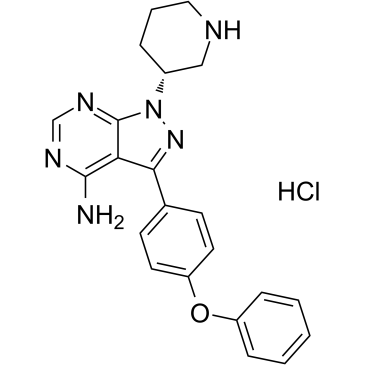
Btk inhibitor 1 R-enantiomer hydrochloride (IBT6A hydrochloride), the R-isomer and hydrochloride salt form of Btk inhibitor 1, is a novel and potent Bruton's tyrosine kinase (BTK) inhibitor with potential antitumor activity.
Physicochemical Properties
| Molecular Formula | C22H23CLN6O |
| Molecular Weight | 422.9106 |
| Exact Mass | 422.162 |
| CAS # | 1553977-42-6 |
| Related CAS # | (Rac)-IBT6A;1412418-47-3;IBT6A;1022150-12-4;(Rac)-IBT6A hydrochloride;1807619-60-8 |
| PubChem CID | 78357770 |
| Appearance | White to off-white solid |
| LogP | 5.504 |
| Hydrogen Bond Donor Count | 3 |
| Hydrogen Bond Acceptor Count | 6 |
| Rotatable Bond Count | 4 |
| Heavy Atom Count | 30 |
| Complexity | 521 |
| Defined Atom Stereocenter Count | 1 |
| SMILES | Cl[H].O(C1C([H])=C([H])C([H])=C([H])C=1[H])C1C([H])=C([H])C(=C([H])C=1[H])C1C2=C(N([H])[H])N=C([H])N=C2N([C@@]2([H])C([H])([H])N([H])C([H])([H])C([H])([H])C2([H])[H])N=1 |
| InChi Key | ATLAMSZMAHXMSQ-PKLMIRHRSA-N |
| InChi Code | InChI=1S/C22H22N6O.ClH/c23-21-19-20(15-8-10-18(11-9-15)29-17-6-2-1-3-7-17)27-28(22(19)26-14-25-21)16-5-4-12-24-13-16;/h1-3,6-11,14,16,24H,4-5,12-13H2,(H2,23,25,26);1H/t16-;/m1./s1 |
| Chemical Name | 3-(4-phenoxyphenyl)-1-[(3R)-piperidin-3-yl]pyrazolo[3,4-d]pyrimidin-4-amine;hydrochloride |
| Synonyms | 1553977-42-6; Btk inhibitor 1 (R enantiomer hydrochloride); IBT6A (hydrochloride); IBT6A hydrochloride; Btk inhibitor 1 R enantiomer hydrochloride; Btk Inhibitor 1 R-Enantiomer Hydrochloride; (R)-3-(4-Phenoxyphenyl)-1-(piperidin-3-yl)-1H-pyrazolo[3,4-d]pyrimidin-4-amine hydrochloride; 3-(4-phenoxyphenyl)-1-[(3R)-piperidin-3-yl]pyrazolo[3,4-d]pyrimidin-4-amine;hydrochloride; |
| HS Tariff Code | 2934.99.9001 |
| Storage |
Powder-20°C 3 years 4°C 2 years In solvent -80°C 6 months -20°C 1 month Note: Please store this product in a sealed and protected environment, avoid exposure to moisture. |
| Shipping Condition | Room temperature (This product is stable at ambient temperature for a few days during ordinary shipping and time spent in Customs) |
Biological Activity
| Targets | BTK |
| ln Vitro | Btk inhibitor 1 R enantiomer hydrochloride can be utilized to create activity-based probes (ABPs) based on itrutinib and itrutinib itself [3]. |
| References |
[1]. A QUALITY BY DESIGN APPROACH FOR DEVELOPMENT OF SIMPLE AND ROBUST REVERSED PHASE STABILITY INDICATING HPLC METHOD FOR ESTIMATION OF IBRUTINIB AND ITS IMPURITIES. [2]. The Bruton tyrosine kinase inhibitor PCI-32765 blocks B-cell activation and is efficacious in models of autoimmune disease and B-cell malignancy. Proc Natl Acad Sci U S A. 2010 Jul 20;107(29):13075-80. [3]. Direct and two-step bioorthogonal probes for Bruton's tyrosine kinase based on ibrutinib: a comparative study. Org Biomol Chem. 2015 May 14;13(18):5147-57. |
| Additional Infomation |
Activation of the B-cell antigen receptor (BCR) signaling pathway contributes to the initiation and maintenance of B-cell malignancies and autoimmune diseases. The Bruton tyrosine kinase (Btk) is specifically required for BCR signaling as demonstrated by human and mouse mutations that disrupt Btk function and prevent B-cell maturation at steps that require a functional BCR pathway. Herein we describe a selective and irreversible Btk inhibitor, PCI-32765, that is currently under clinical development in patients with B-cell non-Hodgkin lymphoma. We have used this inhibitor to investigate the biologic effects of Btk inhibition on mature B-cell function and the progression of B cell-associated diseases in vivo. PCI-32765 blocked BCR signaling in human peripheral B cells at concentrations that did not affect T cell receptor signaling. In mice with collagen-induced arthritis, orally administered PCI-32765 reduced the level of circulating autoantibodies and completely suppressed disease. PCI-32765 also inhibited autoantibody production and the development of kidney disease in the MRL-Fas(lpr) lupus model. Occupancy of the Btk active site by PCI-32765 was monitored in vitro and in vivo using a fluorescent affinity probe for Btk. Active site occupancy of Btk was tightly correlated with the blockade of BCR signaling and in vivo efficacy. Finally, PCI-32765 induced objective clinical responses in dogs with spontaneous B-cell non-Hodgkin lymphoma. These findings support Btk inhibition as a therapeutic approach for the treatment of human diseases associated with activation of the BCR pathway.[2] Ibrutinib is a covalent and irreversible inhibitor of Bruton's tyrosine kinase (BTK) and has been approved for the treatment of haematological malignancies, such as chronic lymphocytic leukaemia, mantle cell lymphoma and Waldenström's macroglobulinemia. The covalent and irreversible nature of its molecular mode of action allows identification and monitoring of its target in an activity-based protein profiling (ABPP) setting. Fluorescent and biotinylated ibrutinib derivatives have appeared in the literature in recent years to monitor BTK in vitro and in situ. The work described here complements this existing methodology and pertains a comparative study on the efficacy of direct and two-step bioorthogonal ABPP of BTK. [3] |
Solubility Data
| Solubility (In Vitro) | DMSO: ~100 mg/mL (~236.5 mM) |
| Solubility (In Vivo) |
Solubility in Formulation 1: ≥ 2.5 mg/mL (5.91 mM) (saturation unknown) in 10% DMSO + 40% PEG300 + 5% Tween80 + 45% Saline (add these co-solvents sequentially from left to right, and one by one), clear solution. For example, if 1 mL of working solution is to be prepared, you can add 100 μL of 25.0 mg/mL clear DMSO stock solution to 400 μL PEG300 and mix evenly; then add 50 μL Tween-80 to the above solution and mix evenly; then add 450 μL normal saline to adjust the volume to 1 mL. Preparation of saline: Dissolve 0.9 g of sodium chloride in 100 mL ddH₂ O to obtain a clear solution. Solubility in Formulation 2: ≥ 2.5 mg/mL (5.91 mM) (saturation unknown) in 10% DMSO + 90% (20% SBE-β-CD in Saline) (add these co-solvents sequentially from left to right, and one by one), clear solution. For example, if 1 mL of working solution is to be prepared, you can add 100 μL of 25.0 mg/mL clear DMSO stock solution to 900 μL of 20% SBE-β-CD physiological saline solution and mix evenly. Preparation of 20% SBE-β-CD in Saline (4°C,1 week): Dissolve 2 g SBE-β-CD in 10 mL saline to obtain a clear solution. Solubility in Formulation 3: ≥ 2.5 mg/mL (5.91 mM) (saturation unknown) in 10% DMSO + 90% Corn Oil (add these co-solvents sequentially from left to right, and one by one), clear solution. For example, if 1 mL of working solution is to be prepared, you can add 100 μL of 25.0 mg/mL clear DMSO stock solution to 900 μL of corn oil and mix evenly. (Please use freshly prepared in vivo formulations for optimal results.) |
| Preparing Stock Solutions | 1 mg | 5 mg | 10 mg | |
| 1 mM | 2.3646 mL | 11.8228 mL | 23.6457 mL | |
| 5 mM | 0.4729 mL | 2.3646 mL | 4.7291 mL | |
| 10 mM | 0.2365 mL | 1.1823 mL | 2.3646 mL |