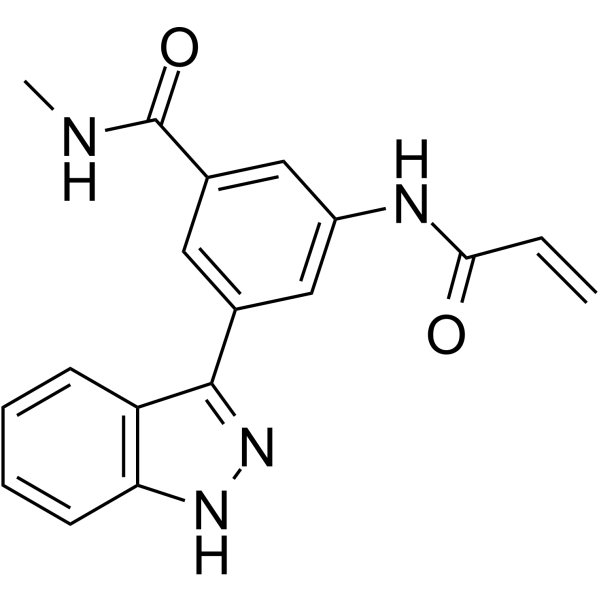
Physicochemical Properties
| Molecular Formula | C18H16N4O2 |
| Exact Mass | 320.127 |
| CAS # | 2283355-59-7 |
| Related CAS # | 2283355-59-7 |
| PubChem CID | 137796287 |
| Appearance | Off-white to gray solid |
| LogP | 2.3 |
| Hydrogen Bond Donor Count | 3 |
| Hydrogen Bond Acceptor Count | 3 |
| Rotatable Bond Count | 4 |
| Heavy Atom Count | 24 |
| Complexity | 495 |
| Defined Atom Stereocenter Count | 0 |
| InChi Key | OIVBYXJDKPKZFE-UHFFFAOYSA-N |
| InChi Code | InChI=1S/C18H16N4O2/c1-3-16(23)20-13-9-11(8-12(10-13)18(24)19-2)17-14-6-4-5-7-15(14)21-22-17/h3-10H,1H2,2H3,(H,19,24)(H,20,23)(H,21,22) |
| Chemical Name | 3-(1H-indazol-3-yl)-N-methyl-5-(prop-2-enoylamino)benzamide |
| Synonyms | MKK7-COV-9 |
| HS Tariff Code | 2934.99.9001 |
| Storage |
Powder-20°C 3 years 4°C 2 years In solvent -80°C 6 months -20°C 1 month |
| Shipping Condition | Room temperature (This product is stable at ambient temperature for a few days during ordinary shipping and time spent in Customs) |
Biological Activity
| Targets | p38 MAP kinase |
| ln Vitro |
The piperidine analogs MKK7-COV-10 and MKK7-COV-11, as well as the carboxylic acid MKK7-COV-8, demonstrate poor permeability and inactivity in ICW in 3T3 cells. As an amide counterpart, MKK7-COV-9, in contrast, keeps its activity (EC50=4.06 μM) and additionally offers a new vector for further derivatization[1]. MKK7-COV-9 (10 μM; 48 hours) only exhibits a minimally cytotoxic effect at the highest tested concentration. For these two substances, only one cell line, HCT116, showed a half-maximal lethal dose (LD50)<10 μM[1]. Except for the negative control MKK7-NEG-1, MKK7-COV-9 (10 μM; 2 hr pre-incubation) is able to inhibit 60% of the CD86+ response to LPS stimulation in primary mouse B cells. In response to lipopolysaccharide , JNK is known to mediate B cell activation via the TLR4 signaling pathway. Through the TLR4 signaling pathway, MKK7-COV-9 (0–10 M; 2 hr pre-incubation) is able to mediate the activation of B cells in response to LPS; it displays dose-response curves for inhibiting LPS-induced activation and exhibits an EC50 value of μM.(EC50=4.98 μM for MKK7-COV-12; EC50>10 μM for MKK7-COV-7; EC50=2.23 μM for JNK-IN-8)[1]. |
| References |
[1]. Covalent Docking Identifies a Potent and Selective MKK7 Inhibitor. Cell Chem Biol. 2019 Jan 17;26(1):98-108.e5. |
Solubility Data
| Solubility (In Vitro) | DMSO: ~50 mg/mL (~156.1 mM) |
| Solubility (In Vivo) |
Solubility in Formulation 1: ≥ 2.5 mg/mL (7.80 mM) (saturation unknown) in 10% DMSO + 40% PEG300 + 5% Tween80 + 45% Saline (add these co-solvents sequentially from left to right, and one by one), clear solution. For example, if 1 mL of working solution is to be prepared, you can add 100 μL of 25.0 mg/mL clear DMSO stock solution to 400 μL PEG300 and mix evenly; then add 50 μL Tween-80 to the above solution and mix evenly; then add 450 μL normal saline to adjust the volume to 1 mL. Preparation of saline: Dissolve 0.9 g of sodium chloride in 100 mL ddH₂ O to obtain a clear solution. Solubility in Formulation 2: ≥ 2.5 mg/mL (7.80 mM) (saturation unknown) in 10% DMSO + 90% (20% SBE-β-CD in Saline) (add these co-solvents sequentially from left to right, and one by one), clear solution. For example, if 1 mL of working solution is to be prepared, you can add 100 μL of 25.0 mg/mL clear DMSO stock solution to 900 μL of 20% SBE-β-CD physiological saline solution and mix evenly. Preparation of 20% SBE-β-CD in Saline (4°C,1 week): Dissolve 2 g SBE-β-CD in 10 mL saline to obtain a clear solution. Solubility in Formulation 3: ≥ 2.5 mg/mL (7.80 mM) (saturation unknown) in 10% DMSO + 90% Corn Oil (add these co-solvents sequentially from left to right, and one by one), clear solution. For example, if 1 mL of working solution is to be prepared, you can add 100 μL of 25.0 mg/mL clear DMSO stock solution to 900 μL of corn oil and mix evenly. (Please use freshly prepared in vivo formulations for optimal results.) |