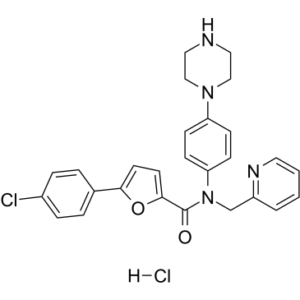
MK2-IN-1 HCl is a novel, potent, non-ATP competitive and selecitve MAPKAPK2(MK2) inhibitor(IC50=0.11 uM). By screening against a large panel of 150 protein kinases at a concentration of 10 μM, MK2-IN-1 was profiled for kinase selectivity, and only CK1γ3 was significantly inhibited at levels higher than 50%. The human THP1 acute monocytic leukemia cell line secreted pro-inflammatory cytokines less frequently as a result of MK2-IN-1, which led to a dose-dependent reduction in TNFα and IL6 production. The secretion of matrixmetalloprotease (MMP)13 from the SW1353 chondrosarcoma cell line and primary human chondrocyte cultures was also inhibited by MK2-IN-1 in a dose-dependent manner. Notably, given its high level of selectivity, our data imply that MK2-IN-1 may be an excellent pharmacologic tool for specifically exploring and validating MK2 biology.
Physicochemical Properties
| Molecular Formula | C27H26CL2N4O2 |
| Molecular Weight | 509.43 |
| Exact Mass | 508.143 |
| CAS # | 1314118-94-9 |
| Related CAS # | MK2-IN-1;1314118-92-7 |
| PubChem CID | 70681199 |
| Appearance | Light yellow to pink solid |
| LogP | 6.447 |
| Hydrogen Bond Donor Count | 2 |
| Hydrogen Bond Acceptor Count | 5 |
| Rotatable Bond Count | 6 |
| Heavy Atom Count | 35 |
| Complexity | 645 |
| Defined Atom Stereocenter Count | 0 |
| SMILES | ClC1C=CC(=CC=1)C1=CC=C(C(N(CC2C=CC=CN=2)C2C=CC(=CC=2)N2CCNCC2)=O)O1.Cl |
| InChi Key | AZDOSXSDARWKGX-UHFFFAOYSA-N |
| InChi Code | InChI=1S/C27H25ClN4O2.ClH/c28-21-6-4-20(5-7-21)25-12-13-26(34-25)27(33)32(19-22-3-1-2-14-30-22)24-10-8-23(9-11-24)31-17-15-29-16-18-31;/h1-14,29H,15-19H2;1H |
| Chemical Name | 5-(4-chlorophenyl)-N-(4-piperazin-1-ylphenyl)-N-(pyridin-2-ylmethyl)furan-2-carboxamide;hydrochloride |
| Synonyms | MK2-IN-1; MK2-IN 1; MK2 IN-1; MK25; MK-25; MK 25; MK2 Inhibitor IV; MK2 Inhibitor-IV |
| HS Tariff Code | 2934.99.9001 |
| Storage |
Powder-20°C 3 years 4°C 2 years In solvent -80°C 6 months -20°C 1 month Note: Please store this product in a sealed and protected environment (e.g. under nitrogen), avoid exposure to moisture. |
| Shipping Condition | Room temperature (This product is stable at ambient temperature for a few days during ordinary shipping and time spent in Customs) |
Biological Activity
| Targets | MK2 (IC50 = 0.11 μM) |
| ln Vitro |
Addition of the MK2 inhibitor MK2-IN-1 induced more alkaline phosphatase (AP)-positive colonies than the other factors in a short time , implying that MK2 may be responsible for the phosphorylation of Tfcp2l1.[2] 46C mESCs were treated with MK2-IN-1 for a period of time. The Tfcp2l1 protein level gradually increased without a change in the Tfcp2l1 transcript level within 2 h .[2] |
| References |
[1]. Facile synthesis of tetracyclic azepine and oxazocine derivatives and their potential as MAPKAP-K2 (MK2) inhibitors. Bioorg Med Chem Lett. 2012 Jan 15;22(2):1068-72. p>[2]. MK2 promotes Tfcp2l1 degradation via β-TrCP ubiquitin ligase to regulate mouse embryonic stem cell self-renewal. Cell Rep. 2021 Nov 2;37(5):109949.[3]. A three-step protocol for lead optimization: quick identification of key conformational features and functional groups in the SAR studies of non-ATP competitive MK2 (MAPKAPK2) inhibitors. Bioorg Med Chem Lett. 2012 Jan 1;22(1):65-70. [4]. Discovery and Hit-to-Lead Optimization of Non-ATP Competitive MK2 (MAPKAPK2) Inhibitors. ACS Med Chem Lett. 2011 Jun 24;2(8):632-7. |
Solubility Data
| Solubility (In Vitro) |
DMSO: ~100 mg/mL (~196.3 mM) Ethanol: ~2 mg/mL (~3.9 mM) |
| Solubility (In Vivo) |
Solubility in Formulation 1: ≥ 1.67 mg/mL (3.28 mM) (saturation unknown) in 10% DMSO + 40% PEG300 + 5% Tween80 + 45% Saline (add these co-solvents sequentially from left to right, and one by one), clear solution. For example, if 1 mL of working solution is to be prepared, you can add 100 μL of 16.7 mg/mL clear DMSO stock solution to 400 μL PEG300 and mix evenly; then add 50 μL Tween-80 to the above solution and mix evenly; then add 450 μL normal saline to adjust the volume to 1 mL. Preparation of saline: Dissolve 0.9 g of sodium chloride in 100 mL ddH₂ O to obtain a clear solution. Solubility in Formulation 2: ≥ 1.67 mg/mL (3.28 mM) (saturation unknown) in 10% DMSO + 90% (20% SBE-β-CD in Saline) (add these co-solvents sequentially from left to right, and one by one), clear solution. For example, if 1 mL of working solution is to be prepared, you can add 100 μL of 16.7 mg/mL clear DMSO stock solution to 900 μL of 20% SBE-β-CD physiological saline solution and mix evenly. Preparation of 20% SBE-β-CD in Saline (4°C,1 week): Dissolve 2 g SBE-β-CD in 10 mL saline to obtain a clear solution. Solubility in Formulation 3: ≥ 1.67 mg/mL (3.28 mM) (saturation unknown) in 10% DMSO + 90% Corn Oil (add these co-solvents sequentially from left to right, and one by one), clear solution. For example, if 1 mL of working solution is to be prepared, you can add 100 μL of 16.7 mg/mL clear DMSO stock solution to 900 μL of corn oil and mix evenly. (Please use freshly prepared in vivo formulations for optimal results.) |
| Preparing Stock Solutions | 1 mg | 5 mg | 10 mg | |
| 1 mM | 1.9630 mL | 9.8149 mL | 19.6298 mL | |
| 5 mM | 0.3926 mL | 1.9630 mL | 3.9260 mL | |
| 10 mM | 0.1963 mL | 0.9815 mL | 1.9630 mL |