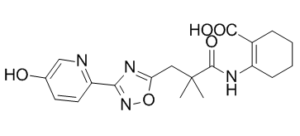
MK-6892 (MK6892) is a novel, potent and selective full agonist for GPR109A, which is a high affinity nicotinic acid receptor. GPR109A is activated with Ki and GTPγS EC50 values of 4 nM and 16 nM on Human GPR109A, respectively. Biaryl cyclohexene carboxylic acids were discovered as full and potent niacin receptor (GPR109A) agonists. In rats and dogs, MK-6892 showed superior therapeutic window over niacin with respect to FFA reduction versus vasodilation, along with good ancillary pharmacology, good PK across species, and exceptionally clean off-target profiles.
Physicochemical Properties
| Molecular Formula | C19H22N4O5 |
| Molecular Weight | 386.408 |
| Exact Mass | 386.159 |
| Elemental Analysis | C, 59.06; H, 5.74; N, 14.50; O, 20.70 |
| CAS # | 917910-45-3 |
| PubChem CID | 135416394 |
| Appearance | White to off-white solid powder |
| LogP | 3.275 |
| Hydrogen Bond Donor Count | 3 |
| Hydrogen Bond Acceptor Count | 8 |
| Rotatable Bond Count | 6 |
| Heavy Atom Count | 28 |
| Complexity | 636 |
| Defined Atom Stereocenter Count | 0 |
| SMILES | O=C(C1CCCCC=1NC(C(CC1ON=C(C2C=CC(O)=CN=2)N=1)(C)C)=O)O |
| InChi Key | CJHXBFSJXDUJHP-UHFFFAOYSA-N |
| InChi Code | InChI=1S/C19H22N4O5/c1-19(2,18(27)21-13-6-4-3-5-12(13)17(25)26)9-15-22-16(23-28-15)14-8-7-11(24)10-20-14/h7-8,10,24H,3-6,9H2,1-2H3,(H,21,27)(H,25,26) |
| Chemical Name | 2-[[3-[3-(5-hydroxypyridin-2-yl)-1,2,4-oxadiazol-5-yl]-2,2-dimethylpropanoyl]amino]cyclohexene-1-carboxylic acid |
| Synonyms | MK-6892; MK 6892; MK6892 |
| HS Tariff Code | 2934.99.9001 |
| Storage |
Powder-20°C 3 years 4°C 2 years In solvent -80°C 6 months -20°C 1 month |
| Shipping Condition | Room temperature (This product is stable at ambient temperature for a few days during ordinary shipping and time spent in Customs) |
Biological Activity
| Targets | GPR109A ( Ki = 4 nM ); GPR109A ( EC50 = 16 nM ) |
| ln Vitro | MK-6892 stimulates GPR109A to internalize powerfully in U2OS β-arrestin2-RrGFP cells.In the calcium mobilization assay, MK-6892 exhibits an EC50 value of 74 nM[2]. |
| ln Vivo | MK-6892 is given orally to mice bearing the same genetic background (C57Bl/6) that are WT or nicotinic acid (NA) receptor null. The blood levels of MK-6892 at 15 minutes are 229 μM (~950-fold greater than the in vitro EC50 determined in mouse NA receptor GTPγS assay, which is 240 nM) in WT mice and 148 μM (~620-fold greater than the in vitro EC50) in NA receptor null mice. This is after feeding WT or NA receptor null mice 100 mg/kg of MK-6892 for 15 minutes. MK-6892 efficiently reduces plasma FFA in WT animals but not in NA receptor null animals, suggesting that MK-6892's FFA reduction is dependent on NA receptors. MK-6892 has been chosen for the research due to its favorable PK and activity profiles in these two species (EC50= 1.3 μM for the dog NA receptor and 4.6 μM for the rat NA receptor in the GTPηS assay). Although MK-6892 exhibits significantly less activity in rat and dog models compared to human models, it still demonstrates good activity in reducing FFA in these models[1]. |
| References |
[1]. Discovery of a biaryl cyclohexene carboxylic acid (MK-6892): a potent and selective high affinity niacin receptor full agonist with reduced flushing profiles in animals as a preclinical candidate. J Med Chem. 2010 Mar 25;53(6):2666-70. [2]. Discovery of 4-(phenyl)thio-1H-pyrazole derivatives as agonists of GPR109A, a high affinity niacin receptor. Arch Pharm Res. 2015 Jun;38(6):1019-32. |
Solubility Data
| Solubility (In Vitro) | DMSO: ~50 mg/mL (~129.4 mM) |
| Solubility (In Vivo) |
Solubility in Formulation 1: ≥ 2.5 mg/mL (6.47 mM) (saturation unknown) in 10% DMSO + 40% PEG300 + 5% Tween80 + 45% Saline (add these co-solvents sequentially from left to right, and one by one), clear solution. For example, if 1 mL of working solution is to be prepared, you can add 100 μL of 25.0 mg/mL clear DMSO stock solution to 400 μL PEG300 and mix evenly; then add 50 μL Tween-80 to the above solution and mix evenly; then add 450 μL normal saline to adjust the volume to 1 mL. Preparation of saline: Dissolve 0.9 g of sodium chloride in 100 mL ddH₂ O to obtain a clear solution. Solubility in Formulation 2: ≥ 2.5 mg/mL (6.47 mM) (saturation unknown) in 10% DMSO + 90% (20% SBE-β-CD in Saline) (add these co-solvents sequentially from left to right, and one by one), clear solution. For example, if 1 mL of working solution is to be prepared, you can add 100 μL of 25.0 mg/mL clear DMSO stock solution to 900 μL of 20% SBE-β-CD physiological saline solution and mix evenly. Preparation of 20% SBE-β-CD in Saline (4°C,1 week): Dissolve 2 g SBE-β-CD in 10 mL saline to obtain a clear solution. Solubility in Formulation 3: ≥ 2.5 mg/mL (6.47 mM) (saturation unknown) in 10% DMSO + 90% Corn Oil (add these co-solvents sequentially from left to right, and one by one), clear solution. For example, if 1 mL of working solution is to be prepared, you can add 100 μL of 25.0 mg/mL clear DMSO stock solution to 900 μL of corn oil and mix evenly. (Please use freshly prepared in vivo formulations for optimal results.) |
| Preparing Stock Solutions | 1 mg | 5 mg | 10 mg | |
| 1 mM | 2.5879 mL | 12.9396 mL | 25.8792 mL | |
| 5 mM | 0.5176 mL | 2.5879 mL | 5.1758 mL | |
| 10 mM | 0.2588 mL | 1.2940 mL | 2.5879 mL |