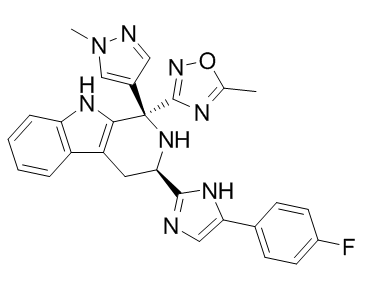
MK-4256 is a novel, potent and selective SSTR3 (somatostatin subtype receptor 3) antagonist with IC50s of 0.66 nM and 0.36 nM in human and mouse receptor binding assays, respectively. Somatostatin subtype receptor 3 (sstr3) antagonistic therapy has been proposed as a possible treatment for Type 2 diabetes. Because of a dose-dependent prolongation of the QTc (QT interval corrected for heart rate) seen in a conscious cardiovascular (CV) dog model, the development of our first preclinical candidate, MK-4256, was regrettably abandoned.
Physicochemical Properties
| Molecular Formula | C27H23FN8O |
| Molecular Weight | 494.522927522659 |
| Exact Mass | 494.2 |
| Elemental Analysis | C, 65.58; H, 4.69; F, 3.84; N, 22.66; O, 3.24 |
| CAS # | 1104599-69-0 |
| PubChem CID | 56927659 |
| Appearance | Light yellow to yellow solid powder |
| LogP | 3.1 |
| Hydrogen Bond Donor Count | 3 |
| Hydrogen Bond Acceptor Count | 7 |
| Rotatable Bond Count | 4 |
| Heavy Atom Count | 37 |
| Complexity | 815 |
| Defined Atom Stereocenter Count | 2 |
| SMILES | CC1=NC(=NO1)[C@]2(C3=C(C[C@@H](N2)C4=NC=C(N4)C5=CC=C(C=C5)F)C6=CC=CC=C6N3)C7=CN(N=C7)C |
| InChi Key | NTIFDLOQPKMIJK-AJTFRIOCSA-N |
| InChi Code | InChI=1S/C27H23FN8O/c1-15-31-26(35-37-15)27(17-12-30-36(2)14-17)24-20(19-5-3-4-6-21(19)32-24)11-22(34-27)25-29-13-23(33-25)16-7-9-18(28)10-8-16/h3-10,12-14,22,32,34H,11H2,1-2H3,(H,29,33)/t22-,27-/m1/s1 |
| Chemical Name | 3-[(1R,3R)-3-[5-(4-fluorophenyl)-1H-imidazol-2-yl]-1-(1-methylpyrazol-4-yl)-2,3,4,9-tetrahydropyrido[3,4-b]indol-1-yl]-5-methyl-1,2,4-oxadiazole |
| Synonyms | MK4256; MK-4256; MK 4256 |
| HS Tariff Code | 2934.99.9001 |
| Storage |
Powder-20°C 3 years 4°C 2 years In solvent -80°C 6 months -20°C 1 month |
| Shipping Condition | Room temperature (This product is stable at ambient temperature for a few days during ordinary shipping and time spent in Customs) |
Biological Activity
| Targets | human SSTR3 ( IC50 = 0.66 nM ); mouse SSTR3 ( IC50 = 0.36 nM ) |
| ln Vitro | MK-4256 has shown selectivity for other SSTR subtypes in in vitro experiments. In human adsorptive binding assays, MK-4256 has an IC50 of >2 μM for SSTR1 and SSTR2. Although SSTR4 and SSTR5 have IC50 values below 1 μM, they are >500-fold selective. MK-4256 was tested in functional antagonist assays against SSTR4 and SSTR5. IC50 value is greater than 5 μM (at least 5000 times selectivity) [1]. -4256 dilution labeled MK-499 binds to hERG channel, IC50=1.74 μM. In functional patch clamp assays, MK-4256 demonstrated 50% amplification of hERG at a concentration of 3.4 μM [2]. |
| ln Vivo | MK-4256 reduces blood glucose excursions in a dose-dependent manner, achieving maximum efficacy at doses as low as 0.03 mg/kg po. MK-4256 exhibits superior SSTR3-mediated glucose-lowering efficacy with minimal low-risk trends in a mouse oGTT model. MK-4256 achieved complete ablation of drift drift (109%) at 1 mg/kg po. MK-4256 reduced drift drift from 0.003 to 10 mg/kg in a dose-dependent manner. MK-4256 At simulated doses of 0.01, 0.1 and 1 mg/kg, MK-4256 reached Cmax of 7, 88 and 493 nM, respectively [1]. |
| Animal Protocol | Mice: In SSTR3 KO mice, the impact of a maximally effective dosage of MK-4256 on blood glucose excursion during an oGTT was examined in order to show that the observed glucose lowering by MK-4256 is SSTR3-dependent. When given to age-matched C57BL/6N male WT mice, MK-4256 (1 mg/kg) and compound A (1 mg/kg; des-F-sitagliptin, a DPP-4 inhibitor included as a positive control) significantly reduce blood glucose excursion by 112 and 91%, respectively. |
| References |
[1]. The Discovery of MK-4256, a Potent SSTR3 Antagonist as a Potential Treatment of Type 2 Diabetes. ACS Med Chem Lett. 2012 May 7;3(6):484-9. [2]. Investigation of Cardiovascular Effects of Tetrahydro-β-carboline sstr3 antagonists. ACS Med Chem Lett. 2014 Apr 21;5(7):748-53. |
Solubility Data
| Solubility (In Vitro) | DMSO: ≥ 100 mg/mL (~202.2 mM) |
| Solubility (In Vivo) |
Solubility in Formulation 1: ≥ 3 mg/mL (6.07 mM) (saturation unknown) in 10% DMSO + 40% PEG300 + 5% Tween80 + 45% Saline (add these co-solvents sequentially from left to right, and one by one), clear solution. For example, if 1 mL of working solution is to be prepared, you can add 100 μL of 30.0 mg/mL clear DMSO stock solution to 400 μL PEG300 and mix evenly; then add 50 μL Tween-80 to the above solution and mix evenly; then add 450 μL normal saline to adjust the volume to 1 mL. Preparation of saline: Dissolve 0.9 g of sodium chloride in 100 mL ddH₂ O to obtain a clear solution. Solubility in Formulation 2: ≥ 3 mg/mL (6.07 mM) (saturation unknown) in 10% DMSO + 90% Corn Oil (add these co-solvents sequentially from left to right, and one by one), clear solution. For example, if 1 mL of working solution is to be prepared, you can add 100 μL of 30.0 mg/mL clear DMSO stock solution to 900 μL of corn oil and mix evenly. (Please use freshly prepared in vivo formulations for optimal results.) |
| Preparing Stock Solutions | 1 mg | 5 mg | 10 mg | |
| 1 mM | 2.0222 mL | 10.1108 mL | 20.2216 mL | |
| 5 mM | 0.4044 mL | 2.0222 mL | 4.0443 mL | |
| 10 mM | 0.2022 mL | 1.0111 mL | 2.0222 mL |