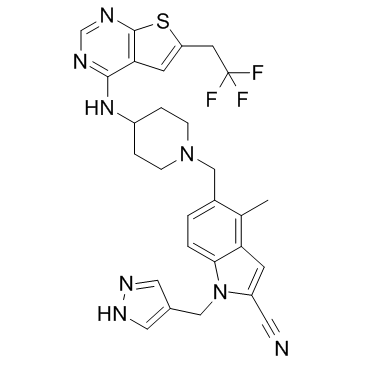
MI-503 (MI503) is a novel, orally bioavailable and potent Menin-MLL interaction inhibitor (IC50= 14.7 nM) with potential anticancer activity. Chromosomal translocations affecting mixed lineage leukemia gene (MLL) result in acute leukemias resistant to therapy. The leukemogenic activity of MLL fusion proteins is dependent on their interaction with menin, providing basis for therapeutic intervention.
Physicochemical Properties
| Molecular Formula | C28H27F3N8S |
| Molecular Weight | 564.6352 |
| Exact Mass | 564.203 |
| CAS # | 1857417-13-0 |
| PubChem CID | 91667931 |
| Appearance | White to off-white solid powder |
| Density | 1.5±0.1 g/cm3 |
| Boiling Point | 782.9±60.0 °C at 760 mmHg |
| Flash Point | 427.3±32.9 °C |
| Vapour Pressure | 0.0±2.7 mmHg at 25°C |
| Index of Refraction | 1.712 |
| LogP | 4.08 |
| Hydrogen Bond Donor Count | 2 |
| Hydrogen Bond Acceptor Count | 10 |
| Rotatable Bond Count | 7 |
| Heavy Atom Count | 40 |
| Complexity | 908 |
| Defined Atom Stereocenter Count | 0 |
| InChi Key | DETOMBLLEOZTMZ-UHFFFAOYSA-N |
| InChi Code | InChI=1S/C28H27F3N8S/c1-17-19(2-3-25-23(17)8-21(11-32)39(25)14-18-12-35-36-13-18)15-38-6-4-20(5-7-38)37-26-24-9-22(10-28(29,30)31)40-27(24)34-16-33-26/h2-3,8-9,12-13,16,20H,4-7,10,14-15H2,1H3,(H,35,36)(H,33,34,37) |
| Chemical Name | 4-Methyl-1-(1H-pyrazol-4-ylmethyl)-5-[[4-[[6-(2,2,2-trifluoroethyl)thieno[2,3-d]pyrimidin-4-yl]amino]-1-piperidinyl]methyl]-1H-indole-2-carbonitrile |
| Synonyms | MI503 MI 503 MI-503 |
| HS Tariff Code | 2934.99.9001 |
| Storage |
Powder-20°C 3 years 4°C 2 years In solvent -80°C 6 months -20°C 1 month |
| Shipping Condition | Room temperature (This product is stable at ambient temperature for a few days during ordinary shipping and time spent in Customs) |
Biological Activity
| ln Vitro | MI-503 forms hydrogen connections with Tyr276 by occupying the F9 and P13 pockets on menin. It also extends beyond the P13 pocket to make hydrogen bonds with Trp341 and Glu366. When MI-503 was applied to mouse bone marrow cells (BMC) that had been transformed with the mLL-AF9 oncogene, there was a noticeable growth inhibition (GI50 of 0.22 μM). After 7–10 days of treatment, MI–503 exhibits a considerable time-dependent cell growth inhibitory impact [1]. | |
| ln Vivo | After a single intravenous or oral dosage, MI-503 exhibits significant levels in peripheral blood and a high oral bioavailability of 75%. MI-503 administered intraperitoneally (ip) once day significantly reduces the growth of tumors. Two mice that received MI-503 treatment had total tumor regression and a reduction in MV4;11 tumor volume of more than 80%. Ten days of continuous MI-503 treatment greatly slowed the MLL leukemia progression in mice and greatly decreased the burden of leukemic tumors. The expression of Hoxa9 and Meis1, two downstream targets of MLL fusion proteins that are markedly elevated in MLL leukemia, was considerably reduced upon treatment with MI-503 and MI-463 [1]. | |
| Cell Assay |
|
|
| References |
[1]. Pharmacologic inhibition of the Menin-MLL interaction blocks progression of MLL leukemia in vivo. Cancer Cell. 2015 Apr 13;27(4):589-602. |
Solubility Data
| Solubility (In Vitro) | DMSO : ~25 mg/mL (~44.28 mM) |
| Solubility (In Vivo) |
Solubility in Formulation 1: ≥ 2.08 mg/mL (3.68 mM) (saturation unknown) in 10% DMSO + 40% PEG300 + 5% Tween80 + 45% Saline (add these co-solvents sequentially from left to right, and one by one), clear solution. For example, if 1 mL of working solution is to be prepared, you can add 100 μL of 20.8 mg/mL clear DMSO stock solution to 400 μL PEG300 and mix evenly; then add 50 μL Tween-80 to the above solution and mix evenly; then add 450 μL normal saline to adjust the volume to 1 mL. Preparation of saline: Dissolve 0.9 g of sodium chloride in 100 mL ddH₂ O to obtain a clear solution. Solubility in Formulation 2: ≥ 2.08 mg/mL (3.68 mM) (saturation unknown) in 10% DMSO + 90% Corn Oil (add these co-solvents sequentially from left to right, and one by one), clear solution. For example, if 1 mL of working solution is to be prepared, you can add 100 μL of 20.8 mg/mL clear DMSO stock solution to 900 μL of corn oil and mix evenly. (Please use freshly prepared in vivo formulations for optimal results.) |
| Preparing Stock Solutions | 1 mg | 5 mg | 10 mg | |
| 1 mM | 1.7710 mL | 8.8552 mL | 17.7104 mL | |
| 5 mM | 0.3542 mL | 1.7710 mL | 3.5421 mL | |
| 10 mM | 0.1771 mL | 0.8855 mL | 1.7710 mL |