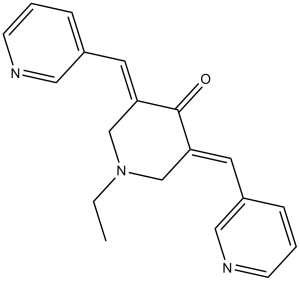
MCB-613 is a novel and potent stimulator of p160 steroid receptor coactivators (SRCs). It is a Pan-SRCs stimulator. MCB-613 is confirmed to be a strong activator of all three SRCs family proteins. MCB-613 can super-activate transcriptional activity of SRCs. MCB-613 markedly increases SRCs’ interactions with other coactivators. Coactivation of MMP2 or MMP13 promoter-driven luciferase reporter with SRC-3 was greatly enhanced by MCB-613. MCB-613 increased SRC-3’s interaction with CBP and CARM1 robustly in a dose-dependent manner.
Physicochemical Properties
| Molecular Formula | C20H20N2O | |
| Molecular Weight | 304.39 | |
| Exact Mass | 304.157 | |
| CAS # | 1162656-22-5 | |
| Related CAS # |
|
|
| PubChem CID | 2175947 | |
| Appearance | Light yellow to yellow solid powder | |
| Density | 1.159±0.06 g/cm3 | |
| Boiling Point | 510.4±50.0 °C at 760 mmHg | |
| Flash Point | 257.9±36.5 °C | |
| Vapour Pressure | 0.0±1.3 mmHg at 25°C | |
| Index of Refraction | 1.640 | |
| LogP | 4.55 | |
| Hydrogen Bond Donor Count | 0 | |
| Hydrogen Bond Acceptor Count | 3 | |
| Rotatable Bond Count | 3 | |
| Heavy Atom Count | 23 | |
| Complexity | 440 | |
| Defined Atom Stereocenter Count | 0 | |
| SMILES | CCC1C/C(=C\C2=CN=CC=C2)/C(=O)/C(=C/C3=CN=CC=C3)/C1 |
|
| InChi Key | MMBSCBVEHMETSA-GDAWTGGTSA-N | |
| InChi Code | InChI=1S/C20H20N2O/c1-2-15-9-18(11-16-5-3-7-21-13-16)20(23)19(10-15)12-17-6-4-8-22-14-17/h3-8,11-15H,2,9-10H2,1H3/b18-11+,19-12+ | |
| Chemical Name | (2E,6E)-4-ethyl-2,6-bis(pyridin-3-ylmethylidene)cyclohexan-1-one | |
| Synonyms |
|
|
| HS Tariff Code | 2934.99.9001 | |
| Storage |
Powder-20°C 3 years 4°C 2 years In solvent -80°C 6 months -20°C 1 month |
|
| Shipping Condition | Room temperature (This product is stable at ambient temperature for a few days during ordinary shipping and time spent in Customs) |
Biological Activity
| ln Vitro | In MDA-MB-231 cells, endogenous MMP13 mRNA expression is activated by MCB-613 (6-8 μM; 24 hours)[1]. In 4 hours, MCB-613 (2-10 μM) induces ER stress and proteasome failure. It also phosphorylates eIF2α and IRE1α and increases the expression of the ATF4 protein, which are indicators for the unfolded protein response (UPR)[1]. The viability of SRC-3 KO and WT HeLa cells is impacted by MCB-613 (0-7 μM; 4 hours); SRC-3 WT HeLa cells are more impacted by MCB-613 than KO cells[1]. |
| ln Vivo | When compared to the control group, MCB-613 (intravenous injection; 20 mg/kg; three times/week; seven weeks) markedly and significantly slows the growth of the tumor while posing no clear risk to the animals[1]. |
| Cell Assay |
RT-PCR[1] Cell Types: MDA-MB-231 cells Tested Concentrations: 6 μM; 8 μM Incubation Duration: 24 hrs (hours) Experimental Results: Increased MMP13 mRNA expression. Western Blot Analysis[1] Cell Types: HeLa cells Tested Concentrations: 2 μM; 4 μM; 6 μM; 8 μM; 10 μM Incubation Duration: 24 hrs (hours) Experimental Results: Induced the p-eIF2α, p -IRE1α, and ATF-4 protein expression. Cell Viability Assay[1] Cell Types: SRC-3 KO and WT HeLa cells Tested Concentrations: 3 μM; 4 μM; 5 μM; 6 μM; 7 μM Incubation Duration: 24 hrs (hours) Experimental Results: diminished SRC-3 KO and WT HeLa cell viability. |
| Animal Protocol |
Animal/Disease Models: MCF-7 breast cancer mouse xenograft model (athymic nude mice by injecting MCF-7 cells into mammary fat pads)[1] Doses: 20 mg/kg Route of Administration: intravenous (iv) injection; 20 mg/kg; 3 times/week; 7 weeks Experimental Results: Inhibited tumor growth in vivo. |
| References |
[1]. Characterization of a Steroid Receptor Coactivator Small Molecule Stimulator that Overstimulates Cancer Cells and Leads to Cell Stress and Death. Cancer Cell. 2015 Aug 10;28(2):240-52. |
| Additional Infomation | MCB-613 is a cyclic ketone that is 4-ethylcyclohexanone which is substituted by pyridin-3-ylmethylene groups at positions 2 and 6. It is a potent small molecule stimulator of steroid receptor coactivators (SRCs). MCB-613 increases SRCs' interactions with other coactivators and markedly induces ER stress coupled to the generation of reactive oxygen species. Since cancer cells overexpress SRCs and rely on them for growth, MCB-613 can be used to selectively induce excessive stress in cancer cells. It has a role as a steroid receptor coactivator stimulator and an antineoplastic agent. It is a cyclic ketone, an enone and a member of pyridines. |
Solubility Data
| Solubility (In Vitro) |
|
|||
| Solubility (In Vivo) |
Solubility in Formulation 1: ≥ 2.5 mg/mL (8.21 mM) (saturation unknown) in 10% DMSO + 40% PEG300 + 5% Tween80 + 45% Saline (add these co-solvents sequentially from left to right, and one by one), clear solution. For example, if 1 mL of working solution is to be prepared, you can add 100 μL of 25.0 mg/mL clear DMSO stock solution to 400 μL PEG300 and mix evenly; then add 50 μL Tween-80 to the above solution and mix evenly; then add 450 μL normal saline to adjust the volume to 1 mL. Preparation of saline: Dissolve 0.9 g of sodium chloride in 100 mL ddH₂ O to obtain a clear solution. Solubility in Formulation 2: ≥ 2.5 mg/mL (8.21 mM) (saturation unknown) in 10% DMSO + 90% (20% SBE-β-CD in Saline) (add these co-solvents sequentially from left to right, and one by one), clear solution. For example, if 1 mL of working solution is to be prepared, you can add 100 μL of 25.0 mg/mL clear DMSO stock solution to 900 μL of 20% SBE-β-CD physiological saline solution and mix evenly. Preparation of 20% SBE-β-CD in Saline (4°C,1 week): Dissolve 2 g SBE-β-CD in 10 mL saline to obtain a clear solution. Solubility in Formulation 3: ≥ 2.5 mg/mL (8.21 mM) (saturation unknown) in 10% DMSO + 90% Corn Oil (add these co-solvents sequentially from left to right, and one by one), clear solution. For example, if 1 mL of working solution is to be prepared, you can add 100 μL of 25.0 mg/mL clear DMSO stock solution to 900 μL of corn oil and mix evenly. Solubility in Formulation 4: 4% DMSO +30%PEG 300 +ddH2O: 2mg/mL (Please use freshly prepared in vivo formulations for optimal results.) |
| Preparing Stock Solutions | 1 mg | 5 mg | 10 mg | |
| 1 mM | 3.2853 mL | 16.4263 mL | 32.8526 mL | |
| 5 mM | 0.6571 mL | 3.2853 mL | 6.5705 mL | |
| 10 mM | 0.3285 mL | 1.6426 mL | 3.2853 mL |