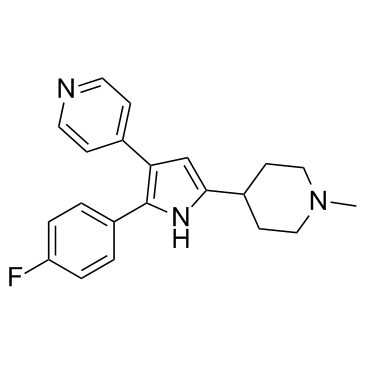
MBP146-78 (MBP-146-78) is a potent and selective inhibitor of cGMP dependent protein kinases with the potential for the treatment of murine toxoplasmosis.
Physicochemical Properties
| Molecular Formula | C21H22FN3 |
| Molecular Weight | 335.4179 |
| Exact Mass | 335.18 |
| CAS # | 188343-77-3 |
| PubChem CID | 500899 |
| Appearance | White to off-white solid powder |
| LogP | 4.629 |
| Hydrogen Bond Donor Count | 1 |
| Hydrogen Bond Acceptor Count | 3 |
| Rotatable Bond Count | 3 |
| Heavy Atom Count | 25 |
| Complexity | 409 |
| Defined Atom Stereocenter Count | 0 |
| SMILES | FC1C([H])=C([H])C(=C([H])C=1[H])C1=C(C2C([H])=C([H])N=C([H])C=2[H])C([H])=C(C2([H])C([H])([H])C([H])([H])N(C([H])([H])[H])C([H])([H])C2([H])[H])N1[H] |
| InChi Key | RBWNFHXBUDPAIO-UHFFFAOYSA-N |
| InChi Code | InChI=1S/C21H22FN3/c1-25-12-8-16(9-13-25)20-14-19(15-6-10-23-11-7-15)21(24-20)17-2-4-18(22)5-3-17/h2-7,10-11,14,16,24H,8-9,12-13H2,1H3 |
| Chemical Name | 4-[2-(4-fluorophenyl)-5-(1-methylpiperidin-4-yl)-1H-pyrrol-3-yl]pyridine |
| Synonyms | MBP146-78 |
| HS Tariff Code | 2934.99.9001 |
| Storage |
Powder-20°C 3 years 4°C 2 years In solvent -80°C 6 months -20°C 1 month |
| Shipping Condition | Room temperature (This product is stable at ambient temperature for a few days during ordinary shipping and time spent in Customs) |
Biological Activity
| Targets | Toxoplasma |
| ln Vitro | MBP146-78 exhibits a dose-dependent inhibition of T. gondii tachyzoites replicating within HFF, with an IC50 of 210 nM. MBP146-78 has the ability to reverse the inhibition of lytic parasite growth. HFF cell monolayers are completely lysed when the medium containing MBP146-78 is substituted after up to seven days of treatment at a concentration of 2 μM. At concentrations of up to 10 μM, MBP146-78 neither inhibits nor is toxic to proliferating or confluent monolayers of HFFs[1]. |
| ln Vivo | Parasites are not visible in any of the tissues examined during the 10-day treatment period in mice that are infected and given MBP146-78 at a dose of 50 mg/kg twice daily. All survivors experience a brief period of asymptomatic parasite recrudescence, as evidenced by the presence of parasites in samples from the brain, spleen, and lung of infected treated mice, even after MBP146-78 administration has stopped. Following the cessation of MBP146-78 treatment, mice's ability to control Toxoplasma infection implies that chemotherapy and the mouse immune system work in concert to control the infection[1]. |
| Cell Assay | In order to evaluate the toxicity of MBP146-78 to HFFs, 1000 cells are plated in each well of 96-well plates, and the cells are left to adhere for the entire night before the compound is added. The cultures are kept in an incubator with 5% CO2 at 37°C for five days. The cell-proliferating assay in the Cell-Titer 96 Aqueous One solution is used to determine viability[1]. |
| Animal Protocol | Mice: In water, MBP146-78 dissolves. Intraperitoneal injections of 100 μL doses of MBP146-78 are given beginning 24 hours after parasite inoculation. Throughout the trial, mice are checked twice a day for signs of toxoplasmosis and mortality[1]. |
| References |
[1]. Evaluation of a cyclic GMP-dependent protein kinase inhibitor in treatment of murine toxoplasmosis: gamma interferon is required for efficacy. Antimicrob Agents Chemother. 2002 Feb;46(2):300-7. |
| Additional Infomation | Pyridine, 4-[2-(4-fluorophenyl)-5-(1-methyl-4-piperidinyl)-1H-pyrrol-3-yl]- has been reported in Diaporthe with data available. |
Solubility Data
| Solubility (In Vitro) |
DMSO: ~7.7~12 mg/mL (~22.9~35.8 mM) Ethanol: ~12 mg/mL |
| Solubility (In Vivo) |
Solubility in Formulation 1: ≥ 0.77 mg/mL (2.30 mM) (saturation unknown) in 10% DMSO + 40% PEG300 + 5% Tween80 + 45% Saline (add these co-solvents sequentially from left to right, and one by one), clear solution. For example, if 1 mL of working solution is to be prepared, you can add 100 μL of 7.7 mg/mL clear DMSO stock solution to 400 μL PEG300 and mix evenly; then add 50 μL Tween-80 to the above solution and mix evenly; then add 450 μL normal saline to adjust the volume to 1 mL. Preparation of saline: Dissolve 0.9 g of sodium chloride in 100 mL ddH₂ O to obtain a clear solution. Solubility in Formulation 2: ≥ 0.77 mg/mL (2.30 mM) (saturation unknown) in 10% DMSO + 90% (20% SBE-β-CD in Saline) (add these co-solvents sequentially from left to right, and one by one), clear solution. For example, if 1 mL of working solution is to be prepared, you can add 100 μL of 7.7 mg/mL clear DMSO stock solution to 900 μL of 20% SBE-β-CD physiological saline solution and mix evenly. Preparation of 20% SBE-β-CD in Saline (4°C,1 week): Dissolve 2 g SBE-β-CD in 10 mL saline to obtain a clear solution. Solubility in Formulation 3: ≥ 0.77 mg/mL (2.30 mM) (saturation unknown) in 10% DMSO + 90% Corn Oil (add these co-solvents sequentially from left to right, and one by one), clear solution. For example, if 1 mL of working solution is to be prepared, you can add 100 μL of 7.7 mg/mL clear DMSO stock solution to 900 μL of corn oil and mix evenly. (Please use freshly prepared in vivo formulations for optimal results.) |
| Preparing Stock Solutions | 1 mg | 5 mg | 10 mg | |
| 1 mM | 2.9813 mL | 14.9067 mL | 29.8134 mL | |
| 5 mM | 0.5963 mL | 2.9813 mL | 5.9627 mL | |
| 10 mM | 0.2981 mL | 1.4907 mL | 2.9813 mL |