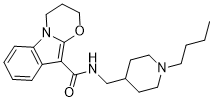
Piboserod (SB 207266; trade name Serlipet) is a novel, potent and selective 5-HT(4) receptor antagonist marketed by GSK. It is applied in the treatment of irritable bowel syndrome and atrial fibrillation. A clinical phase II study was completed in 2007 by the Norwegian company Bio-Medisinsk Innovasjon AS (BMI) to examine the impact of piboserod in patients suffering from chronic heart failure.
Physicochemical Properties
| Molecular Formula | C22H31N3O2 |
| Molecular Weight | 369.50044 |
| Exact Mass | 369.242 |
| Elemental Analysis | C, 71.51; H, 8.46; N, 11.37; O, 8.66 |
| CAS # | 152811-62-6 |
| Related CAS # | Piboserod hydrochloride; 178273-87-5 |
| PubChem CID | 177336 |
| Appearance | White to off-white solid powder |
| LogP | 3.994 |
| Hydrogen Bond Donor Count | 1 |
| Hydrogen Bond Acceptor Count | 3 |
| Rotatable Bond Count | 6 |
| Heavy Atom Count | 27 |
| Complexity | 492 |
| Defined Atom Stereocenter Count | 0 |
| SMILES | O=C(C1=C(OCCC2)N2C3=C1C=CC=C3)NCC4CCN(CCCC)CC4 |
| InChi Key | KVCSJPATKXABRQ-UHFFFAOYSA-N |
| InChi Code | InChI=1S/C22H31N3O2/c1-2-3-11-24-13-9-17(10-14-24)16-23-21(26)20-18-7-4-5-8-19(18)25-12-6-15-27-22(20)25/h4-5,7-8,17H,2-3,6,9-16H2,1H3,(H,23,26) |
| Chemical Name | N-[(1-butylpiperidin-4-yl)methyl]-3,4-dihydro-2H-[1,3]oxazino[3,2-a]indole-10-carboxamide |
| Synonyms | Piboserod; SB-207266; SB 207266; SB207266; trade name: Serlipet |
| HS Tariff Code | 2934.99.9001 |
| Storage |
Powder-20°C 3 years 4°C 2 years In solvent -80°C 6 months -20°C 1 month |
| Shipping Condition | Room temperature (This product is stable at ambient temperature for a few days during ordinary shipping and time spent in Customs) |
Biological Activity
| Targets | 5-HT4 Receptor |
| ln Vitro |
Piboserod (SB 207266) is a selective 5-HT(4) receptor antagonist, at inhibiting the 5-HT(4)-mediated potentiating effect of serotonin (5-HT) on the neurally-mediated contractile responses of human detrusor strips to electrical field stimulations (EFS). [1] Strips of human detrusor muscle were mounted in Krebs-HEPES buffer under a resting tension of 500 mg and EFS (20 Hz, 1 ms duration at 300 mA for 5 s) was applied continuously at 1 min intervals. After stabilization of the EFS-induced contractions, concentration-response curves to 5-HT (0.1 nM-100 microM) were constructed in the absence or presence of 1 or 100 nM of piboserod. [1] Piboserod did not modify the basal contractions but concentration-dependently antagonized the ability of 5-HT to enhance bladder strip contractions to EFS. In presence of 1 and 100 nM of piboserod, the maximal 5-HT-induced potentiations were reduced to 45.0+/-7.9 and 38.7+/-8.7%, respectively. A mean apparent antagonist dissociation constant value (K(B)) of 0.56+/-0.09 nM was determined. These data show the ability of piboserod to antagonize with high potency the enhancing properties of 5-HT on neurally-mediated contractions of isolated human bladder strips. [1] |
| References |
[1]. Piboserod (SB 207266), a selective 5-HT4 receptor antagonist, reduces serotonin potentiation of neurally-mediated contractile responses of human detrusor muscle. World J Urol. 2005 Jun;23(2):147-51. [2]. Effect of piboserod, a 5-HT4 serotonin receptor antagonist, on left ventricular function in patients with symptomatic heart failure. Eur J Heart Fail. 2009 Aug;11(8):771-8. [3]. In-vivo rat striatal 5-HT4 receptor occupancy using non-radiolabelled SB207145. J Pharm Pharmacol. 2013 May;65(5):704-12. |
| Additional Infomation |
Piboserod (SB 207266) is a selective 5-HT(4) receptor antagonist. Drug Indication For the treatment of atrial fibrillation and irritable bowel syndrome (IBS). Mechanism of Action Piboserod appears to act as a specific antagonist of one of the receptors for 5-hydroxytryptamine, the 5-HT4 receptor. The 5-HT4 receptor antagonists are thought to antagonize both the ability of serotonin to sensitize the peristaltic reflex and 5-HT-induced defecation, at least in animal studies. As 5-HT4 receptors are present in human atrial cells and when stimulated may cause atrial arrhythmias, piboserod was under investigation in clinical trials for atrial fibrillation. Pharmacodynamics GlaxoSmithKline was investigating piboserod, a 5HT4 antagonist, for the treatment of atrial fibrillation. Phase II trials were ongoing in March 2004, but by December of that year, development had been discontinued. Piboserod had previously being investigated for the treatment of irritable bowel syndrome (IBS), but development for this indication was terminated in 1999. |
Solubility Data
| Solubility (In Vitro) | DMSO: ~25 mg/mL (~67.7 mM) |
| Solubility (In Vivo) |
Solubility in Formulation 1: ≥ 2.5 mg/mL (6.77 mM) (saturation unknown) in 10% DMSO + 40% PEG300 + 5% Tween80 + 45% Saline (add these co-solvents sequentially from left to right, and one by one), clear solution. For example, if 1 mL of working solution is to be prepared, you can add 100 μL of 25.0 mg/mL clear DMSO stock solution to 400 μL PEG300 and mix evenly; then add 50 μL Tween-80 to the above solution and mix evenly; then add 450 μL normal saline to adjust the volume to 1 mL. Preparation of saline: Dissolve 0.9 g of sodium chloride in 100 mL ddH₂ O to obtain a clear solution. Solubility in Formulation 2: ≥ 2.5 mg/mL (6.77 mM) (saturation unknown) in 10% DMSO + 90% Corn Oil (add these co-solvents sequentially from left to right, and one by one), clear solution. For example, if 1 mL of working solution is to be prepared, you can add 100 μL of 25.0 mg/mL clear DMSO stock solution to 900 μL of corn oil and mix evenly. (Please use freshly prepared in vivo formulations for optimal results.) |
| Preparing Stock Solutions | 1 mg | 5 mg | 10 mg | |
| 1 mM | 2.7064 mL | 13.5318 mL | 27.0636 mL | |
| 5 mM | 0.5413 mL | 2.7064 mL | 5.4127 mL | |
| 10 mM | 0.2706 mL | 1.3532 mL | 2.7064 mL |