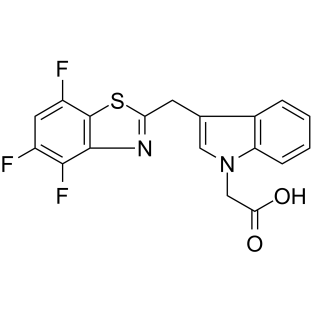
Lidorestat (EML-676; ALN-101; IDD-000676-01; IDD-676) is a novel and potent aldose reductase inhibitor which is orally bioactive and can be used to treat chronic diabetes complications. It inhibits aldose reductase with an IC50 of 5 nM. Lidorestat Lidorestat also improves nerve conduction and reduces cataract formation.
Physicochemical Properties
| Molecular Formula | C18H11F3N2O2S |
| Molecular Weight | 376.35 |
| Exact Mass | 376.049 |
| CAS # | 245116-90-9 |
| PubChem CID | 157839 |
| Appearance | Light yellow to yellow solid powder |
| Density | 1.55g/cm3 |
| Boiling Point | 591.4ºC at 760 mmHg |
| Melting Point | 177-178 °C |
| Flash Point | 311.4ºC |
| Vapour Pressure | 7.87E-15mmHg at 25°C |
| Index of Refraction | 1.681 |
| LogP | 4.343 |
| Hydrogen Bond Donor Count | 1 |
| Hydrogen Bond Acceptor Count | 7 |
| Rotatable Bond Count | 4 |
| Heavy Atom Count | 26 |
| Complexity | 543 |
| Defined Atom Stereocenter Count | 0 |
| InChi Key | KYHVTMFADJNSGS-UHFFFAOYSA-N |
| InChi Code | InChI=1S/C18H11F3N2O2S/c19-11-6-12(20)18-17(16(11)21)22-14(26-18)5-9-7-23(8-15(24)25)13-4-2-1-3-10(9)13/h1-4,6-7H,5,8H2,(H,24,25) |
| Chemical Name | 2-[3-[(4,5,7-trifluoro-1,3-benzothiazol-2-yl)methyl]indol-1-yl]acetic acid |
| Synonyms | IDD-676 EML-676 ALN-101IDD676 EML676 ALN101 |
| HS Tariff Code | 2934.99.9001 |
| Storage |
Powder-20°C 3 years 4°C 2 years In solvent -80°C 6 months -20°C 1 month |
| Shipping Condition | Room temperature (This product is stable at ambient temperature for a few days during ordinary shipping and time spent in Customs) |
Biological Activity
| ln Vitro | Lidorestat has an IC50 of 5 μM against recombinant human aldose reductase (/h/-ALR2), according to in vitro tests. With an IC50 of 27,000 μM against recombinant human aldehyde reductase (/h/-ALR1), Lidorestat has been reported to have a selectivity of /h/-ALR1//h/-ALR2 of 5400:1[1][2]. |
| ln Vivo | Lidorestat (25 mg/kg/day; oral administration; twice daily; for 6 weeks; diabetic mice) therapy decreases fructose and reduces mortality in diabetic hAR-expressing mice. And Lidorestat does not alter weight[1]. |
| Animal Protocol |
Animal/Disease Models: Diabetic low -density lipoprotein (LDL) receptor-deficient [Ldlr(-/-)] mice[1] Doses: 25 mg/kg/day Route of Administration: Oral administration; twice (two times) daily; for 6 weeks Experimental Results: Diabetic hAR-expressing mice had diminished fructose and decreased mortality. |
| References |
[1]. Regulation of plasma fructose and mortality in mice by the aldose reductase inhibitor lidorestat. J Pharmacol Exp Ther. 2009 Feb;328(2):496-503. [2]. Discovery of 3-[(4,5,7-trifluorobenzothiazol-2-yl)methyl]indole-N-acetic acid (lidorestat) and congeners as highly potent and selective inhibitors of aldose reductase for treatment of chronic diabetic complications. J Med Chem. 2005 M. [3]. Identification of new non-carboxylic acid containing inhibitors of aldose reductase. Bioorg Med Chem. 2010 Jun 1;18(11):4049-55. |
Solubility Data
| Solubility (In Vitro) | DMSO : ~50 mg/mL (~132.86 mM) |
| Solubility (In Vivo) |
Solubility in Formulation 1: ≥ 2.08 mg/mL (5.53 mM) (saturation unknown) in 10% DMSO + 90% (20% SBE-β-CD in Saline) (add these co-solvents sequentially from left to right, and one by one), clear solution. For example, if 1 mL of working solution is to be prepared, you can add 100 μL of 20.8 mg/mL clear DMSO stock solution to 900 μL of 20% SBE-β-CD physiological saline solution and mix evenly. Preparation of 20% SBE-β-CD in Saline (4°C,1 week): Dissolve 2 g SBE-β-CD in 10 mL saline to obtain a clear solution. Solubility in Formulation 2: ≥ 0.56 mg/mL (1.49 mM) (saturation unknown) in 10% DMSO + 40% PEG300 + 5% Tween80 + 45% Saline (add these co-solvents sequentially from left to right, and one by one), clear solution. For example, if 1 mL of working solution is to be prepared, you can add 100 μL of 5.6 mg/mL clear DMSO stock solution to 400 μL PEG300 and mix evenly; then add 50 μL Tween-80 to the above solution and mix evenly; then add 450 μL normal saline to adjust the volume to 1 mL. Preparation of saline: Dissolve 0.9 g of sodium chloride in 100 mL ddH₂ O to obtain a clear solution. Solubility in Formulation 3: ≥ 0.56 mg/mL (1.49 mM) (saturation unknown) in 10% DMSO + 90% Corn Oil (add these co-solvents sequentially from left to right, and one by one), clear solution. For example, if 1 mL of working solution is to be prepared, you can add 100 μL of 5.6 mg/mL clear DMSO stock solution to 900 μL of corn oil and mix evenly. (Please use freshly prepared in vivo formulations for optimal results.) |
| Preparing Stock Solutions | 1 mg | 5 mg | 10 mg | |
| 1 mM | 2.6571 mL | 13.2855 mL | 26.5710 mL | |
| 5 mM | 0.5314 mL | 2.6571 mL | 5.3142 mL | |
| 10 mM | 0.2657 mL | 1.3286 mL | 2.6571 mL |