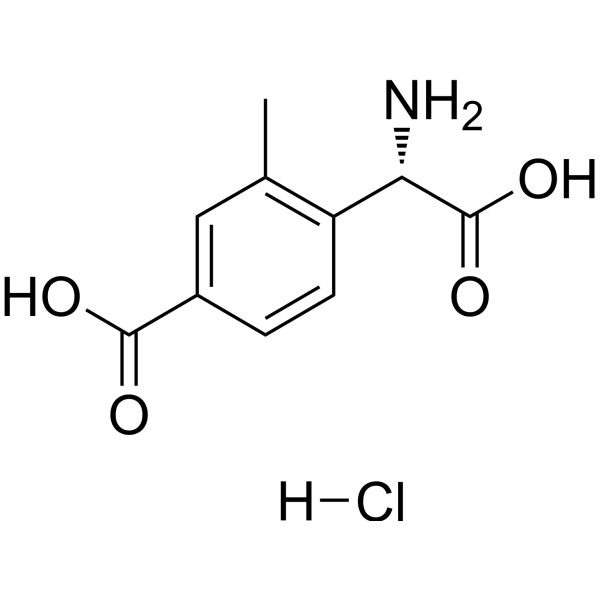
Physicochemical Properties
| Molecular Formula | C10H12CLNO4 |
| Molecular Weight | 245.66 |
| Exact Mass | 245.045 |
| CAS # | 2829282-00-8 |
| Related CAS # | LY367385;198419-91-9 |
| PubChem CID | 122360845 |
| Appearance | White to off-white solid powder |
| Hydrogen Bond Donor Count | 4 |
| Hydrogen Bond Acceptor Count | 5 |
| Rotatable Bond Count | 3 |
| Heavy Atom Count | 16 |
| Complexity | 266 |
| Defined Atom Stereocenter Count | 1 |
| SMILES | OC(C1C=CC([C@@H](C(=O)O)N)=C(C)C=1)=O.Cl |
| InChi Key | IGKQWSUZDKTEPR-QRPNPIFTSA-N |
| InChi Code | InChI=1S/C10H11NO4.ClH/c1-5-4-6(9(12)13)2-3-7(5)8(11)10(14)15;/h2-4,8H,11H2,1H3,(H,12,13)(H,14,15);1H/t8-;/m0./s1 |
| Chemical Name | 4-[(S)-amino(carboxy)methyl]-3-methylbenzoic acid;hydrochloride |
| HS Tariff Code | 2934.99.9001 |
| Storage |
Powder-20°C 3 years 4°C 2 years In solvent -80°C 6 months -20°C 1 month Note: Please store this product in a sealed and protected environment, avoid exposure to moisture. |
| Shipping Condition | Room temperature (This product is stable at ambient temperature for a few days during ordinary shipping and time spent in Customs) |
Biological Activity
| Targets | mGluR1a 8.8 μM (IC50) |
| ln Vitro | Maximum reductions in NMDA toxicity range from 40% to 60%. LY367385 hydrochloride binds to N-methyl-D-aspartate (NMDA) during hazardous pulses, attenuating neuronal degeneration in a concentration-dependent way. LY367385 hydrochloride was more effective than LY367366, and none of these substances by itself had any effect on the vitality of neurons. At a dose of 10 nM, LY367385 hydrochloride demonstrated strong neuroprotection and a 50% reduction in the potentiating impact of (S)-3,5-dihydroxyphenylglycine (DHPG). Under experimental conditions involving greater antagonist doses, the amplifying impact of DHPG on NMDA toxicity was fully neutralized by LY367385 hydrochloride [2]. |
| ln Vivo | Intracerebroventricular (icv) administration of LY367385 hydrochloride has been used in DBA/2 mice and somnolescent mice (lh/lh), as well as central administration to the inferior colliculus of rats that are genetically prone to epilepsy (GEPR). LY367385 hydrochloride (ED50=12 nM, icv, 5 minutes) quickly and transiently inhibited sound-induced clonic seizures in DBA/2 mice. Following the treatment of LY367385 hydrochloride (250 nM) icv, the occurrence of spontaneous spikes and wave discharges on the electroencephalogram was dramatically reduced in sleepy mice [3]. This reduction occurred from 30 minutes to >150 minutes. Rats prone to hereditary epilepsy experience less clonic seizures when exposed to LY367385 hydrochloride. After two to four hours, LY367385 hydrochloride at 160 nM on both sides totally prevents clonic seizures [3]. |
| References |
[1]. (+)-2-Methyl-4-carboxyphenylglycine (LY 367385) selectively antagonises metabotropic glutamate mGluR1 receptors. Bioorg.Med.Chem.Lett. November 1997, 7 (21): 2777-2780. [2]. Neuroprotective activity of the potent and selective mGlu1a metabotropic glutamate receptor antagonist, (+)-2-methyl-4 carboxyphenylglycine (LY367385): comparison with LY357366, a broader spectrum antagonist with equal affinity for mGlu1a and mGlu5 receptors. Neuropharmacology. 1999 Feb;38(2):199-207. [3]. Anticonvulsant actions of LY 367385 ((+)-2-methyl-4-carboxyphenylglycine) and AIDA ((RS)-1-aminoindan-1,5-dicarboxylic acid). Eur J Pharmacol. 1999 Feb 26;368(1):17-24. |
Solubility Data
| Solubility (In Vitro) |
DMSO: 125 mg/mL (508.83 mM) H2O: 12.5 mg/mL (50.88 mM) |
| Solubility (In Vivo) |
Solubility in Formulation 1: ≥ 2.08 mg/mL (8.47 mM) (saturation unknown) in 10% DMSO + 40% PEG300 + 5% Tween80 + 45% Saline (add these co-solvents sequentially from left to right, and one by one), clear solution. For example, if 1 mL of working solution is to be prepared, you can add 100 μL of 20.8 mg/mL clear DMSO stock solution to 400 μL PEG300 and mix evenly; then add 50 μL Tween-80 to the above solution and mix evenly; then add 450 μL normal saline to adjust the volume to 1 mL. Preparation of saline: Dissolve 0.9 g of sodium chloride in 100 mL ddH₂ O to obtain a clear solution. Solubility in Formulation 2: ≥ 2.08 mg/mL (8.47 mM) (saturation unknown) in 10% DMSO + 90% (20% SBE-β-CD in Saline) (add these co-solvents sequentially from left to right, and one by one), clear solution. For example, if 1 mL of working solution is to be prepared, you can add 100 μL of 20.8 mg/mL clear DMSO stock solution to 900 μL of 20% SBE-β-CD physiological saline solution and mix evenly. Preparation of 20% SBE-β-CD in Saline (4°C,1 week): Dissolve 2 g SBE-β-CD in 10 mL saline to obtain a clear solution. Solubility in Formulation 3: ≥ 2.08 mg/mL (8.47 mM) (saturation unknown) in 10% DMSO + 90% Corn Oil (add these co-solvents sequentially from left to right, and one by one), clear solution. For example, if 1 mL of working solution is to be prepared, you can add 100 μL of 20.8 mg/mL clear DMSO stock solution to 900 μL of corn oil and mix evenly. Solubility in Formulation 4: 50 mg/mL (203.53 mM) in PBS (add these co-solvents sequentially from left to right, and one by one), clear solution; with ultrasonication. (Please use freshly prepared in vivo formulations for optimal results.) |
| Preparing Stock Solutions | 1 mg | 5 mg | 10 mg | |
| 1 mM | 4.0707 mL | 20.3533 mL | 40.7067 mL | |
| 5 mM | 0.8141 mL | 4.0707 mL | 8.1413 mL | |
| 10 mM | 0.4071 mL | 2.0353 mL | 4.0707 mL |