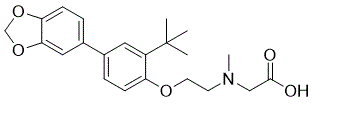
LY2365109 (LY-2365109) is a novel and potent glycine transporter 1 (GlyT1) inhibitor (IC50 = 15.8 nM) with the potential to be used as an antiictogenic drug.
Physicochemical Properties
| Molecular Formula | C22H27NO5 |
| Molecular Weight | 385.45 |
| Exact Mass | 385.1889229 |
| Elemental Analysis | C, 68.55; H, 7.06; N, 3.63; O, 20.75 |
| CAS # | 868265-28-5 |
| Related CAS # | 1779796-27-8 (HCl);868265-28-5; |
| PubChem CID | 11552757 |
| Appearance | White to off-white solid powder |
| LogP | 2.4 |
| Hydrogen Bond Donor Count | 1 |
| Hydrogen Bond Acceptor Count | 6 |
| Rotatable Bond Count | 8 |
| Heavy Atom Count | 28 |
| Complexity | 520 |
| Defined Atom Stereocenter Count | 0 |
| SMILES | CC(C)(C)C1=C(C=CC(=C1)C2=CC3=C(C=C2)OCO3)OCCN(C)CC(=O)O |
| InChi Key | FKPLJWGRBCQLTL-UHFFFAOYSA-N |
| InChi Code | InChI=1S/C22H27NO5/c1-22(2,3)17-11-15(16-6-8-19-20(12-16)28-14-27-19)5-7-18(17)26-10-9-23(4)13-21(24)25/h5-8,11-12H,9-10,13-14H2,1-4H3,(H,24,25) |
| Chemical Name | 2-[2-[4-(1,3-benzodioxol-5-yl)-2-tert-butylphenoxy]ethyl-methylamino]acetic acid |
| Synonyms | LY-2365109; LY 2365109; LY2365,109; LY-2365,109; LY 2365,109; 2-({2-[4-(2H-1,3-benzodioxol-5-yl)-2-tert-butylphenoxy]ethyl}(methyl)amino)acetic acid; 2-((2-(4-(2H-1,3-benzodioxol-5-yl)-2-tert-butylphenoxy)ethyl)(methyl)amino)acetic acid; ((2-(4-benzo(1,3)dioxol-5-yl-2-tert-butylphenoxy)ethyl)methylamino)acetic acid; LY-2365109 hydrochloride; GTPL4712; LY2365109 |
| HS Tariff Code | 2934.99.9001 |
| Storage |
Powder-20°C 3 years 4°C 2 years In solvent -80°C 6 months -20°C 1 month Note: Please store this product in a sealed and protected environment, avoid exposure to moisture. |
| Shipping Condition | Room temperature (This product is stable at ambient temperature for a few days during ordinary shipping and time spent in Customs) |
Biological Activity
| Targets |
Glycine Transporter 1 (GlyT1) (Ki = 16 nM for human GlyT1) [1] |
| ln Vitro | LY2365109 potently inhibited [³H]glycine uptake in CHO cells expressing human GlyT1, with an IC₅₀ of 17 nM. It exhibited >300-fold selectivity over GlyT2 and negligible activity at other neurotransmitter transporters (e.g., norepinephrine, dopamine, serotonin) or receptors (e.g., NMDA, GABA_A). [1] |
| ln Vivo |
In mice, subcutaneous administration of LY2365109 (3–30 mg/kg) dose-dependently elevated glycine levels in cerebrospinal fluid (CSF) and hippocampal microdialysates, with maximal effects in caudal brain regions (e.g., spinal cord) versus cortex. [1] LY2365109 (10–30 mg/kg, s.c.) significantly reduced seizure severity and mortality in the maximal electroshock (MES) and pentylenetetrazol (PTZ) models of epilepsy. This effect was reversed by glycine receptor antagonists, confirming GlyT1-dependent action. [2] Glycine levels in cerebrospinal fluid rise in a dose-dependent manner when oral LY2365109 hydrochloride (0.3–30 mg/kg) is administered [1]. In mice, the threshold for seizures is raised by LY2365109 hydrochloride [2]. |
| Enzyme Assay |
Competitive binding assays measured affinity for GlyT1 using [³H]LY2365109 in human GlyT1-expressing membranes. Saturation and displacement studies determined Ki values. Functional inhibition was confirmed via [³H]glycine uptake kinetics. [1] |
| Cell Assay |
[³H]Glycine uptake assays were performed in CHO cells stably transfected with human GlyT1. Cells were incubated with LY2365109 and [³H]glycine, then rapidly washed and lysed. Radioactivity was quantified to determine glycine uptake inhibition. [1] |
| Animal Protocol |
For neurochemistry: Mice received subcutaneous (s.c.) injections of LY2365109 (0.3–30 mg/kg) dissolved in saline. CSF and brain microdialysates were collected at 30–120 min post-dose for glycine quantification. [1] For epilepsy models: Mice were pretreated with LY2365109 (10–30 mg/kg, s.c.) 30 min before MES or PTZ challenge. Seizure severity was scored, and mortality recorded over 24h. [2] Animal/Disease Models: Male SD (SD (Sprague-Dawley)) rat (250-300 g) [1] Doses: 0.3 mg/kg, 1 mg/kg, 5 mg/kg, 10 mg/kg, 30 mg/kg Route of Administration: Oral Experimental Results: Produces a dose-dependent increase in cerebrospinal fluid glycine levels measured 1 hour after administration. |
| References |
[1]. Neurochemical and behavioral profiling of the selective GlyT1 inhibitors ALX5407 and LY2365109 indicate a preferential action in caudal vs. cortical brain areas. Neuropharmacology. 2008 Oct;55(5):743-54. [2]. Glycine transporter 1 is a target for the treatment of epilepsy. Neuropharmacology. 2015 Dec;99:554-65. |
| Additional Infomation |
LY2365109 demonstrates region-specific GlyT1 inhibition, preferentially enhancing glycine neurotransmission in subcortical/spinal areas over cortex. This may underlie its efficacy in seizure models without inducing cortical hyperexcitability. [1] GlyT1 inhibition by LY2365109 suppresses epileptiform activity via disinhibition of glycinergic neurotransmission, particularly in brainstem and spinal circuits, offering a novel mechanism for epilepsy treatment. [2] LY2365109 demonstrates region-specific GlyT1 inhibition, preferentially enhancing glycine neurotransmission in subcortical/spinal areas over cortex. This may underlie its efficacy in seizure models without inducing cortical hyperexcitability. [1] GlyT1 inhibition by LY2365109 suppresses epileptiform activity via disinhibition of glycinergic neurotransmission, particularly in brainstem and spinal circuits, offering a novel mechanism for epilepsy treatment. [2] |
Solubility Data
| Solubility (In Vitro) |
DMSO : ≥ 31 mg/mL (~73.48 mM) H2O : < 0.1 mg/mL |
| Solubility (In Vivo) |
Solubility in Formulation 1: ≥ 2.5 mg/mL (5.93 mM) (saturation unknown) in 10% DMSO + 40% PEG300 + 5% Tween80 + 45% Saline (add these co-solvents sequentially from left to right, and one by one), clear solution. For example, if 1 mL of working solution is to be prepared, you can add 100 μL of 25.0 mg/mL clear DMSO stock solution to 400 μL PEG300 and mix evenly; then add 50 μL Tween-80 to the above solution and mix evenly; then add 450 μL normal saline to adjust the volume to 1 mL. Preparation of saline: Dissolve 0.9 g of sodium chloride in 100 mL ddH₂ O to obtain a clear solution. Solubility in Formulation 2: ≥ 2.5 mg/mL (5.93 mM) (saturation unknown) in 10% DMSO + 90% (20% SBE-β-CD in Saline) (add these co-solvents sequentially from left to right, and one by one), clear solution. For example, if 1 mL of working solution is to be prepared, you can add 100 μL of 25.0 mg/mL clear DMSO stock solution to 900 μL of 20% SBE-β-CD physiological saline solution and mix evenly. Preparation of 20% SBE-β-CD in Saline (4°C,1 week): Dissolve 2 g SBE-β-CD in 10 mL saline to obtain a clear solution. Solubility in Formulation 3: ≥ 2.5 mg/mL (5.93 mM) (saturation unknown) in 10% DMSO + 90% Corn Oil (add these co-solvents sequentially from left to right, and one by one), clear solution. For example, if 1 mL of working solution is to be prepared, you can add 100 μL of 25.0 mg/mL clear DMSO stock solution to 900 μL of corn oil and mix evenly. (Please use freshly prepared in vivo formulations for optimal results.) |
| Preparing Stock Solutions | 1 mg | 5 mg | 10 mg | |
| 1 mM | 2.5944 mL | 12.9719 mL | 25.9437 mL | |
| 5 mM | 0.5189 mL | 2.5944 mL | 5.1887 mL | |
| 10 mM | 0.2594 mL | 1.2972 mL | 2.5944 mL |