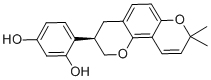
Physicochemical Properties
| Molecular Formula | C20H20O4 |
| Molecular Weight | 324.37 |
| Exact Mass | 324.136 |
| CAS # | 59870-68-7 |
| PubChem CID | 124052 |
| Appearance | Off-white to light yellow solid powder |
| Density | 1.3±0.1 g/cm3 |
| Boiling Point | 518.6±50.0 °C at 760 mmHg |
| Melting Point | 154-155ºC |
| Flash Point | 267.4±30.1 °C |
| Vapour Pressure | 0.0±1.4 mmHg at 25°C |
| Index of Refraction | 1.623 |
| LogP | 4.26 |
| Hydrogen Bond Donor Count | 2 |
| Hydrogen Bond Acceptor Count | 4 |
| Rotatable Bond Count | 1 |
| Heavy Atom Count | 24 |
| Complexity | 488 |
| Defined Atom Stereocenter Count | 1 |
| SMILES | CC1(C=CC2=C(O1)C=CC3=C2OC[C@H](C3)C4=C(C=C(C=C4)O)O)C |
| InChi Key | LBQIJVLKGVZRIW-ZDUSSCGKSA-N |
| InChi Code | InChI=1S/C20H20O4/c1-20(2)8-7-16-18(24-20)6-3-12-9-13(11-23-19(12)16)15-5-4-14(21)10-17(15)22/h3-8,10,13,21-22H,9,11H2,1-2H3/t13-/m0/s1 |
| Chemical Name | (R)-4-(8,8-dimethyl-3,4-dihydro-2H,8H-pyrano[2,3-f]chromen-3-yl)benzene-1,3-diol |
| Synonyms | Glabridin Q-100692 Q 100692Q100692 KB289522 KB 289522KB-289522 LS176045 LS 176045LS-176045 |
| HS Tariff Code | 2934.99.9001 |
| Storage |
Powder-20°C 3 years 4°C 2 years In solvent -80°C 6 months -20°C 1 month |
| Shipping Condition | Room temperature (This product is stable at ambient temperature for a few days during ordinary shipping and time spent in Customs) |
Biological Activity
| ln Vitro | Glabridin has an EC50 of 6115 nM for binding to and activating PPARγ [1]. After 24 and 48 hours of treatment, Glabridin (40, 80 μM) suppresses the swelling of SAS and SCC-9 cell lines in a dose- and time-regulated manner [2]. (0 - 80 μM) also causes cellular candles in SCC-9 and SAS cell lines, which results in sub-G1 cell cycle signaling [2]. ERK1/2, JNK1/2, and p in SCC-9 cells -38 MAPK were considerably phosphorylated by glycyrrhizin (0, 20, 40, and 80 μM) dosages, which also enhanced PARP space and mimicked the activation of caspase-3, -8, and -9[2]. |
| ln Vivo | Glycyrrhizin (50 mg/kg, once daily) reduces inflammation brought on by changes in sodium sulfate (DSS) caused by glucose and has strong anti-inflammatory properties [3]. |
| References |
[1]. Identification of glabridin as a bioactive compound in licorice (Glycyrrhiza glabra L.) extract that activates human peroxisome proliferator-activated receptor gamma (PPARγ). Fitoterapia. 2015 Oct;106:55-61. [2]. Glabridin induces apoptosis and cell cycle arrest in oral cancer cells through the JNK1/2 signaling pathway. Environ Toxicol. 2018 Jun;33(6):679-685. [3]. Downregulation of iNOS and elevation of cAMP mediate the anti-inflammatory effect of glabridin in rats with ulcerative colitis. Inflammopharmacology. 2018 Apr;26(2):551-559. |
| Additional Infomation |
Glabridin is a member of the class of hydroxyisoflavans that is (R)-isoflavan substituted by hydroxy groups at positions 2' and 4' and a 2,2-dimethyl-2H-pyran group across positions 7 and 8 respectively. It has a role as an antiplasmodial drug. It derives from a hydride of a (R)-isoflavan. Glabridin has been reported in Glycyrrhiza uralensis, Ornithopus sativus, and other organisms with data available. See also: Glycyrrhiza Glabra (part of). |
Solubility Data
| Solubility (In Vitro) | DMSO : ~25 mg/mL (~77.07 mM) |
| Solubility (In Vivo) |
Solubility in Formulation 1: ≥ 2.5 mg/mL (7.71 mM) (saturation unknown) in 10% DMSO + 40% PEG300 + 5% Tween80 + 45% Saline (add these co-solvents sequentially from left to right, and one by one), clear solution. For example, if 1 mL of working solution is to be prepared, you can add 100 μL of 25.0 mg/mL clear DMSO stock solution to 400 μL PEG300 and mix evenly; then add 50 μL Tween-80 to the above solution and mix evenly; then add 450 μL normal saline to adjust the volume to 1 mL. Preparation of saline: Dissolve 0.9 g of sodium chloride in 100 mL ddH₂ O to obtain a clear solution. Solubility in Formulation 2: ≥ 2.5 mg/mL (7.71 mM) (saturation unknown) in 10% DMSO + 90% (20% SBE-β-CD in Saline) (add these co-solvents sequentially from left to right, and one by one), clear solution. For example, if 1 mL of working solution is to be prepared, you can add 100 μL of 25.0 mg/mL clear DMSO stock solution to 900 μL of 20% SBE-β-CD physiological saline solution and mix evenly. Preparation of 20% SBE-β-CD in Saline (4°C,1 week): Dissolve 2 g SBE-β-CD in 10 mL saline to obtain a clear solution. Solubility in Formulation 3: ≥ 2.5 mg/mL (7.71 mM) (saturation unknown) in 10% DMSO + 90% Corn Oil (add these co-solvents sequentially from left to right, and one by one), clear solution. For example, if 1 mL of working solution is to be prepared, you can add 100 μL of 25.0 mg/mL clear DMSO stock solution to 900 μL of corn oil and mix evenly. (Please use freshly prepared in vivo formulations for optimal results.) |
| Preparing Stock Solutions | 1 mg | 5 mg | 10 mg | |
| 1 mM | 3.0829 mL | 15.4145 mL | 30.8290 mL | |
| 5 mM | 0.6166 mL | 3.0829 mL | 6.1658 mL | |
| 10 mM | 0.3083 mL | 1.5414 mL | 3.0829 mL |