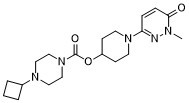
LML134 is a novel, orally bioactive and highly selective Histamine 3 receptor (H3R) inverse agonist with Kis of 0.3 nM and 12 nM for hH3R cAMP and hH3R bdg. LML134 penetrates the brain rapidly, leading to high H3R occupancy, and disengages its target with a fast kinetic profile. LML134 has the potential for excessive sleep disorders.
Physicochemical Properties
| Molecular Formula | C19H29N5O3 |
| Molecular Weight | 375.465264081955 |
| Exact Mass | 375.23 |
| Elemental Analysis | C, 60.78 H, 7.79 N, 18.65 O, 12.78 |
| CAS # | 1542135-76-1 |
| PubChem CID | 72948400 |
| Appearance | Light yellow to yellow solid powder |
| LogP | 0.6 |
| Hydrogen Bond Donor Count | 0 |
| Hydrogen Bond Acceptor Count | 5 |
| Rotatable Bond Count | 4 |
| Heavy Atom Count | 27 |
| Complexity | 629 |
| Defined Atom Stereocenter Count | 0 |
| InChi Key | BVUJMFFRMZRNAT-UHFFFAOYSA-N |
| InChi Code | InChI=1S/C19H29N5O3/c1-21-18(25)6-5-17(20-21)23-9-7-16(8-10-23)27-19(26)24-13-11-22(12-14-24)15-3-2-4-15/h5-6,15-16H,2-4,7-14H2,1H3 |
| Chemical Name | [1-(1-methyl-6-oxopyridazin-3-yl)piperidin-4-yl] 4-cyclobutylpiperazine-1-carboxylate |
| Synonyms | LML-134; LML 134; LML134 |
| HS Tariff Code | 2934.99.9001 |
| Storage |
Powder-20°C 3 years 4°C 2 years In solvent -80°C 6 months -20°C 1 month |
| Shipping Condition | Room temperature (This product is stable at ambient temperature for a few days during ordinary shipping and time spent in Customs) |
Biological Activity
| Targets | H3 receptor |
| ln Vivo |
LML134 (compound 18b) (oral; 10 mg/kg) in male Sprague-Dawley rats shows fast oral absorption with a Tmax of 0.5 hours, t1/2 of 1.54 hours, and a fraction absorbed of 44%[1]. It also shows rapid clearance.[1] LML134 (i.v.; 1 mg/kg) causes low plasma protein binding (Fu = 39.0%) and has a t1/2 of 0.44 hours and a CL of 28 mL/min/kg in male Sprague-Dawley rat.[1] |
| References |
[1]. The Discovery of LML134, a Histamine H3 Receptor Inverse Agonist for the Clinical Treatment of Excessive Sleep Disorders. ChemMedChem. 2019 Jul 3;14(13):1238-1247. |
Solubility Data
| Solubility (In Vitro) | DMSO: ~12.5 mg/mL (~33.3 mM) |
| Solubility (In Vivo) |
Solubility in Formulation 1: ≥ 1.25 mg/mL (3.33 mM) (saturation unknown) in 10% DMSO + 40% PEG300 + 5% Tween80 + 45% Saline (add these co-solvents sequentially from left to right, and one by one), clear solution. For example, if 1 mL of working solution is to be prepared, you can add 100 μL of 12.5 mg/mL clear DMSO stock solution to 400 μL PEG300 and mix evenly; then add 50 μL Tween-80 to the above solution and mix evenly; then add 450 μL normal saline to adjust the volume to 1 mL. Preparation of saline: Dissolve 0.9 g of sodium chloride in 100 mL ddH₂ O to obtain a clear solution. Solubility in Formulation 2: ≥ 1.25 mg/mL (3.33 mM) (saturation unknown) in 10% DMSO + 90% (20% SBE-β-CD in Saline) (add these co-solvents sequentially from left to right, and one by one), clear solution. For example, if 1 mL of working solution is to be prepared, you can add 100 μL of 12.5 mg/mL clear DMSO stock solution to 900 μL of 20% SBE-β-CD physiological saline solution and mix evenly. Preparation of 20% SBE-β-CD in Saline (4°C,1 week): Dissolve 2 g SBE-β-CD in 10 mL saline to obtain a clear solution. Solubility in Formulation 3: ≥ 1.25 mg/mL (3.33 mM) (saturation unknown) in 10% DMSO + 90% Corn Oil (add these co-solvents sequentially from left to right, and one by one), clear solution. For example, if 1 mL of working solution is to be prepared, you can add 100 μL of 12.5 mg/mL clear DMSO stock solution to 900 μL of corn oil and mix evenly. (Please use freshly prepared in vivo formulations for optimal results.) |
| Preparing Stock Solutions | 1 mg | 5 mg | 10 mg | |
| 1 mM | 2.6633 mL | 13.3166 mL | 26.6333 mL | |
| 5 mM | 0.5327 mL | 2.6633 mL | 5.3267 mL | |
| 10 mM | 0.2663 mL | 1.3317 mL | 2.6633 mL |