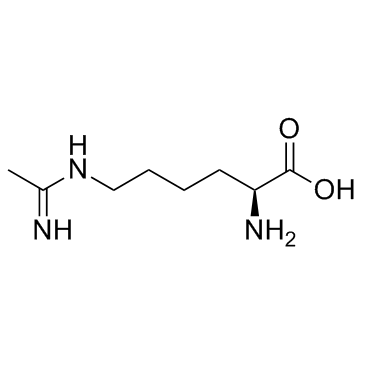
Description: L-NIL is a selective inhibitor of inducible nitric oxide synthase (iNOS) (IC50 = 3.3 μM for miNOS) with anti-inflammatory activity. L-NIL has an IC50 of 3.3 microM for miNOS compared to an IC50 of 92 microM for rat brain constitutive NOS indicating that L-NIL is 28-fold more selective for inducible NOS. L-N5-(1-Iminoethyl)ornithine (L-NIO), which differs from L-NIL by having one less methylene group, has very similar potency for inducible NOS, but lacks selectivity. DL-N7-(1-Iminoethyl)homolysine was also synthesized and found to be substantially less potent than L-NIL or L-NIO, with intermediate selectivity for inducible NOS. These data suggest that L-NIL may be useful as a selective inhibitor of inducible NOS for determining the role of this enzyme in disease models.
Physicochemical Properties
| Molecular Formula | C8H17N3O2 |
| Molecular Weight | 187.23948 |
| Exact Mass | 187.132 |
| CAS # | 53774-63-3 |
| Related CAS # | L-NIL hydrochloride;150403-89-7;L-NIL dihydrochloride;159190-45-1 |
| PubChem CID | 2733506 |
| Appearance | White to off-white solid powder |
| LogP | 1.346 |
| Hydrogen Bond Donor Count | 3 |
| Hydrogen Bond Acceptor Count | 4 |
| Rotatable Bond Count | 6 |
| Heavy Atom Count | 13 |
| Complexity | 192 |
| Defined Atom Stereocenter Count | 1 |
| SMILES | CC(=NCCCC[C@@H](C(=O)O)N)N |
| InChi Key | ONYFNWIHJBLQKE-ZETCQYMHSA-N |
| InChi Code | InChI=1S/C8H17N3O2/c1-6(9)11-5-3-2-4-7(10)8(12)13/h7H,2-5,10H2,1H3,(H2,9,11)(H,12,13)/t7-/m0/s1 |
| Chemical Name | (2S)-2-amino-6-(1-aminoethylideneamino)hexanoic acid |
| HS Tariff Code | 2934.99.9001 |
| Storage |
Powder-20°C 3 years 4°C 2 years In solvent -80°C 6 months -20°C 1 month Note: Please store this product in a sealed and protected environment, avoid exposure to moisture. |
| Shipping Condition | Room temperature (This product is stable at ambient temperature for a few days during ordinary shipping and time spent in Customs) |
Biological Activity
| ln Vitro | Both rat brain constitutive NOS (rcNOS) and mouse inducible NOS (miNOS) were inhibited concentration-dependently by L-NIL, with rcNOS being considerably more potent than miNOS. L-NIL was 28 times more selective for miNOS than rcNOS, as seen by its IC50 values of 3.3 and 92 pM with miNOS and rcNOS, respectively. Furthermore, L-NIL has a potency against miNOS that is about six times greater than that of L-NMA or L-NNA [3]. |
| ln Vivo | In mouse kidneys, L-NIL (10 and 30 mg/kg, IP) inhibits oxidative damage, autophagy, and inflammation brought on by IR [1]. |
| Animal Protocol |
Animal/Disease Models: Adult male Balb/c (20-25 g)[1]. Doses: 10 and 30 mg/kg. Route of Administration: Intraperitoneally at the end of CLP and at 6 h after sepsis induction. Experimental Results: Led to a negligible increase in plasma NGAL compared to sham mice. Led to a significant decrease in both TLR4 and IL1β protein contents and clusterin transcript. demonstrated an increase in NFAT5 mRNA levels, as compared with mice treated with vehicle. Promoted a decrease in AR protein expression, as compared with animals treated with vehicle. |
| References |
[1]. l-NIL prevents the ischemia and reperfusion injury involving TLR-4, GST, clusterin, and NFAT-5 in mice. Am J Physiol Renal Physiol. 2019 Apr 1;316(4):F624-F634. [2]. Intravenous Arginine Administration Downregulates NLRP3 Inflammasome Activity and Attenuates Acute Kidney Injury in Mice with Polymicrobial Sepsis. Mediators Inflamm. 2020 May 11;2020:3201635. [3]. L-N6-(1-iminoethyl)lysine: a selective inhibitor of inducible nitric oxide synthase. J Med Chem. 1994 Nov 11;37(23):3886-8. |
| Additional Infomation | N(6)-acetimidoyl-L-lysine is an L-lysine derivative that is L-lysine in which one of the hydrogens attached to N(6) is substituted by an acetimidoyl group It is a L-lysine derivative and a non-proteinogenic L-alpha-amino acid. It is a conjugate acid of a N(6)-acetimidoyl-L-lysinium(2+). |
Solubility Data
| Solubility (In Vitro) |
H2O : ~50 mg/mL (~267.04 mM) DMSO : ~1 mg/mL (~5.34 mM) |
| Solubility (In Vivo) |
Solubility in Formulation 1: 100 mg/mL (534.07 mM) in PBS (add these co-solvents sequentially from left to right, and one by one), clear solution; with sonication. (Please use freshly prepared in vivo formulations for optimal results.) |
| Preparing Stock Solutions | 1 mg | 5 mg | 10 mg | |
| 1 mM | 5.3407 mL | 26.7037 mL | 53.4074 mL | |
| 5 mM | 1.0681 mL | 5.3407 mL | 10.6815 mL | |
| 10 mM | 0.5341 mL | 2.6704 mL | 5.3407 mL |