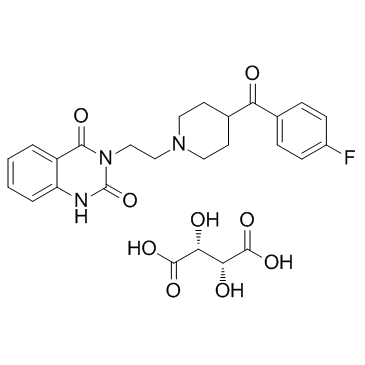
Ketanserin tartrate (R-41468; Vulketan) is an aprroved antihypertensive drug, acting as a potent and specific 5-HT2A serotonin receptor antagonist with a Ki of 2.5 nM for rat and human 5-HT2A. Additionally, it can be applied to distinguish between 5-HT1D and 5-HT1B receptor subtypes. When postjunctional alpha adrenergic activation occurs, ketanserin prevents the contraction of the canine saphenous vein and the rat caudal artery.
Physicochemical Properties
| Molecular Formula | C26H28FN3O9 |
| Molecular Weight | 545.52 |
| Exact Mass | 545.18 |
| Elemental Analysis | C, 57.25; H, 5.17; F, 3.48; N, 7.70; O, 26.40 |
| CAS # | 83846-83-7 |
| Related CAS # | Ketanserin; 74050-98-9 |
| PubChem CID | 3822 |
| Appearance | White to off-white solid powder |
| Boiling Point | 780.4ºC at 760 mmHg |
| Flash Point | 425.8ºC |
| LogP | 0.239 |
| Hydrogen Bond Donor Count | 1 |
| Hydrogen Bond Acceptor Count | 5 |
| Rotatable Bond Count | 5 |
| Heavy Atom Count | 29 |
| Complexity | 627 |
| Defined Atom Stereocenter Count | 0 |
| SMILES | FC1C([H])=C([H])C(=C([H])C=1[H])C(C1([H])C([H])([H])C([H])([H])N(C([H])([H])C([H])([H])N2C(N([H])C3=C([H])C([H])=C([H])C([H])=C3C2=O)=O)C([H])([H])C1([H])[H])=O |
| InChi Key | KMTLTEVOQLMYRS-UHFFFAOYSA-N |
| InChi Code | InChI=1S/C22H22FN3O3.C4H6O6/c23-17-7-5-15(6-8-17)20(27)16-9-11-25(12-10-16)13-14-26-21(28)18-3-1-2-4-19(18)24-22(26)29;5-1(3(7)8)2(6)4(9)10/h1-8,16H,9-14H2,(H,24,29);1-2,5-6H,(H,7,8)(H,9,10) |
| Chemical Name | 2,3-dihydroxybutanedioic acid;3-[2-[4-(4-fluorobenzoyl)piperidin-1-yl]ethyl]-1H-quinazoline-2,4-dione |
| Synonyms | Ketanserin tartrate; KJK-945; R49945; KJK945; Ketanserin tartrate; 83846-83-7; 3-(2-(4-(p-Fluorobenzoyl)-1-piperidinyl)ethyl)-2,4(1H,3H)-quinazolinedione L-tartrate; 2,3-dihydroxybutanedioic acid;3-[2-[4-(4-fluorobenzoyl)piperidin-1-yl]ethyl]-1H-quinazoline-2,4-dione; SMR000058867; KETANSERINTARTRATE; 3-[2-[4-(4-Fluorobenzoyl)-1-piperidinyl]ethyl]-2,4[1H,3H]-quinazolinedione tartrate; SR-01000002994; R 49945; KJK 945; R-49945 |
| HS Tariff Code | 2934.99.9001 |
| Storage |
Powder-20°C 3 years 4°C 2 years In solvent -80°C 6 months -20°C 1 month Note: Please store this product in a sealed and protected environment, avoid exposure to moisture. |
| Shipping Condition | Room temperature (This product is stable at ambient temperature for a few days during ordinary shipping and time spent in Customs) |
Biological Activity
| Targets | 5-HT2 Receptor; hERG current ( IC50 = 0.11 μM ) | ||
| ln Vitro |
|
||
| ln Vivo |
|
||
| Enzyme Assay | The serotonergic receptor antagonist 3-(2-[4-(4-fluorobenzoyl)-1-piperidinyl]ethyl)-2,4-[1H,3H]quinazolinedione Ketanserin (R 41 468) caused a dose-dependent inhibition on the contractile responses to 5-hydroxytryptamine of isolated rat caudal artery, canine basilar, carotid, coronary and gastrosplenic arteries, canine gastrosplenic veins (threshold 10(-10)-10(-9) M) and canine saphenous veins (threshold 10(-8) M). In concentrations up to 2.5 X 10(-5) M, it did not have agonistic properties. From 10(-8) M on, R 41 468 inhibited the contractions of rat caudal arteries and canine saphenous veins caused by postjunctional alpha adrenergic activation. In the rat caudal artery, R 41 468, in concentrations which did not affect the contractile response to norepinephrine, abolished the amplifying effect of low concentrations of 5-hydroxytryptamine on alpha adrenergic activation. In the canine saphenous vein, R 41 468 did not affect the prejunctional inhibitory effect of 5-hydroxytryptamine during sympathetic nerve stimulation. In the perfused guinea-pig stomach, R 41 468 depressed and in certain experiments reversed the vasoconstrictor response to 5-hydroxytryptamine. In isolated perfused kidneys from both normotensive and spontaneously hypertensive rats, R 41 468, in concentrations which did not depress vasoconstrictor responses to exogenous norepinephrine, inhibited those to 5-hydroxytryptamine. The compound caused a dose-related reduction in aortic blood pressure in unanesthetized spontaneously hypertensive rats, which was larger and occurred at lower concentrations, than in control animals. These results demonstrate that R 41 468 is a potent antagonist of the vasoconstrictor effects of 5-hydroxytryptamine, in particular of its amplifying effect on threshold amounts of norepinephrine, which may help explain its antihypertensive properties[J Pharmacol Exp Ther . 1981 Jul;218(1):217-30.]. | ||
| Cell Assay | The HEK 293 cell line, which has been established to express hERG channels consistently, is cultivated in Dulbecco's modified Eagles medium (DMEM) that has been enhanced with 10% foetal bovine serum and 400 μg/mL G418. The HEK 293 cell line is cultured in DMEM supplemented with 10% foetal bovine serum and 100 μg/mL hygromycin, which is responsible for the stable expression of recombinant human cardiac KCNQ1/KCNE1 channel current (IKs). On a glass coverslip, cells are seeded for electrophysiology. HEK 293 cells are used to create the mutant hERG channels, which are then temporarily expressed using 10 μL of Lipofectamine 2000 in combination with 4 μg of hERG mutant cDNA in pCDNA3 vector. | ||
| Animal Protocol |
|
||
| References |
[1]. The 5-HT2 antagonist Ketanserin is an open channel blocker of human cardiac ether-à-go-go-related gene (hERG) potassium channels. Br J Pharmacol. 2008 Oct;155(3):365-73. [2]. Investigation of cyclooxygenase and signaling pathways involved in human platelet aggregation mediated by synergistic interaction of various agonists. Drug Des Devel Ther. 2015 Jul 6;9:3497-506. [3]. Antiserotonergic properties of terguride in blood vessels, platelets, and valvular interstitial cells. J Pharmacol Exp Ther. 2012 Feb;340(2):369-76. [4]. Serotonin regulates brain-derived neurotrophic factor expression in select brain regions during acute psychological stress. Neural Regen Res. 2016 Sep;11(9):1471-1479. |
||
| Additional Infomation |
Ketanserin is a member of the class of quinazolines that is quinazoline-2,4(1H,3H)-dione which is substituted at position 3 by a 2-[4-(p-fluorobenzoyl)piperidin-1-yl]ethyl group. It has a role as an alpha-adrenergic antagonist, a serotonergic antagonist, an antihypertensive agent, a cardiovascular drug and an EC 3.4.21.26 (prolyl oligopeptidase) inhibitor. It is a member of quinazolines, a member of piperidines, an organofluorine compound and an aromatic ketone. It is a conjugate base of a ketanserin(1+). Ketanserin has been investigated for the treatment of Septic Shock, Severe Sepsis, and Diabetic Foot Ulcer. Ketanserin is a quinazoline derivative and serotonin (5-hydroxytryptamine, 5HT) receptor subtype 2 (5-HTR2) antagonist with potential antihypertensive and antiplatelet activities. Following administration, ketanserin binds to and inhibits the signaling mediated by 5-HTR2, which inhibits serotonin-dependent vasoconstriction and platelet activation. A selective serotonin receptor antagonist with weak adrenergic receptor blocking properties. The drug is effective in lowering blood pressure in essential hypertension. It also inhibits platelet aggregation. It is well tolerated and is particularly effective in older patients. See also: Ketanserin Tartrate (annotation moved to). |
Solubility Data
| Solubility (In Vitro) |
DMSO: ~125 mg/mL (~229.1 mM) H2O: ~6 mg/mL (~11.0 mM) |
| Solubility (In Vivo) |
Solubility in Formulation 1: ≥ 2.08 mg/mL (3.81 mM) (saturation unknown) in 10% DMSO + 40% PEG300 + 5% Tween80 + 45% Saline (add these co-solvents sequentially from left to right, and one by one), clear solution. For example, if 1 mL of working solution is to be prepared, you can add 100 μL of 20.8 mg/mL clear DMSO stock solution to 400 μL PEG300 and mix evenly; then add 50 μL Tween-80 to the above solution and mix evenly; then add 450 μL normal saline to adjust the volume to 1 mL. Preparation of saline: Dissolve 0.9 g of sodium chloride in 100 mL ddH₂ O to obtain a clear solution. Solubility in Formulation 2: ≥ 2.08 mg/mL (3.81 mM) (saturation unknown) in 10% DMSO + 90% (20% SBE-β-CD in Saline) (add these co-solvents sequentially from left to right, and one by one), clear solution. For example, if 1 mL of working solution is to be prepared, you can add 100 μL of 20.8 mg/mL clear DMSO stock solution to 900 μL of 20% SBE-β-CD physiological saline solution and mix evenly. Preparation of 20% SBE-β-CD in Saline (4°C,1 week): Dissolve 2 g SBE-β-CD in 10 mL saline to obtain a clear solution. Solubility in Formulation 3: ≥ 2.08 mg/mL (3.81 mM) (saturation unknown) in 10% DMSO + 90% Corn Oil (add these co-solvents sequentially from left to right, and one by one), clear solution. For example, if 1 mL of working solution is to be prepared, you can add 100 μL of 20.8 mg/mL clear DMSO stock solution to 900 μL of corn oil and mix evenly. (Please use freshly prepared in vivo formulations for optimal results.) |
| Preparing Stock Solutions | 1 mg | 5 mg | 10 mg | |
| 1 mM | 1.8331 mL | 9.1656 mL | 18.3311 mL | |
| 5 mM | 0.3666 mL | 1.8331 mL | 3.6662 mL | |
| 10 mM | 0.1833 mL | 0.9166 mL | 1.8331 mL |