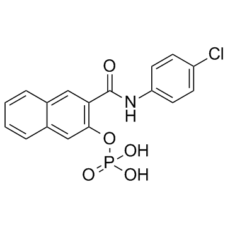
KG-501 is a potent inhibitor of CREB (cAMP response element-binding protein) with an IC50 of 6.89 μM. KG-501 (2-naphthol-AS-E-phosphate), targeted a surface distal to the CREB binding groove that includes Arg-600, a residue that is required for the CREB:CBP interaction. When added to live cells, KG-501 disrupted the CREB: CBP complex and attenuated target gene induction in response to cAMP agonist. These results demonstrate the ability of small molecules to interfere with second-messenger signaling cascades by inhibiting specific protein-protein interactions in the nucleus.
Physicochemical Properties
| Molecular Formula | C17H13CLNO5P | |
| Molecular Weight | 377.71 | |
| Exact Mass | 377.022 | |
| CAS # | 18228-17-6 | |
| Related CAS # |
|
|
| PubChem CID | 87517 | |
| Appearance | White to light yellow solid powder | |
| Density | 1.567g/cm3 | |
| Index of Refraction | 1.723 | |
| LogP | 4.29 | |
| Hydrogen Bond Donor Count | 3 | |
| Hydrogen Bond Acceptor Count | 5 | |
| Rotatable Bond Count | 4 | |
| Heavy Atom Count | 25 | |
| Complexity | 519 | |
| Defined Atom Stereocenter Count | 0 | |
| InChi Key | RQAQWBFHPMSXKR-UHFFFAOYSA-N | |
| InChi Code | InChI=1S/C17H13ClNO5P/c18-13-5-7-14(8-6-13)19-17(20)15-9-11-3-1-2-4-12(11)10-16(15)24-25(21,22)23/h1-10H,(H,19,20)(H2,21,22,23) | |
| Chemical Name |
|
|
| Synonyms |
|
|
| HS Tariff Code | 2934.99.9001 | |
| Storage |
Powder-20°C 3 years 4°C 2 years In solvent -80°C 6 months -20°C 1 month |
|
| Shipping Condition | Room temperature (This product is stable at ambient temperature for a few days during ordinary shipping and time spent in Customs) |
Biological Activity
| ln Vitro | In NSCLC, KG-501 suppresses CREB-target gene expression, disrupts the CREB-CBP complex, and blocks IL-1β-mediated angiogenic activity by directly targeting the KIX domain of CBP[1]. At CREB concentrations within the binding assay's linear range, KG-501 inhibits phospho (Ser-133) CREB binding to KIX with a Ki of about 90 μM. Moreover, KG-501 treatment of HEK293T cells prevents forskolin from inducing endogenous CREB target genes (NR4A2, αCG, c-fos, and RGS2), suggesting that KG-501 probably has a broad impact on CREB activity[2]. Because NF-κB requires CBP as a cofactor to regulate gene expression, KG-501 can also suppress NF-κB transcription activity. When A549 cells are treated with IL-1β + 10 μM of KG-501, the migration of HUVECs caused by CM is much less than when A549 cells are treated with IL-1β alone. With the exception of CXCL8, all IL-1β-induced CXC chemokine genes are suppressed at 10 μM by KG-501. At the protein level, CXCL5 protein production caused by IL-1β is markedly suppressed by KG-501. KG-501 has been shown to have comparable effects in the H1734 cell line[3]. | ||
| ln Vivo |
|
||
| Animal Protocol |
|
||
| References |
[1]. A Novel Small-Molecule Inhibitor Targeting CREB-CBP Complex Possesses Anti-Cancer Effects along with Cell Cycle Regulation, Autophagy Suppression and Endoplasmic Reticulum Stress. PLoS One. 2015 Apr 21;10(4):e0122628. [2]. Identification of small-molecule antagonists that inhibit an activator: coactivator interaction. Proc Natl Acad Sci U S A. 2004 Dec 21;101(51):17622-7. [3]. Cyclic AMP-responsive element binding protein- and nuclear factor-kappaB-regulated CXC chemokine gene expression in lung carcinogenesis. Cancer Prev Res (Phila). 2008 Oct;1(5):316-28. |
Solubility Data
| Solubility (In Vitro) |
|
|||
| Solubility (In Vivo) |
Solubility in Formulation 1: ≥ 2 mg/mL (5.29 mM) (saturation unknown) in 10% DMSO + 40% PEG300 + 5% Tween80 + 45% Saline (add these co-solvents sequentially from left to right, and one by one), clear solution. For example, if 1 mL of working solution is to be prepared, you can add 100 μL of 20.0 mg/mL clear DMSO stock solution to 400 μL PEG300 and mix evenly; then add 50 μL Tween-80 to the above solution and mix evenly; then add 450 μL normal saline to adjust the volume to 1 mL. Preparation of saline: Dissolve 0.9 g of sodium chloride in 100 mL ddH₂ O to obtain a clear solution. Solubility in Formulation 2: ≥ 2 mg/mL (5.29 mM) (saturation unknown) in 10% DMSO + 90% (20% SBE-β-CD in Saline) (add these co-solvents sequentially from left to right, and one by one), suspension solution. For example, if 1 mL of working solution is to be prepared, you can add 100 μL of 20.0 mg/mL clear DMSO stock solution to 900 μL of 20% SBE-β-CD physiological saline solution and mix evenly. Preparation of 20% SBE-β-CD in Saline (4°C,1 week): Dissolve 2 g SBE-β-CD in 10 mL saline to obtain a clear solution. Solubility in Formulation 3: ≥ 2 mg/mL (5.29 mM) (saturation unknown) in 10% DMSO + 90% Corn Oil (add these co-solvents sequentially from left to right, and one by one), clear solution. For example, if 1 mL of working solution is to be prepared, you can add 100 μL of 20.0 mg/mL clear DMSO stock solution to 900 μL of corn oil and mix evenly. (Please use freshly prepared in vivo formulations for optimal results.) |
| Preparing Stock Solutions | 1 mg | 5 mg | 10 mg | |
| 1 mM | 2.6475 mL | 13.2377 mL | 26.4753 mL | |
| 5 mM | 0.5295 mL | 2.6475 mL | 5.2951 mL | |
| 10 mM | 0.2648 mL | 1.3238 mL | 2.6475 mL |