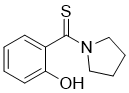
K-Ras-IN-1 (formerly known as K-Ras-Inhibitor-1) is a novel small molecule K-Ras inhibitor that binds to K-Ras in a hydrophobic pocket that is occupied by Tyr-71 in the apo-Ras crystal structure, in other words, K-Ras-IN-1 binds directly to K-Ras between switch I and switch II and inhibit Sos-catalyzed K-Ras activation. It inhibits Sos-mediated nucleotide exchange by attaching to K-Ras and preventing Sos from binding. K-Ras-IN-1 serves as a platform for acquiring probe molecules that are helpful in clarifying novel understandings of Ras signaling and in identifying K-Ras inhibitors for the management of cancer.
Physicochemical Properties
| Molecular Formula | C11H13NOS | |
| Molecular Weight | 207.29 | |
| Exact Mass | 207.071 | |
| Elemental Analysis | C, 63.74; H, 6.32; N, 6.76; O, 7.72; S, 15.47 | |
| CAS # | 84783-01-7 | |
| Related CAS # |
|
|
| PubChem CID | 551134 | |
| Appearance | White to off-white solid powder | |
| Density | 1.3±0.1 g/cm3 | |
| Boiling Point | 332.1±44.0 °C at 760 mmHg | |
| Flash Point | 154.7±28.4 °C | |
| Vapour Pressure | 0.0±0.7 mmHg at 25°C | |
| Index of Refraction | 1.668 | |
| LogP | 2.06 | |
| Hydrogen Bond Donor Count | 1 | |
| Hydrogen Bond Acceptor Count | 2 | |
| Rotatable Bond Count | 1 | |
| Heavy Atom Count | 14 | |
| Complexity | 213 | |
| Defined Atom Stereocenter Count | 0 | |
| SMILES | S=C(N1CCCC1)C1C(O)=CC=CC=1 |
|
| InChi Key | QIKLOVZAPGSYNO-UHFFFAOYSA-N | |
| InChi Code | InChI=1S/C11H13NOS/c13-10-6-2-1-5-9(10)11(14)12-7-3-4-8-12/h1-2,5-6,13H,3-4,7-8H2 | |
| Chemical Name | (2-hydroxyphenyl)-pyrrolidin-1-ylmethanethione | |
| Synonyms |
|
|
| HS Tariff Code | 2934.99.9001 | |
| Storage |
Powder-20°C 3 years 4°C 2 years In solvent -80°C 6 months -20°C 1 month |
|
| Shipping Condition | Room temperature (This product is stable at ambient temperature for a few days during ordinary shipping and time spent in Customs) |
Biological Activity
| Targets | K-Ras | ||
| ln Vitro |
|
||
| ln Vivo |
|
||
| Enzyme Assay | Compounds that blocked Sos-mediated nucleotide exchange were tested for their ability to investigate the functional effects of binding to K-Ras. In this experiment, BODIPY-GTP is swapped for unlabeled GDP, which is catalyzed by Sos and causes a rise in fluorescence. | ||
| Animal Protocol |
|
||
| References |
[1]. J Chem Inf Model . 2014 Feb 24;54(2):530-8. [2]. Angew Chem Int Ed Engl . 2012 Jun 18;51(25):6140-3. |
Solubility Data
| Solubility (In Vitro) |
|
|||
| Solubility (In Vivo) |
Solubility in Formulation 1: ≥ 2.5 mg/mL (12.06 mM) (saturation unknown) in 10% DMSO + 40% PEG300 + 5% Tween80 + 45% Saline (add these co-solvents sequentially from left to right, and one by one), clear solution. For example, if 1 mL of working solution is to be prepared, you can add 100 μL of 25.0 mg/mL clear DMSO stock solution to 400 μL PEG300 and mix evenly; then add 50 μL Tween-80 to the above solution and mix evenly; then add 450 μL normal saline to adjust the volume to 1 mL. Preparation of saline: Dissolve 0.9 g of sodium chloride in 100 mL ddH₂ O to obtain a clear solution. Solubility in Formulation 2: ≥ 2.5 mg/mL (12.06 mM) (saturation unknown) in 10% DMSO + 90% (20% SBE-β-CD in Saline) (add these co-solvents sequentially from left to right, and one by one), clear solution. For example, if 1 mL of working solution is to be prepared, you can add 100 μL of 25.0 mg/mL clear DMSO stock solution to 900 μL of 20% SBE-β-CD physiological saline solution and mix evenly. Preparation of 20% SBE-β-CD in Saline (4°C,1 week): Dissolve 2 g SBE-β-CD in 10 mL saline to obtain a clear solution. Solubility in Formulation 3: ≥ 2.5 mg/mL (12.06 mM) (saturation unknown) in 10% DMSO + 90% Corn Oil (add these co-solvents sequentially from left to right, and one by one), clear solution. For example, if 1 mL of working solution is to be prepared, you can add 100 μL of 25.0 mg/mL clear DMSO stock solution to 900 μL of corn oil and mix evenly. (Please use freshly prepared in vivo formulations for optimal results.) |
| Preparing Stock Solutions | 1 mg | 5 mg | 10 mg | |
| 1 mM | 4.8242 mL | 24.1208 mL | 48.2416 mL | |
| 5 mM | 0.9648 mL | 4.8242 mL | 9.6483 mL | |
| 10 mM | 0.4824 mL | 2.4121 mL | 4.8242 mL |