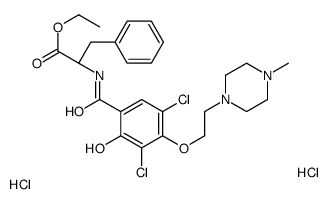
Description: JTE-607 HCl, the hydrochloride of JTE607, is a potent inhibitor of inflammatory cytokine production with the potential for the treatment of systemic inflammatory response. It induces apoptosis accompanied by an increase in p21waf1/cip1 in acute myelogenous leukemia cells. JTE-607 inhibits the production of TNF-α, IL-1β, IL-6, IL-8 and IL-10, from LPS-stimulated human PBMCs, with IC50s of 11, 5.9, 8.8, 7.3 and 9.1 nM, respectively.
Physicochemical Properties
| Molecular Formula | C22H29CL4N3O3 |
| Molecular Weight | 525.292 |
| Exact Mass | 595.117 |
| Elemental Analysis | C, 50.27; H, 5.57; Cl, 23.74; N, 7.03; O, 13.39 |
| CAS # | 188791-09-5 |
| Related CAS # | 188791-71-1;188791-09-5 (HCl); |
| PubChem CID | 9938544 |
| Appearance | White to off-white solid powder |
| LogP | 5.284 |
| Hydrogen Bond Donor Count | 4 |
| Hydrogen Bond Acceptor Count | 7 |
| Rotatable Bond Count | 11 |
| Heavy Atom Count | 37 |
| Complexity | 674 |
| Defined Atom Stereocenter Count | 1 |
| SMILES | ClC1=C(C(C(N([H])[C@]([H])(C(=O)OC([H])([H])C([H])([H])[H])C([H])([H])C2C([H])=C([H])C([H])=C([H])C=2[H])=O)=C([H])C(=C1OC([H])([H])C([H])([H])N1C([H])([H])C([H])([H])N(C([H])([H])[H])C([H])([H])C1([H])[H])Cl)O[H].Cl[H].Cl[H] |
| InChi Key | JUJAUEQJEWIWCQ-FJSYBICCSA-N |
| InChi Code | InChI=1S/C25H31Cl2N3O5.2ClH/c1-3-34-25(33)20(15-17-7-5-4-6-8-17)28-24(32)18-16-19(26)23(21(27)22(18)31)35-14-13-30-11-9-29(2)10-12-30/h4-8,16,20,31H,3,9-15H2,1-2H3,(H,28,32)2*1H/t20-/m0../s1 |
| Chemical Name | N-[3,5-Dichloro-2-hydroxy-4-[2-(4-methyl-1-piperazinyl)ethoxy]benzoyl]-L-phenylalanine ethyl ester dihydrochloride |
| Synonyms | TO-207; TO 207; TO207; JTE-607; JTE 607; JTE 607; JTE-607 HCl; JTE-607 dihydrochloride. |
| HS Tariff Code | 2934.99.9001 |
| Storage |
Powder-20°C 3 years 4°C 2 years In solvent -80°C 6 months -20°C 1 month Note: Please store this product in a sealed and protected environment, avoid exposure to moisture. |
| Shipping Condition | Room temperature (This product is stable at ambient temperature for a few days during ordinary shipping and time spent in Customs) |
Biological Activity
| ln Vitro | JTE-607, with an IC50 of 11, 5.9, 8.8, 7.3, and 9.1 nM, respectively, suppresses the production of inflammatory cytokines by LPS-stimulated human PBMC, including TNF-α, IL-1β, IL-6, IL-8, and IL-10. JTE-607 also has an inhibitory effect on these cytokines' mRNA expression [1]. With an IC 50 of roughly 10 nM, JTE-607 suppresses the release of inflammatory cytokines by LPS-stimulated human PBMC [1]. JTE607 has an IC50 of 59, 780, 1600, and 19000 nM, respectively, which suppresses the production of TNF-α in mouse and rat PBMC and LPS-stimulated IL-8 in monkey and rabbit PBMC [1]. Moreover, JTE607 suppresses IL-1RA and granulocyte-macrophage colony-stimulating factor, with IC50 values of 5.4±0.4 nM and 2.4±0.8 nM, respectively[1]. In monkey, rabbit, mouse, and rat, JTE-607 suppresses cytokine production with IC50 values of 59±26, 780±120, 1600±650, and 19000±3200 nM, respectively[1]. |
| ln Vivo | After an LPS exposure in C, JTE-607 (0.3–10 mg/kg, iv) dose-dependently lowers mortality. mice susceptible to parvum, while lowering TNF-α in mouse plasma [1]. |
| Cell Assay |
RT-PCR[1] Cell Types: human peripheral blood mononuclear cells (PBMCs) Tested Concentrations: 100 nM Incubation Duration: 20 hrs (hours) Experimental Results: decreased the increase in the level of mRNAs of TNF-α, IL-1b, IL-6 and IL -8. |
| Animal Protocol |
Animal/Disease Models: Male C57BL/6 mice (5 to 6 weeks old) are sensitized by injecting Corynebacterium parvum[1] Doses: 0.3, 1, 3, 10 mg/kg Route of Administration: Administered intravenously (iv)10 min before the LPS challenge. Experimental Results: demonstrated dose dependent inhibition of the mortality at 0.3 to 10 mg/kg and significant effect at 3 and 10 mg/kg. |
| References |
[1]. JTE-607, a novel inflammatory cytokine synthesis inhibitor without immunosuppression, protects from endotoxin shock in mice. Inflamm Res. 1999 Aug;48(8):461-8. [2]. CPSF3-dependent pre-mRNA processing as a druggable node in AML and Ewing's sarcoma. Nat Chem Biol. 2020 Jan;16(1):50-59. |
| Additional Infomation | JTE-607 dihydrochloride is the dihydrochloride salt of JTE-607. It is a cytokine inhibitor which suppresses the production of proinflammatory cytokines such as interleukin (IL-1beta), IL-6, IL-8, granulocyte macrophage colony stimulating factor (GM-CSF), and tumor necrosis factor (TNF-alpha). It acts as a pro-drug which is cleaved by carboxylesterase 1 (CES1) to its active free acid form, which then binds to cleavage and polyadenylation specificity factor 3 (CPSF3). It has a role as an anti-inflammatory agent, an antineoplastic agent, an apoptosis inducer, a prodrug, a cardioprotective agent and a CPSF3 inhibitor. It contains a JTE-607(2+). |
Solubility Data
| Solubility (In Vitro) |
DMSO : ~250 mg/mL (~418.51 mM) H2O : ~20 mg/mL (~33.48 mM) |
| Solubility (In Vivo) |
Solubility in Formulation 1: ≥ 2.08 mg/mL (3.48 mM) (saturation unknown) in 10% DMSO + 40% PEG300 + 5% Tween80 + 45% Saline (add these co-solvents sequentially from left to right, and one by one), clear solution. For example, if 1 mL of working solution is to be prepared, you can add 100 μL of 20.8 mg/mL clear DMSO stock solution to 400 μL PEG300 and mix evenly; then add 50 μL Tween-80 to the above solution and mix evenly; then add 450 μL normal saline to adjust the volume to 1 mL. Preparation of saline: Dissolve 0.9 g of sodium chloride in 100 mL ddH₂ O to obtain a clear solution. Solubility in Formulation 2: ≥ 2.08 mg/mL (3.48 mM) (saturation unknown) in 10% DMSO + 90% (20% SBE-β-CD in Saline) (add these co-solvents sequentially from left to right, and one by one), clear solution. For example, if 1 mL of working solution is to be prepared, you can add 100 μL of 20.8 mg/mL clear DMSO stock solution to 900 μL of 20% SBE-β-CD physiological saline solution and mix evenly. Preparation of 20% SBE-β-CD in Saline (4°C,1 week): Dissolve 2 g SBE-β-CD in 10 mL saline to obtain a clear solution. Solubility in Formulation 3: ≥ 2.08 mg/mL (3.48 mM) (saturation unknown) in 10% DMSO + 90% Corn Oil (add these co-solvents sequentially from left to right, and one by one), clear solution. For example, if 1 mL of working solution is to be prepared, you can add 100 μL of 20.8 mg/mL clear DMSO stock solution to 900 μL of corn oil and mix evenly. Solubility in Formulation 4: 100 mg/mL (167.40 mM) in PBS (add these co-solvents sequentially from left to right, and one by one), clear solution; with ultrasonication. (Please use freshly prepared in vivo formulations for optimal results.) |
| Preparing Stock Solutions | 1 mg | 5 mg | 10 mg | |
| 1 mM | 1.9037 mL | 9.5186 mL | 19.0371 mL | |
| 5 mM | 0.3807 mL | 1.9037 mL | 3.8074 mL | |
| 10 mM | 0.1904 mL | 0.9519 mL | 1.9037 mL |