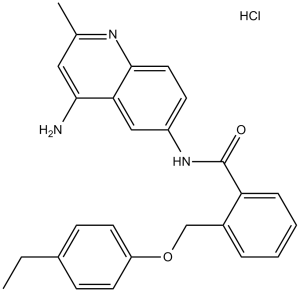
JTC-801 HCl (JTC 801; JTC801), the hydrochloride salt of JTC801, is a potent, orally bioactive and selective opioid receptor-like1 (ORL1) receptor antagonist with potential analgesic activity. It blocks opioid receptor-like1 (ORL1) with an IC50 of 94 nM.
Physicochemical Properties
| Molecular Formula | C26H26CLN3O2 | |
| Molecular Weight | 447.96 | |
| Exact Mass | 447.171 | |
| Elemental Analysis | C, 69.71; H, 5.85; Cl, 7.91; N, 9.38; O, 7.14 | |
| CAS # | 244218-51-7 | |
| Related CAS # |
|
|
| PubChem CID | 5311339 | |
| Appearance | White to off-white solid powder | |
| Boiling Point | 580.9ºC at 760mmHg | |
| Melting Point | 235℃ | |
| Flash Point | 305.1ºC | |
| Vapour Pressure | 1.73E-13mmHg at 25°C | |
| LogP | 6.975 | |
| Hydrogen Bond Donor Count | 3 | |
| Hydrogen Bond Acceptor Count | 4 | |
| Rotatable Bond Count | 6 | |
| Heavy Atom Count | 32 | |
| Complexity | 577 | |
| Defined Atom Stereocenter Count | 0 | |
| SMILES | Cl[H].O(C1C([H])=C([H])C(=C([H])C=1[H])C([H])([H])C([H])([H])[H])C([H])([H])C1=C([H])C([H])=C([H])C([H])=C1C(N([H])C1C([H])=C([H])C2C(=C(C([H])=C(C([H])([H])[H])N=2)N([H])[H])C=1[H])=O |
|
| InChi Key | NQLIYKXNAXKMBL-UHFFFAOYSA-N | |
| InChi Code | InChI=1S/C26H25N3O2.ClH/c1-3-18-8-11-21(12-9-18)31-16-19-6-4-5-7-22(19)26(30)29-20-10-13-25-23(15-20)24(27)14-17(2)28-25;/h4-15H,3,16H2,1-2H3,(H2,27,28)(H,29,30);1H | |
| Chemical Name | N-(4-amino-2-methylquinolin-6-yl)-2-[(4-ethylphenoxy)methyl]benzamide;hydrochloride | |
| Synonyms |
|
|
| HS Tariff Code | 2934.99.9001 | |
| Storage |
Powder-20°C 3 years 4°C 2 years In solvent -80°C 6 months -20°C 1 month Note: Please store this product in a sealed and protected environment, avoid exposure to moisture. |
|
| Shipping Condition | Room temperature (This product is stable at ambient temperature for a few days during ordinary shipping and time spent in Customs) |
Biological Activity
| Targets | NOP Receptor/ORL1 | |
| ln Vitro |
|
|
| ln Vivo |
|
|
| Enzyme Assay | Membranes from human μ-opioid receptor-expressing CHO-K1 cells suspended in 50 mM Tris-HCl buffer (pH 7.4) with 10% sucrose, 5 mM MgCl2, and 0.33 nM 2H-labeled diprenorphine are incubated for 2.5 hours at room temperature with different concentrations of JTC-801. Whatman 934-AH is used to filter the membranes, and a TopCount A9912V scintillation counter is used to count radioactivity. 10 μM naloxone is used to measure nonspecific binding (6.4%). By deducting nonspecific binding from total binding, specific binding is computed. The mean±SE (n=3) is the data. | |
| Animal Protocol |
|
|
| References |
[1]. Br J Pharmacol . 2002 Jan;135(2):323-32. [2]. J Med Chem . 2000 Nov 30;43(24):4667-77. [3]. Neurosci Lett . 2003 Nov 20;351(3):133-6. [4]. Eur J Pharmacol . 2005 Mar 14;510(3):223-8. [5]. Neuropeptides . 2007 Aug;41(4):239-47. [6]. Pharmacol Biochem Behav . 2011 Oct;99(4):540-4. |
Solubility Data
| Solubility (In Vitro) |
|
|||
| Solubility (In Vivo) |
Solubility in Formulation 1: ≥ 2.5 mg/mL (5.58 mM) (saturation unknown) in 10% DMSO + 40% PEG300 + 5% Tween80 + 45% Saline (add these co-solvents sequentially from left to right, and one by one), clear solution. For example, if 1 mL of working solution is to be prepared, you can add 100 μL of 25.0 mg/mL clear DMSO stock solution to 400 μL PEG300 and mix evenly; then add 50 μL Tween-80 to the above solution and mix evenly; then add 450 μL normal saline to adjust the volume to 1 mL. Preparation of saline: Dissolve 0.9 g of sodium chloride in 100 mL ddH₂ O to obtain a clear solution. Solubility in Formulation 2: ≥ 2.5 mg/mL (5.58 mM) (saturation unknown) in 10% DMSO + 90% (20% SBE-β-CD in Saline) (add these co-solvents sequentially from left to right, and one by one), clear solution. For example, if 1 mL of working solution is to be prepared, you can add 100 μL of 25.0 mg/mL clear DMSO stock solution to 900 μL of 20% SBE-β-CD physiological saline solution and mix evenly. Preparation of 20% SBE-β-CD in Saline (4°C,1 week): Dissolve 2 g SBE-β-CD in 10 mL saline to obtain a clear solution. Solubility in Formulation 3: ≥ 2.5 mg/mL (5.58 mM) (saturation unknown) in 10% DMSO + 90% Corn Oil (add these co-solvents sequentially from left to right, and one by one), clear solution. For example, if 1 mL of working solution is to be prepared, you can add 100 μL of 25.0 mg/mL clear DMSO stock solution to 900 μL of corn oil and mix evenly. Solubility in Formulation 4: 0.5% methylcellulose: 30 mg/mL (Please use freshly prepared in vivo formulations for optimal results.) |
| Preparing Stock Solutions | 1 mg | 5 mg | 10 mg | |
| 1 mM | 2.2323 mL | 11.1617 mL | 22.3234 mL | |
| 5 mM | 0.4465 mL | 2.2323 mL | 4.4647 mL | |
| 10 mM | 0.2232 mL | 1.1162 mL | 2.2323 mL |