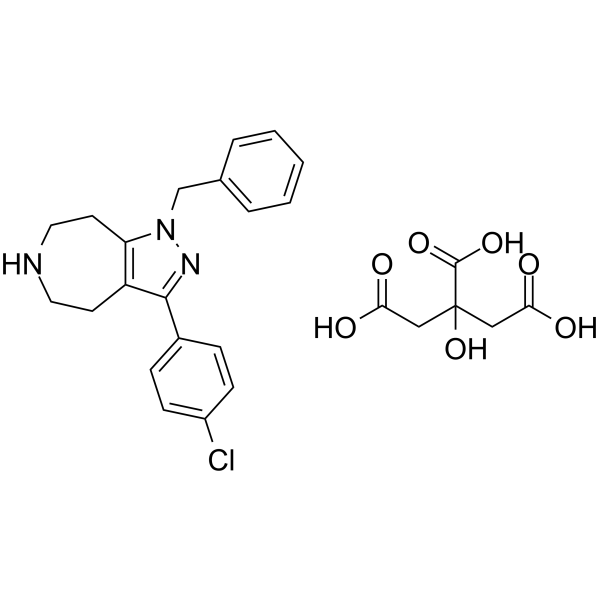
JNJ-18038683 is a novel and potent antagonist of 5-Hydroxytryptamine Type 7 (5-HT7) receptor with pKis of 8.19, 8.20 for rat and human 5-HT7 in HEK293 cells, respectively. In rodents, JNJ-18038683 increased the latency to REM sleep and decreased REM duration, and this effect was maintained after repeated administration for 7 days. The compound was effective in the mouse tail suspension test. JNJ-18038683 enhanced serotonin transmission, antidepressant-like behavior, and REM sleep suppression induced by citalopram in rodents. In healthy human volunteers JNJ-18038683 prolonged REM latency and reduced REM sleep duration, demonstrating that the effect of 5-HT(7) blockade on REM sleep translated from rodents to humans. Like in rats, JNJ-18038683 enhanced REM sleep suppression induced by citalopram in humans, although a drug-drug interaction could not be ruled out. In a double-blind, active, and placebo-controlled clinical trial in 225 patients suffering from major depressive disorder, neither treatment with pharmacologically active doses of JNJ-18038683 or escitalopram separated from placebo, indicating a failed study lacking assay sensitivity. Post hoc analyses using an enrichment window strategy, where all the efficacy data from sites with an implausible high placebo response [placebo group Montgomery-Åsberg Depression Rating Scale (MADRS) < = 12] and from sites with no placebo response (MADRS > = 28) are removed, there was a clinically meaningful difference between JNJ-18038683 and placebo. Further clinical studies are required to characterize the potential antidepressant efficacy of JNJ-18038683.
Physicochemical Properties
| Molecular Formula | C20H20N3CL |
| Molecular Weight | 337.8459 |
| Exact Mass | 337.134 |
| CAS # | 851373-91-6 |
| Related CAS # | 851376-05-1 (citrate);851373-91-6; |
| PubChem CID | 11151899 |
| Appearance | White to off-white solid powder |
| Density | 1.3±0.1 g/cm3 |
| Boiling Point | 547.6±50.0 °C at 760 mmHg |
| Flash Point | 285.0±30.1 °C |
| Vapour Pressure | 0.0±1.5 mmHg at 25°C |
| Index of Refraction | 1.656 |
| LogP | 3.84 |
| Hydrogen Bond Donor Count | 1 |
| Hydrogen Bond Acceptor Count | 2 |
| Rotatable Bond Count | 3 |
| Heavy Atom Count | 24 |
| Complexity | 390 |
| Defined Atom Stereocenter Count | 0 |
| InChi Key | UKJPMZGILXATGT-UHFFFAOYSA-N |
| InChi Code | InChI=1S/C20H20ClN3/c21-17-8-6-16(7-9-17)20-18-10-12-22-13-11-19(18)24(23-20)14-15-4-2-1-3-5-15/h1-9,22H,10-14H2 |
| Chemical Name | 3-(4-chlorophenyl)-1-(phenylmethyl)-5,6,7,8-tetrahydro-4H-pyrazolo[5,4-d]azepine |
| Synonyms | JNJ-18038683; JNJ 18038683; JNJ18038683. |
| HS Tariff Code | 2934.99.9001 |
| Storage |
Powder-20°C 3 years 4°C 2 years In solvent -80°C 6 months -20°C 1 month Note: Please store this product in a sealed and protected environment, avoid exposure to moisture. |
| Shipping Condition | Room temperature (This product is stable at ambient temperature for a few days during ordinary shipping and time spent in Customs) |
Biological Activity
| ln Vitro | High affinity [3H]5-CT binding sites from the rat and human 5-HT7 receptors expressed in HEK293 cells were displaced by JNJ-18038683 (pKi=8.19±0.02 and 8.20±0.01, respectively). On the natural 5-HT7 in rat thalamus membranes, comparable values (pKi=8.50±0.20) are found. The values of the hill slope are nearly equal to one, indicating one-site competitive binding. The assessment of adenylate cyclase activity in HEK293 cells expressing the human or rat 5-HT7 receptor determines the antagonist potency of JNJ-18038683. Rat and human 5-HT7/HEK293 cells exhibit enhanced adenylyl cyclase activity in response to 5-HT, with pEC50 values of 8.09 and 8.12, respectively. The concentration-dependent reduction of 5-HT (100 nM)-stimulated adenylyl cyclase is seen while using JNJ-18038683. The related Ki values from [3H]5-CT binding studies[1] and the pKB values found for JNJ-18038683 accord well. |
| ln Vivo | REM sleep is dose-dependently suppressed by JNJ-18038683, often in the first four hours following therapy. After oral delivery, the duration of REM sleep is considerably reduced during the first four hours (P<0.05) starting at a dose of 1 mg/kg. Alongside this, there is a tendency for the REM sleep latency to be prolonged in a dosage-related manner. Only at the highest tested dose (10 mg/kg; P<0.05) does there appear to be a significant increase in REM latency. These changes in REM sleep appear to be condition-specific. A further investigation is carried out to ascertain whether the repeated administration of JNJ-18038683 for a duration of seven days would lead to any modification of the EEG sleep response, specifically on REM sleep, in rats both during and following treatment. For seven days in a row, JNJ-18038683 is given subcutaneously at a dose of 1 mg/kg every day, two hours into the light phase. JNJ-18038683 causes a prolonging of the REM sleep latency and a considerable reduction in the amount of time spent in REM sleep within the first eight hours following the injection on the first day of treatment. During the seven days of repeated treatment, the REM sleep latency increases; on the first recovery day following treatment termination, it returns to normal. Throughout the seven-day repeated treatment, there is no discernible increase in the amount of time spent in REM sleep; instead, a rebound takes place on the first recovery day following treatment termination. Throughout the course of the treatment, neither the NREM sleep latency nor the total NREM sleep duration are impacted[1]. |
| References |
[1]. Translational evaluation of JNJ-18038683, a 5-hydroxytryptamine type 7 receptor antagonist, on rapid eye movement sleep and in major depressive disorder. J Pharmacol Exp Ther. 2012 Aug;342(2):429-40. |
| Additional Infomation | See also: Jnj-18038683 (annotation moved to). |
Solubility Data
| Solubility (In Vitro) | May dissolve in DMSO (in most cases), if not, try other solvents such as H2O, Ethanol, or DMF with a minute amount of products to avoid loss of samples |
| Solubility (In Vivo) |
Note: Listed below are some common formulations that may be used to formulate products with low water solubility (e.g. < 1 mg/mL), you may test these formulations using a minute amount of products to avoid loss of samples. Injection Formulations (e.g. IP/IV/IM/SC) Injection Formulation 1: DMSO : Tween 80: Saline = 10 : 5 : 85 (i.e. 100 μL DMSO stock solution → 50 μL Tween 80 → 850 μL Saline) *Preparation of saline: Dissolve 0.9 g of sodium chloride in 100 mL ddH ₂ O to obtain a clear solution. Injection Formulation 2: DMSO : PEG300 :Tween 80 : Saline = 10 : 40 : 5 : 45 (i.e. 100 μL DMSO → 400 μLPEG300 → 50 μL Tween 80 → 450 μL Saline) Injection Formulation 3: DMSO : Corn oil = 10 : 90 (i.e. 100 μL DMSO → 900 μL Corn oil) Example: Take the Injection Formulation 3 (DMSO : Corn oil = 10 : 90) as an example, if 1 mL of 2.5 mg/mL working solution is to be prepared, you can take 100 μL 25 mg/mL DMSO stock solution and add to 900 μL corn oil, mix well to obtain a clear or suspension solution (2.5 mg/mL, ready for use in animals). Injection Formulation 4: DMSO : 20% SBE-β-CD in saline = 10 : 90 [i.e. 100 μL DMSO → 900 μL (20% SBE-β-CD in saline)] *Preparation of 20% SBE-β-CD in Saline (4°C,1 week): Dissolve 2 g SBE-β-CD in 10 mL saline to obtain a clear solution. Injection Formulation 5: 2-Hydroxypropyl-β-cyclodextrin : Saline = 50 : 50 (i.e. 500 μL 2-Hydroxypropyl-β-cyclodextrin → 500 μL Saline) Injection Formulation 6: DMSO : PEG300 : castor oil : Saline = 5 : 10 : 20 : 65 (i.e. 50 μL DMSO → 100 μLPEG300 → 200 μL castor oil → 650 μL Saline) Injection Formulation 7: Ethanol : Cremophor : Saline = 10: 10 : 80 (i.e. 100 μL Ethanol → 100 μL Cremophor → 800 μL Saline) Injection Formulation 8: Dissolve in Cremophor/Ethanol (50 : 50), then diluted by Saline Injection Formulation 9: EtOH : Corn oil = 10 : 90 (i.e. 100 μL EtOH → 900 μL Corn oil) Injection Formulation 10: EtOH : PEG300:Tween 80 : Saline = 10 : 40 : 5 : 45 (i.e. 100 μL EtOH → 400 μLPEG300 → 50 μL Tween 80 → 450 μL Saline) Oral Formulations Oral Formulation 1: Suspend in 0.5% CMC Na (carboxymethylcellulose sodium) Oral Formulation 2: Suspend in 0.5% Carboxymethyl cellulose Example: Take the Oral Formulation 1 (Suspend in 0.5% CMC Na) as an example, if 100 mL of 2.5 mg/mL working solution is to be prepared, you can first prepare 0.5% CMC Na solution by measuring 0.5 g CMC Na and dissolve it in 100 mL ddH2O to obtain a clear solution; then add 250 mg of the product to 100 mL 0.5% CMC Na solution, to make the suspension solution (2.5 mg/mL, ready for use in animals). Oral Formulation 3: Dissolved in PEG400 Oral Formulation 4: Suspend in 0.2% Carboxymethyl cellulose Oral Formulation 5: Dissolve in 0.25% Tween 80 and 0.5% Carboxymethyl cellulose Oral Formulation 6: Mixing with food powders Note: Please be aware that the above formulations are for reference only. InvivoChem strongly recommends customers to read literature methods/protocols carefully before determining which formulation you should use for in vivo studies, as different compounds have different solubility properties and have to be formulated differently. (Please use freshly prepared in vivo formulations for optimal results.) |
| Preparing Stock Solutions | 1 mg | 5 mg | 10 mg | |
| 1 mM | 2.9599 mL | 14.7995 mL | 29.5989 mL | |
| 5 mM | 0.5920 mL | 2.9599 mL | 5.9198 mL | |
| 10 mM | 0.2960 mL | 1.4799 mL | 2.9599 mL |