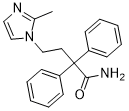
Imidafenacin (formerly also known as KRP-197 and ONO-8025) is a novel, potent and selective inhibitor of M3 receptors with Kb of 0.317 nM and with less potency for M2 receptors (IC50 = 4.13 nM).
Physicochemical Properties
| Molecular Formula | C20H21N3O |
| Molecular Weight | 319.40024 |
| Exact Mass | 319.168 |
| Elemental Analysis | C, 75.21; H, 6.63; N, 13.16; O, 5.01 |
| CAS # | 170105-16-5 |
| Related CAS # | 170105-16-5; 893421-54-0 (Imidafenacin HCl) |
| PubChem CID | 6433090 |
| Appearance | White to off-white solid powder |
| Density | 1.1±0.1 g/cm3 |
| Boiling Point | 579.7±50.0 °C at 760 mmHg |
| Flash Point | 304.4±30.1 °C |
| Vapour Pressure | 0.0±1.6 mmHg at 25°C |
| Index of Refraction | 1.603 |
| LogP | 2.42 |
| Hydrogen Bond Donor Count | 1 |
| Hydrogen Bond Acceptor Count | 2 |
| Rotatable Bond Count | 6 |
| Heavy Atom Count | 24 |
| Complexity | 395 |
| Defined Atom Stereocenter Count | 0 |
| SMILES | NC(C(C1=CC=CC=C1)(C2=CC=CC=C2)CCN3C(C)=NC=C3)=O |
| InChi Key | SQKXYSGRELMAAU-UHFFFAOYSA-N |
| InChi Code | InChI=1S/C20H21N3O/c1-16-22-13-15-23(16)14-12-20(19(21)24,17-8-4-2-5-9-17)18-10-6-3-7-11-18/h2-11,13,15H,12,14H2,1H3,(H2,21,24) |
| Chemical Name | 4-(2-methylimidazol-1-yl)-2,2-diphenylbutanamide |
| Synonyms | KRP-197; ONO-8025; KRP 197; ONO 8025; KRP197; ONO8025 |
| HS Tariff Code | 2934.99.9001 |
| Storage |
Powder-20°C 3 years 4°C 2 years In solvent -80°C 6 months -20°C 1 month |
| Shipping Condition | Room temperature (This product is stable at ambient temperature for a few days during ordinary shipping and time spent in Customs) |
Biological Activity
| Targets | M3 receptor ( Ki = 0.3 nM ); M3 receptor ( Kd = 0.317 nM ); M2 receptor ( IC50 = 4.13 nM ) |
| ADME/Pharmacokinetics |
Absorption, Distribution and Excretion The absolute oral bioavailability is 57.8%. Tmax is 1-3 h after administration. 10% is excreted in the urine as the parent compound. Most is eliminated by metabolism thought to be mediated by CYP3A4 and UGT1A4. The estimated volume of distribution is 43.9 L. The estimated clearance is 21.2 L/h. Metabolism / Metabolites Thought to be metabolized v by CYP3A4 and UGT1A4. No active metabolites have been observed. Biological Half-Life The half life of elimination is 3 h. |
| Toxicity/Toxicokinetics |
Protein Binding Imidafenacin is 88% bounf by human plasma proteins. It binds to serum albumin and α1-acid glycoprotein. |
| References |
[1]. Synthesis and antimuscarinic activity of a series of 4-(1-Imidazolyl)-2,2-diphenylbutyramides: discovery of potent and subtype-selective antimuscarinic agents. Bioorg Med Chem. 1999 Jun;7(6):1151-61. [2]. Imidafenacin has no influence on learning in nucleus basalis of Meynert-lesioned rats. Naunyn Schmiedebergs Arch Pharmacol. 2013 Dec;386(12):1095-102. |
| Additional Infomation |
Imidafenacin is a diarylmethane. Imidafenacin is an antispasmodic agent with anticholinergic effects. It antagonizes muscarinic receptors in the bladder to reduce the frequency of urination in the treatment of overactive bladder. It is marketed in Japan under the tradenames Staybla by Ono Pharmaceutical and Uritos by Kyojin Pharmaceutical. Drug Indication Used in the treatment of overactive bladder. FDA Label Mechanism of Action Imidafenacin binds to and antagonizes muscarinic M1 and M3 receptors with high affinity. It also antagonizes muscarinic M2 receptors but with lower affinity. M3 receptors stimulate contraction of the detrusor muscle in the bladder via release of calcium from the sarcoplasmic reticulum. M2 receptors are also present in the detrusor muscle but serve to inhibit adenylate cyclase which reduces the relaxation mediated by β adrenergic receptors. Finally, M1 receptors are present on the parasympathetic neurons which release acetylcholine in the bladder. They act as an autocrine positive feedback loop and further increase release of acetylcholine. Antagonism of these receptors by imidafenacin prevents contraction of the bladder's detrusor muscle, prevents inhibition of the relation produced by sympathetic tone, and reduces acetylcholine release. Together these reduce the frequency of urination. Pharmacodynamics Imidafenacin is an antimuscarinic agent which acts to reduce the frequency of urination in patients with overactive bladder. |
Solubility Data
| Solubility (In Vitro) | DMSO: 31.3~63 mg/mL (97.8~197.2 mM) |
| Solubility (In Vivo) |
Solubility in Formulation 1: ≥ 2.08 mg/mL (6.51 mM) (saturation unknown) in 10% DMSO + 40% PEG300 + 5% Tween80 + 45% Saline (add these co-solvents sequentially from left to right, and one by one), clear solution. For example, if 1 mL of working solution is to be prepared, you can add 100 μL of 20.8 mg/mL clear DMSO stock solution to 400 μL PEG300 and mix evenly; then add 50 μL Tween-80 to the above solution and mix evenly; then add 450 μL normal saline to adjust the volume to 1 mL. Preparation of saline: Dissolve 0.9 g of sodium chloride in 100 mL ddH₂ O to obtain a clear solution. Solubility in Formulation 2: ≥ 2.08 mg/mL (6.51 mM) (saturation unknown) in 10% DMSO + 90% (20% SBE-β-CD in Saline) (add these co-solvents sequentially from left to right, and one by one), clear solution. For example, if 1 mL of working solution is to be prepared, you can add 100 μL of 20.8 mg/mL clear DMSO stock solution to 900 μL of 20% SBE-β-CD physiological saline solution and mix evenly. Preparation of 20% SBE-β-CD in Saline (4°C,1 week): Dissolve 2 g SBE-β-CD in 10 mL saline to obtain a clear solution. Solubility in Formulation 3: ≥ 2.08 mg/mL (6.51 mM) (saturation unknown) in 10% DMSO + 90% Corn Oil (add these co-solvents sequentially from left to right, and one by one), clear solution. For example, if 1 mL of working solution is to be prepared, you can add 100 μL of 20.8 mg/mL clear DMSO stock solution to 900 μL of corn oil and mix evenly. (Please use freshly prepared in vivo formulations for optimal results.) |
| Preparing Stock Solutions | 1 mg | 5 mg | 10 mg | |
| 1 mM | 3.1309 mL | 15.6544 mL | 31.3087 mL | |
| 5 mM | 0.6262 mL | 3.1309 mL | 6.2617 mL | |
| 10 mM | 0.3131 mL | 1.5654 mL | 3.1309 mL |