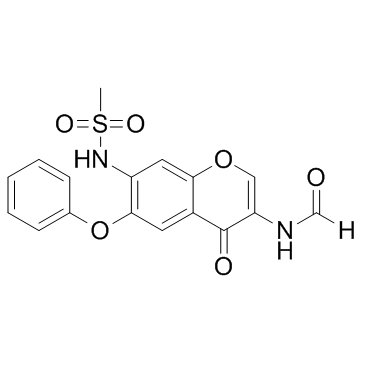
Iguratimod (T614; T-614) is a 4H-1-benzopyran-based antirheumatic agent acting as a novel and potent nhibitor of COX-2 (IC50 = 20 μM) with no effect on COX-1. It also inhibits macrophage migration inhibitory factor (MIF) with an IC50 of 6.81 μM.
Physicochemical Properties
| Molecular Formula | C17H14N2O6S |
| Molecular Weight | 374.37 |
| Exact Mass | 374.057 |
| Elemental Analysis | C, 54.54; H, 3.77; N, 7.48; O, 25.64; S, 8.57 |
| CAS # | 123663-49-0 |
| PubChem CID | 124246 |
| Appearance | White to off-white solid powder |
| Density | 1.5±0.1 g/cm3 |
| Boiling Point | 580.6±60.0 °C at 760 mmHg |
| Melting Point | 238.0 to 242.0 °C |
| Flash Point | 304.9±32.9 °C |
| Vapour Pressure | 0.0±1.6 mmHg at 25°C |
| Index of Refraction | 1.674 |
| LogP | 1.83 |
| Hydrogen Bond Donor Count | 2 |
| Hydrogen Bond Acceptor Count | 7 |
| Rotatable Bond Count | 5 |
| Heavy Atom Count | 26 |
| Complexity | 665 |
| Defined Atom Stereocenter Count | 0 |
| SMILES | CS(=O)(=O)NC1=C(C=C2C(=C1)OC=C(C2=O)NC=O)OC3=CC=CC=C3 |
| InChi Key | ANMATWQYLIFGOK-UHFFFAOYSA-N |
| InChi Code | InChI=1S/C17H14N2O6S/c1-26(22,23)19-13-8-15-12(17(21)14(9-24-15)18-10-20)7-16(13)25-11-5-3-2-4-6-11/h2-10,19H,1H3,(H,18,20) |
| Chemical Name | N-(7-(methylsulfonamido)-4-oxo-6-phenoxy-4H-chromen-3-yl)formamide |
| Synonyms | T614; Iguratimod; 123663-49-0; Careram; Kolbet; T 614; 4IHY34Y2NV; DTXSID0048971; DTXCID3028897; T-614 N7methanesulfonamido4oxo6(phenoxy)chromen3ylformamide |
| HS Tariff Code | 2934.99.9001 |
| Storage |
Powder-20°C 3 years 4°C 2 years In solvent -80°C 6 months -20°C 1 month |
| Shipping Condition | Room temperature (This product is stable at ambient temperature for a few days during ordinary shipping and time spent in Customs) |
Biological Activity
| Targets |
- Cyclooxygenase-2 (COX-2) (IC50 = 20 μM for enzyme activity inhibition) [1] - Macrophage Migration Inhibitory Factor (MIF) (Ki = 6.8 μM for tautomerase activity inhibition) [3] |
| ln Vitro |
Iguratimod (T-614) is an antirheumatic medication that inhibits COX-2 with an IC50 of 20 μM (7.7 μg/mL) but does not affect COX-1. Iguratimod (0.1–10 μg/mL) reduces bradykinin-induced PGE2 release from fibroblasts. Iguratimod suppresses COX activity in bradykinin-stimulated fibroblasts in a concentration-dependent manner (IC50 = 48 μg/mL). Iguratimod (10 and 30 μg/mL) suppresses COX-2 mRNA in a dose-dependent manner [1]. Furthermore, Iguratimod significantly suppresses macrophage migration inhibitory factor (MIF) with an IC50 of 6.81 μM. In vitro, iguratimod interacts synergistically with glucocorticoids [3].
- Iguratimod (T-614) inhibits COX-2 activity in a dose-dependent manner with an IC50 of 3.8 μM, while showing weaker inhibition on COX-1 (IC50 > 100 μM). It also suppresses the induction of COX-2 protein and mRNA expression in fibroblasts stimulated by interleukin-1β (IL-1β), reducing prostaglandin E2 (PGE2) production. The inhibition of COX-2 induction is associated with decreased nuclear factor-κB (NF-κB) activation [1] - Iguratimod (T-614) inhibits MIF tautomerase activity with a Ki of 1.2 μM and blocks MIF-induced extracellular signal-regulated kinase (ERK) phosphorylation in THP-1 cells. It also reduces MIF-mediated chemotaxis of THP-1 cells and peripheral blood mononuclear cells (PBMCs) in a dose-dependent manner [3] |
| ln Vivo |
In a dose-dependent manner, iguratimod (5 or 20 mg/kg) exhibited analgesic effects and markedly raised the rats' left hindpaw's pain threshold. The rise in pERK1/2 and c-Fos in the spinal cord brought on by cancer cell injection is decreased by iguratimod (5 or 20 mg/kg). In rats, iguratimod similarly decreased IL-6 levels in a dose-dependent manner. Rats treated with Iguratimod have decreased osteoclast activity compared to the control group [2]. It has been demonstrated that iguratimod (20 mg/kg ip) considerably increases the survival of endotoxemia-prone BALB/c mice and reduces isolated TNFα release in the serum of wild-type C57BL/6 mice 90 minutes after LPS injection [3].
- In a rat model of cancer-induced bone pain (CIBP) established by inoculating Walker 256 breast cancer cells into the tibia, oral administration of Iguratimod (T-614) (10 and 30 mg/kg/day) for 14 days dose-dependently reduces mechanical allodynia and thermal hyperalgesia. It also decreases bone destruction, as shown by reduced osteoclast numbers and tartrate-resistant acid phosphatase (TRAP) activity in bone tissue, and lowers the levels of pro-inflammatory cytokines (TNF-α, IL-1β) in serum and bone marrow [2] - Iguratimod (T-614) (30 mg/kg/day, oral) reduces MIF-mediated inflammation in a mouse model of acute lung injury, decreasing neutrophil infiltration and cytokine levels (IL-6, KC) in bronchoalveolar lavage fluid (BALF). It also enhances the anti-inflammatory effect of dexamethasone in this model, showing steroid-sparing potential [3] |
| Enzyme Assay |
- COX-2 activity assay: Recombinant human COX-2 enzyme was incubated with different concentrations of Iguratimod (T-614) and arachidonic acid substrate. PGE2 production was measured by radioimmunoassay to determine the IC50 for COX-2 inhibition. A similar assay with COX-1 was performed to assess selectivity [1] - MIF tautomerase activity assay: MIF was incubated with Iguratimod (T-614) and the substrate 4-hydroxyphenylpyruvate (HPP). The rate of HPP tautomerization was measured spectrophotometrically at 340 nm, and kinetic parameters (Ki) were calculated using nonlinear regression analysis [3] |
| Cell Assay |
Briefly, human Raji B cells are plated at a density of 0.5 × 10⁴ cells/well in a 96-well plate and synchronized by incubation for 24 h in RPMI 1640 medium supplemented with 0.1-0.5% FBS. Synchronized cells are pretreated with Iguratimod or vehicle for 30 min prior to stimulation with macrophage migration inhibitory factor (MIF) for 24 h. At 20 h BrdU is added to cells and quantified using a BrdU Cell proliferation assay kit[3]. - Fibroblast COX-2 induction assay: Fibroblasts were pretreated with Iguratimod (T-614) (0.1-100 μM) for 1 hour, then stimulated with IL-1β (10 ng/ml) for 6 hours (for mRNA) or 24 hours (for protein). COX-2 mRNA was measured by Northern blot, and protein by Western blot. PGE2 levels in culture supernatants were determined by radioimmunoassay [1] - MIF signaling assay: THP-1 cells were serum-starved, pretreated with Iguratimod (T-614) (0.1-10 μM) for 30 minutes, then stimulated with MIF (100 ng/ml) for 10 minutes. Cell lysates were analyzed by Western blot for phosphorylated ERK1/2. For chemotaxis assay, PBMCs or THP-1 cells were placed in the upper chamber of transwell plates with Iguratimod (T-614) (0.1-10 μM), and MIF (100 ng/ml) was added to the lower chamber. Migrated cells were counted after 4 hours [3] |
| Animal Protocol |
Mice[3] Endotoxemia is induced by intraperitoneal injection of LPS from E. coli O111:B4. In BALB/c animals, 5 mg/kg LPS is used as a lethal dose for survival experiments; animals are treated with Iguratimod (20 mg/kg i.p.) 0.5 h prior to LPS, 6 h after LPS, and then once daily for 3 days and monitored for survival over 2 weeks. In C57BL/6 animals, 20 mg/kg LPS is used as non-lethal dose for plasma cytokine experiments; animals are pretreated with Iguratimod (20 mg/kg i.p.) twice, one dose each at 2 and 0.5 h prior to LPS administration, and euthanized at 90 min post-LPS by CO2 asphyxiation with cervical dislocation. Blood is collected by cardiac puncture and allowed to clot 20 min at room temperature and 20 min at 4°C; sera are isolated by centrifugation at 300 × g for 10 min and stored at 20°C for further analysis by TNFα ELISA (1:3 dilution)[3]. - CIBP rat model: Walker 256 cells were injected into the tibial medullary cavity of rats to induce bone pain. Iguratimod (T-614) was suspended in 0.5% carboxymethyl cellulose (CMC) and administered orally at 10 or 30 mg/kg/day, starting 1 day after cell inoculation, for 14 consecutive days. Mechanical allodynia (using von Frey filaments) and thermal hyperalgesia (using a thermal stimulator) were assessed on days 7, 10, and 14. Rats were sacrificed on day 14, and bone tissue, serum, and bone marrow were collected for analysis [2] - Acute lung injury mouse model: Mice were intratracheally administered lipopolysaccharide (LPS) to induce lung injury. Iguratimod (T-614) (30 mg/kg) was administered orally 1 hour before LPS, and dexamethasone (1 mg/kg) was given intraperitoneally 30 minutes before LPS if co-administered. Mice were sacrificed 6 hours after LPS, and BALF was collected to count neutrophils and measure cytokine levels [3] |
| References |
[1]. T-614, a novel antirheumatic drug, inhibits both the activity and induction of cyclooxygenase-2 (COX-2) in cultured fibroblasts. Jpn J Pharmacol. 1995 Apr;67(4):305-14. [2]. Anti-rheumatic drug iguratimod protects against cancer-induced bone pain and bone destruction in a rat model. Oncol Lett. 2017 Jun;13(6):4849-4856. [3]. Identification of Iguratimod as an Inhibitor of Macrophage Migration Inhibitory Factor (MIF) with Steroid-sparing Potential. J Biol Chem. 2016 Dec 16;291(51):26502-26514. |
| Additional Infomation |
Iguratimod (T-614) is a novel antirheumatic drug that exerts anti-inflammatory effects by targeting COX-2 and MIF. Its dual mechanism of inhibiting COX-2 activity/induction and MIF function contributes to its efficacy in inflammatory conditions, with potential applications in rheumatic diseases and cancer-induced bone pain [1][2][3] Iguratimod is an organic molecular entity. Iguratimod is under investigation in Rheumatoid Arthritis. |
Solubility Data
| Solubility (In Vitro) | DMSO : ~33.33 mg/mL (~89.03 mM) |
| Solubility (In Vivo) |
Solubility in Formulation 1: 2.5 mg/mL (6.68 mM) in 10% DMSO + 90% (20% SBE-β-CD in Saline) (add these co-solvents sequentially from left to right, and one by one), suspension solution; with sonication. For example, if 1 mL of working solution is to be prepared, you can add 100 μL of 25.0 mg/mL clear DMSO stock solution to 900 μL of 20% SBE-β-CD physiological saline solution and mix evenly. Preparation of 20% SBE-β-CD in Saline (4°C,1 week): Dissolve 2 g SBE-β-CD in 10 mL saline to obtain a clear solution. (Please use freshly prepared in vivo formulations for optimal results.) |
| Preparing Stock Solutions | 1 mg | 5 mg | 10 mg | |
| 1 mM | 2.6712 mL | 13.3558 mL | 26.7115 mL | |
| 5 mM | 0.5342 mL | 2.6712 mL | 5.3423 mL | |
| 10 mM | 0.2671 mL | 1.3356 mL | 2.6712 mL |