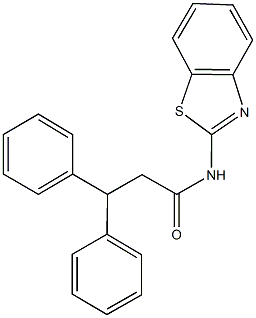
Physicochemical Properties
| Molecular Formula | C22H18N2OS |
| Molecular Weight | 358.456123828888 |
| Exact Mass | 358.113 |
| CAS # | 313480-47-6 |
| PubChem CID | 591698 |
| Appearance | White to off-white solid powder |
| Density | 1.3±0.1 g/cm3 |
| Index of Refraction | 1.700 |
| LogP | 5.65 |
| Hydrogen Bond Donor Count | 1 |
| Hydrogen Bond Acceptor Count | 3 |
| Rotatable Bond Count | 5 |
| Heavy Atom Count | 26 |
| Complexity | 441 |
| Defined Atom Stereocenter Count | 0 |
| InChi Key | GYQWKTIZRYVFEM-UHFFFAOYSA-N |
| InChi Code | InChI=1S/C22H18N2OS/c25-21(24-22-23-19-13-7-8-14-20(19)26-22)15-18(16-9-3-1-4-10-16)17-11-5-2-6-12-17/h1-14,18H,15H2,(H,23,24,25) |
| Chemical Name | N-(1,3-benzothiazol-2-yl)-3,3-diphenylpropanamide |
| HS Tariff Code | 2934.99.9001 |
| Storage |
Powder-20°C 3 years 4°C 2 years In solvent -80°C 6 months -20°C 1 month |
| Shipping Condition | Room temperature (This product is stable at ambient temperature for a few days during ordinary shipping and time spent in Customs) |
Biological Activity
| Targets |
IGS-1.76 targets the interaction between neuronal calcium sensor 1 (NCS1) and guanine nucleotide exchange factor Ric8a, with a Ki value of 0.7 μM (isothermal titration calorimetry, ITC) and an IC₅₀ value of 1.2 μM (HTRF-based binding inhibition assay) [1] |
| ln Vitro |
The Drosophila NCS-1/IGS-1.76 complex is inhibited by IGS-1.76 [1]. IGS-1.76 (0.1–10 μM) dose-dependently inhibited the interaction between recombinant NCS1 and Ric8a, achieving 52% inhibition at 1 μM and 91% inhibition at 10 μM (HTRF assay) [1] - In primary rat cortical neurons: The compound (1–5 μM) reduced NCS1-Ric8a co-immunoprecipitation by 45–78%, confirming disruption of their endogenous interaction (Western blot) [1] - It modulated calcium-dependent synaptic vesicle exocytosis: 3 μM decreased FM4-64 dye release (a marker of vesicle exocytosis) by 58% in cortical neurons, without affecting baseline calcium levels [1] - IGS-1.76 showed high selectivity for NCS1-Ric8a: no significant binding to other NCS family members (NCS2, NCS3) or GEFs (e.g., GEF-H1) at concentrations up to 20 μM [1] - No obvious cytotoxicity was observed in primary cortical neurons or Neuro-2a cells at concentrations up to 20 μM (MTT assay, cell viability >90%) [1] |
| Enzyme Assay |
ITC assay for NCS1-Ric8a binding affinity: Recombinant human NCS1 protein was dialyzed and mixed with serial dilutions of IGS-1.76 (0.05–10 μM) in buffer at 25°C. Ric8a protein was injected into the sample cell, and heat changes were measured to calculate the binding dissociation constant (Ki) [1] - HTRF-based binding inhibition assay: NCS1 was labeled with a donor fluorophore, and Ric8a with an acceptor fluorophore. The labeled proteins were incubated with IGS-1.76 (0.1–20 μM) at 37°C for 60 minutes. Fluorescence resonance energy transfer (FRET) signal was detected to assess inhibition of protein-protein interaction [1] |
| Cell Assay |
Primary cortical neuron culture: Cortical neurons were isolated from E18 rat embryos, plated on poly-L-lysine-coated dishes, and cultured in neurobasal medium for 7–10 days before drug treatment [1] - Co-immunoprecipitation (Co-IP) assay: Neurons were treated with IGS-1.76 (1–5 μM) for 24 hours, lysed, and lysates were incubated with NCS1 antibody. Immunoprecipitated complexes were analyzed by Western blot with Ric8a antibody to detect interaction disruption [1] - Synaptic vesicle exocytosis assay: Neurons were loaded with FM4-64 dye for 10 minutes, washed, and treated with IGS-1.76 (1–5 μM) for 30 minutes. Dye release was induced by high potassium (50 mM KCl), and fluorescence intensity was measured in real-time to quantify exocytosis [1] - Calcium imaging assay: Neurons were loaded with Fluo-4 AM probe, treated with IGS-1.76 (3 μM), and intracellular calcium levels were monitored during KCl stimulation to rule out direct calcium chelation [1] |
| References |
[1]. Deciphering the Inhibition of the Neuronal Calcium Sensor 1 and the Guanine Exchange Factor Ric8a with a Small Phenothiazine Molecule for the Rational Generation of Therapeutic Synapse Function Regulators. J Med Chem. 2018 Jul 26;61(14. |
| Additional Infomation |
IGS-1.76 is a synthetic small-molecule inhibitor belonging to the phenothiazine class, designed to target the NCS1-Ric8a protein-protein interaction [1] - Its mechanism of action involves binding to the hydrophobic pocket of NCS1 (residues Leu66, Phe72, Ile100), which is critical for Ric8a recognition, thereby blocking their association [1] - The compound is a valuable tool for studying NCS1-Ric8a-mediated signaling pathways, including regulation of synaptic function and neuronal excitability [1] - It has potential applications as a therapeutic synapse function regulator for neuropsychiatric disorders (e.g., schizophrenia, epilepsy) associated with abnormal NCS1-Ric8a activity [1] |
Solubility Data
| Solubility (In Vitro) | DMSO : ~250 mg/mL (~697.43 mM) |
| Solubility (In Vivo) |
Solubility in Formulation 1: ≥ 2.08 mg/mL (5.80 mM) (saturation unknown) in 10% DMSO + 90% Corn Oil (add these co-solvents sequentially from left to right, and one by one), clear solution. For example, if 1 mL of working solution is to be prepared, you can add 100 μL of 20.8 mg/mL clear DMSO stock solution to 900 μL of corn oil and mix evenly. (Please use freshly prepared in vivo formulations for optimal results.) |
| Preparing Stock Solutions | 1 mg | 5 mg | 10 mg | |
| 1 mM | 2.7897 mL | 13.9486 mL | 27.8971 mL | |
| 5 mM | 0.5579 mL | 2.7897 mL | 5.5794 mL | |
| 10 mM | 0.2790 mL | 1.3949 mL | 2.7897 mL |