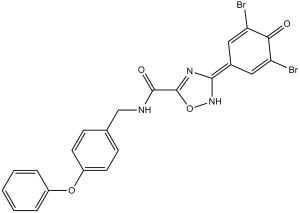
IOWH-032 (IOWH032; IOWH 032) is a potent and synthetic CFTR (Cystic fibrosis transmembrane conductance regulator) inhibitor with antifibrotic activity. It inhibits CFTR with IC50s of 1.01 μM and in CHO-CFTR and T84-CFTR cell based assays, respectively. IOWH-032 rapidly blocked and potentiated hCFTR activity in a concentration-dependent manner with apparent Kd value of 6.1 nM and 0.64 nM, respectively. However, IOWH-032 did not potentiate and only blocked mCFTR with an apparent Kd value of 42.9 μM.
Physicochemical Properties
| Molecular Formula | C22H15BR2N3O4 | |
| Molecular Weight | 545.18 | |
| Exact Mass | 542.942 | |
| CAS # | 1191252-49-9 | |
| Related CAS # |
|
|
| PubChem CID | 135565181 | |
| Appearance | White to off-white solid powder | |
| Density | 1.7±0.1 g/cm3 | |
| Index of Refraction | 1.665 | |
| LogP | 7.13 | |
| Hydrogen Bond Donor Count | 2 | |
| Hydrogen Bond Acceptor Count | 6 | |
| Rotatable Bond Count | 6 | |
| Heavy Atom Count | 31 | |
| Complexity | 575 | |
| Defined Atom Stereocenter Count | 0 | |
| InChi Key | DSFNLJXHXBIKDS-UHFFFAOYSA-N | |
| InChi Code | InChI=1S/C22H15Br2N3O4/c23-17-10-14(11-18(24)19(17)28)20-26-22(31-27-20)21(29)25-12-13-6-8-16(9-7-13)30-15-4-2-1-3-5-15/h1-11,28H,12H2,(H,25,29) | |
| Chemical Name | 3-(3,5-dibromo-4-hydroxyphenyl)-N-(4-phenoxybenzyl)-1,2,4-oxadiazole-5-carboxamide | |
| Synonyms |
|
|
| HS Tariff Code | 2934.99.9001 | |
| Storage |
Powder-20°C 3 years 4°C 2 years In solvent -80°C 6 months -20°C 1 month |
|
| Shipping Condition | Room temperature (This product is stable at ambient temperature for a few days during ordinary shipping and time spent in Customs) |
Biological Activity
| Targets |
Cystic Fibrosis Transmembrane Conductance Regulator (CFTR) (IC50 for CFTR-mediated chloride transport inhibition: ~0.5 μM; EC50 for SARS-CoV-2 infection inhibition in human bronchial epithelial cells: 1.2 μM)[1][3][4] |
| ln Vitro |
IOWH-032 (10 µM; 0-72 h) enhances the ACE-2 expression in SARS-CoV-2 infected CFBE41o- WT cells[1]. In human bronchial epithelial cells (HBECs) and colonic epithelial cells (T84), IOWH032 (0.1-5 μM) dose-dependently inhibited CFTR-mediated chloride transport, with an IC50 of ~0.5 μM (Ussing chamber assay). At 2 μM, it blocked forskolin-stimulated chloride current by 85%, suppressing epithelial fluid secretion associated with acute secretory diarrhea[1][4] - In human bronchial epithelial cells (CALU-3) infected with SARS-CoV-2, IOWH032 (0.5-3 μM) reduced viral replication and infection rate. At 1.2 μM (EC50), it inhibited viral nucleoprotein expression by 60% and decreased viral titers by 1.8 log10 PFU/mL. It also attenuated SARS-CoV-2-induced epithelial barrier dysfunction[3] - IOWH032 showed high selectivity for CFTR: at 10 μM, it had no significant effect on other chloride channels (e.g., ENaC, TMEM16A) or ion transporters, with inhibition rates <10%[1][4] |
| ln Vivo |
In a mouse closed-loop model, IOWH032 causes a statistical significant inhibition against cholera toxin (CTX) induced secretion. IOWH032 (5 mg/kg) reduces the fecal output index by ~70% in a cecetomized rat model. In a rodent model of cholera toxin-induced acute secretory diarrhea, oral administration of IOWH032 (1 mg/kg, 3 mg/kg, 10 mg/kg) dose-dependently reduced intestinal fluid accumulation. The 10 mg/kg dose decreased intestinal weight/length ratio by 75% compared to vehicle control, with a therapeutic effect lasting up to 6 hours[1][4] - In a mouse model of rotavirus-induced diarrhea, intraperitoneal injection of IOWH032 (5 mg/kg) reduced stool output by 65% and shortened diarrhea duration by 30% without affecting viral clearance[2][4] |
| Enzyme Assay |
CFTR channel activity assay: Recombinant human CFTR was expressed in HEK293 cells or Xenopus oocytes. Gradient concentrations of IOWH032 (0.05-5 μM) were added to the extracellular solution. Whole-cell patch-clamp (HEK293 cells) or two-electrode voltage clamp (oocytes) was used to record CFTR-mediated currents. Chloride flux was quantified to calculate IC50 for CFTR inhibition[1][4] |
| Cell Assay |
Western Blot Analysis[1] Cell Types: CFBE41o- cells Tested Concentrations: 10 µM Incubation Duration: 0, 24, 48, 72 h Experimental Results: Increased the ACE-2 expression in SARS-CoV-2 infected CFBE41o- WT cells in a time-dependent manner. CFTR-mediated chloride transport inhibition assay: T84 or HBECs were seeded on permeable supports and cultured to confluence. IOWH032 (0.1 μM, 0.5 μM, 2 μM, 5 μM) was added to the apical medium, and CFTR was activated by forskolin. Transepithelial chloride current was measured by Ussing chamber to assess inhibition efficiency[1][4] - SARS-CoV-2 infection inhibition assay: CALU-3 cells were seeded in 96-well plates and pre-treated with IOWH032 (0.5 μM, 1.2 μM, 3 μM) for 1 hour, then infected with SARS-CoV-2 (MOI = 0.1). After 24 hours, viral nucleoprotein expression was detected by immunofluorescence, and viral titers in cell supernatants were quantified by plaque assay. Epithelial barrier function was evaluated by transepithelial electrical resistance (TEER) measurement[3] |
| Animal Protocol |
Dissolved in DMSO; ~5 mg/kg; p.o. A cecetomized rat model Cholera toxin-induced diarrhea rodent model: Male Wistar rats (180-220 g) were randomly grouped. IOWH032 was suspended in 0.5% carboxymethylcellulose sodium (CMC-Na) and administered orally at 1 mg/kg, 3 mg/kg, or 10 mg/kg 30 minutes before intraperitoneal injection of cholera toxin. Six hours later, rats were euthanized, and the small intestine was isolated to measure weight/length ratio as a marker of fluid accumulation[1][4] - Rotavirus-induced diarrhea mouse model: Female BALB/c mice (18-22 g) were infected with rotavirus via oral gavage. IOWH032 was dissolved in DMSO/saline (1:99) and administered intraperitoneally at 5 mg/kg once daily for 3 days. Stool output was recorded daily, and diarrhea duration was monitored until symptom resolution[2][4] |
| ADME/Pharmacokinetics |
Absorption: Oral bioavailability of IOWH032 in rats is ~65%, with peak plasma concentration (Cmax) of 80 ng/mL achieved 1.5 hours after 10 mg/kg oral administration[1] - Distribution: Volume of distribution is ~2.3 L/kg in rats, with good penetration into intestinal and lung epithelial tissues[1][4] - Metabolism: Minimally metabolized in the liver; ~85% of the drug remains unchanged[1] - Excretion: ~70% of the dose is excreted in feces, and ~25% in urine, primarily as parent drug[1] - Half-life: Elimination half-life is ~5.5 hours in rats[1] |
| Toxicity/Toxicokinetics |
Plasma protein binding rate: IOWH032 is 90% bound to rat plasma proteins and 92% bound to human plasma proteins[1] - Acute toxicity: No mortality observed in rats after oral administration of up to 200 mg/kg; no significant clinical signs of toxicity[1][4] - Organ toxicity: Subchronic toxicity study (28 days, rats, 10-100 mg/kg oral) showed no significant elevations in ALT, AST, creatinine, or BUN; no histopathological changes in liver, kidney, or intestinal tissues[1] - Drug-drug interactions: No significant inhibition or induction of cytochrome P450 enzymes (CYP1A2, CYP2C9, CYP3A4), with low interaction risk[1] |
| References |
[1]. Inhibitors Of The CFTR Chloride Ion Channel As Potential Treatment For Acute Secretory Diarrhea: Development Of 5-membered Heterocycles Suitable For Pre-clinical Evaluation. [2]. Developing novel antisecretory drugs to treat infectious diarrhea. Future Med Chem. 2011 Aug;3(10):1317-25. [3]. CFTR Modulation Reduces SARS-CoV-2 Infection in Human Bronchial Epithelial Cells. Cells. 2022 Apr 15;11(8):1347. [4]. CFTR inhibitors for treating diarrheal disease. Clin Pharmacol Ther. 2012 Sep;92(3):287-90. |
| Additional Infomation |
Iowh032 has been investigated for the treatment of Cholera, Diarrhea, and Secretory Diarrhea. IOWH032 is a novel 5-membered heterocycle-derived CFTR inhibitor developed as a potential treatment for acute secretory diarrhea and viral infections (e.g., SARS-CoV-2)[1][3][4] - Its core mechanism involves reversible binding to CFTR, blocking chloride transport across epithelial membranes to reduce pathological fluid secretion and inhibit viral entry/ replication in airway epithelial cells[3][4] - It exhibits potent antisecretory activity against diarrhea induced by cholera toxin, rotavirus, and other enteric pathogens, with rapid onset of action[1][2][4] - The drug shows therapeutic potential for SARS-CoV-2 infection by targeting CFTR-mediated epithelial barrier dysfunction and viral replication[3] - It has favorable preclinical pharmacokinetics (oral bioavailability, tissue penetration) and safety profile, supporting its suitability for preclinical and clinical development[1][4] |
Solubility Data
| Solubility (In Vitro) |
|
|||
| Solubility (In Vivo) |
Solubility in Formulation 1: ≥ 2.5 mg/mL (4.59 mM) (saturation unknown) in 10% DMSO + 40% PEG300 + 5% Tween80 + 45% Saline (add these co-solvents sequentially from left to right, and one by one), clear solution. For example, if 1 mL of working solution is to be prepared, you can add 100 μL of 25.0 mg/mL clear DMSO stock solution to 400 μL PEG300 and mix evenly; then add 50 μL Tween-80 to the above solution and mix evenly; then add 450 μL normal saline to adjust the volume to 1 mL. Preparation of saline: Dissolve 0.9 g of sodium chloride in 100 mL ddH₂ O to obtain a clear solution. Solubility in Formulation 2: ≥ 2.5 mg/mL (4.59 mM) (saturation unknown) in 10% DMSO + 90% Corn Oil (add these co-solvents sequentially from left to right, and one by one), clear solution. For example, if 1 mL of working solution is to be prepared, you can add 100 μL of 25.0 mg/mL clear DMSO stock solution to 900 μL of corn oil and mix evenly. (Please use freshly prepared in vivo formulations for optimal results.) |
| Preparing Stock Solutions | 1 mg | 5 mg | 10 mg | |
| 1 mM | 1.8343 mL | 9.1713 mL | 18.3426 mL | |
| 5 mM | 0.3669 mL | 1.8343 mL | 3.6685 mL | |
| 10 mM | 0.1834 mL | 0.9171 mL | 1.8343 mL |