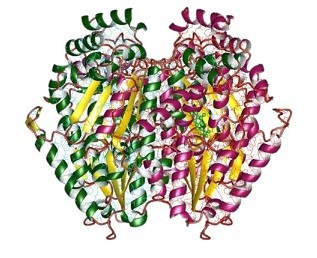
Hyaluronidase (Hyaluronoglucosaminidase; Hyaluronate 4-glycanohydrolase) is a natural enzyme found in high amount in testis, and is able to depolymerize hyaluronic acid by cleaving the glycosidic bonds, used as a local anesthetic additive.
Physicochemical Properties
| Molecular Formula | N/A |
| Molecular Weight | 55 kDa |
| Exact Mass | 342.073 |
| CAS # | 37326-33-3 |
| PubChem CID | 91820602 |
| Appearance | Off-white to light yellow solid powder |
| Density | 1.5±0.1 g/cm3 |
| Boiling Point | 598.6±50.0 °C at 760 mmHg |
| Flash Point | 223.2±23.6 °C |
| Vapour Pressure | 0.0±1.8 mmHg at 25°C |
| Index of Refraction | 1.642 |
| LogP | 2.41 |
| Hydrogen Bond Donor Count | 2 |
| Hydrogen Bond Acceptor Count | 3 |
| Rotatable Bond Count | 6 |
| Heavy Atom Count | 21 |
| Complexity | 375 |
| Defined Atom Stereocenter Count | 0 |
| SMILES | OC(C(C1C=CC2OCOC=2C=1)CC(C1C=CC2OCOC=2C=1)=O)=O |
| InChi Key | SVMKEDBUSSWSFY-UHFFFAOYSA-N |
| InChi Code | InChI=1S/C17H23NO2.BrH/c1-13-17(2,3)14-9-6-7-10-15(14)18(13)12-8-4-5-11-16(19)20;/h6-7,9-10H,1,4-5,8,11-12H2,2-3H3,(H,19,20);1H |
| Chemical Name | 6-(3,3-dimethyl-2-methylideneindol-1-yl)hexanoic acid;hydrobromide |
| Synonyms | Hyaluronate 4-glycanohydrolase; 37326-33-3; Hyaluronoglucosaminidase; 9001-54-1; Hyaluronidase from Bovine Testes,; SCHEMBL25199975; SVMKEDBUSSWSFY-UHFFFAOYSA-N; Hyaluronoglucosaminidase |
| HS Tariff Code | 2934.99.9001 |
| Storage |
Powder-20°C 3 years 4°C 2 years In solvent -80°C 6 months -20°C 1 month |
| Shipping Condition | Room temperature (This product is stable at ambient temperature for a few days during ordinary shipping and time spent in Customs) |
Biological Activity
| Targets | Hyaluronic acid/HA |
| ln Vitro | Hyaluronidase, an enzyme that breaks down hyaluronic acid, has long been used to increase the absorption of drugs into tissue and to reduce tissue damage in cases of extravasation of a drug. With the increasing popularity of hyaluronic acid filler, hyaluronidase has become an essential drug for the correction of complications and unsatisfactory results after filler injection. For this reason, when performing procedures using hyaluronic acid filler, a sufficient knowledge of hyaluronidase is required. In order for hyaluronidase to dissolve a hyaluronic acid filler, it must interact with its binding sites within the hyaluronic acid. The reaction of a filler to hyaluronidase depends on the hyaluronic acid concentration, the number of crosslinks, and the form of the filler. Hyaluronidase is rapidly degraded and deactivated in the body. Therefore, in order to dissolve a hyaluronic acid filler, a sufficient amount of hyaluronidase must be injected close to the filler. If the filler is placed subcutaneously, injection of hyaluronidase into the filler itself may help, but if the filler is placed within a blood vessel, it is sufficient to inject hyaluronidase in the vicinity of the vessel, instead of into the filler itself. Allergic reactions are a common side effect of hyaluronidase. Most allergic reactions to hyaluronidase are local, but systemic reactions may occur in infrequent cases. Since most allergic responses to hyaluronidase are immediate hypersensitivity reactions, skin tests are recommended before use. However, some patients experience delayed allergic reactions, which skin tests may not predict.[3] |
| ln Vivo | Hyaluronidase dramatically reduced the size of the augmentation created by injected Restylane in all of our subjects. A comparison of average scores of saline-injected sites vs hyaluronidase-injected sites revealed a statistically significant difference. By 4 to 7 days after hyaluronidase injection, skin scores were at 20% of baseline (P<.001). Dose-related response to injected hyaluronidase was also observed, although it was not statistically significant. A number of patients (25%) demonstrated localized, self-limiting hypersensitivity reactions to injected hyaluronidase. Conclusions: Intradermal hyaluronidase injections can be used to reduce dermal augmentation from previously injected Restylane. A small dose of hyaluronidase equivalent to 5 to 10 U may be injected initially.[1] |
| Animal Protocol |
To determine the effects of injected hyaluronidase in cutaneous areas previously augmented with Restylane (Q-Med AB, Uppsala, Sweden), a nonanimal, stabilized hyaluronic acid (NASHA) gel.
Methods: A prospective, randomized study was undertaken in 2 parts. First, the effects of hyaluronidase and saline were compared on post-NASHA dermal augmentation. Next, 3 different doses of hyaluronidase were evaluated after NASHA gel dermal augmentation. A blinded evaluator assigned postinjection skin scores. Each patient served as his or her own control.[1] The efficacy of hyaluronidase for the reversal of HA injections was formally demonstrated by a randomized, controlled trial conducted by Vartanian et al. In the study, twelve participants received two 0.2 mL injections of non-animal stabilized HA in the proximal forearm. One to three days after injection, skin scores were determined on a 0-5 scale based on the size of augmentation. Participants then randomly received 0.5 mL of 75 units of hyaluronidase or normal saline vehicle. After one week, participants who received hyaluronidase demonstrated an 80% decline in skin scores, compared to a 10% decline among saline controls (p<0.001). Ninety days after treatment, there was no palpable remnant of the HA injection in 92% of subjects in the treatment group, while all control patients injected with saline continued to have detectable HA. In practice, one primary consideration in the use of hyaluronidase is in the clinical context in which the removal of HA is desired. In general, complications of HA fillers can be categorized as emergent complications, notably vascular obstruction and skin necrosis, and non-emergent complications, such as over-correction, non-inflamed nodules, edema, and inflammatory nodules. Accordingly the approach to using hyaluronidase should be adjusted according to the indication, anatomical location, and desired clinical effect [2]. |
| References |
[1]. Injected hyaluronidase reduces restylane-mediated cutaneous\naugmentation. Arch Facial Plast Surg. 2005 Jul-Aug;7(4):231-7. [2]. The Use of Hyaluronidase in Cosmetic Dermatology: A Review of\nthe Literature. J Clin Investigat Dermatol. 2015;3(2): 7. [3]. Hyaluronidase: An overview of its properties, applications, and side effects. Arch Plast Surg. 2020 Jul;47(4):297-300. |
| Additional Infomation |
An enzyme that catalyzes the random hydrolysis of 1,4-linkages between N-acetyl-beta-D-glucosamine and D-glucuronate residues in hyaluronate. (From Enzyme Nomenclature, 1992) There has been use as ANTINEOPLASTIC AGENTS to limit NEOPLASM METASTASIS. See also: Hyaluronidase (annotation moved to). |
Solubility Data
| Solubility (In Vitro) | H2O : ~100 mg/mL |
| Solubility (In Vivo) |
Note: Listed below are some common formulations that may be used to formulate products with low water solubility (e.g. < 1 mg/mL), you may test these formulations using a minute amount of products to avoid loss of samples. Injection Formulations (e.g. IP/IV/IM/SC) Injection Formulation 1: DMSO : Tween 80: Saline = 10 : 5 : 85 (i.e. 100 μL DMSO stock solution → 50 μL Tween 80 → 850 μL Saline) *Preparation of saline: Dissolve 0.9 g of sodium chloride in 100 mL ddH ₂ O to obtain a clear solution. Injection Formulation 2: DMSO : PEG300 :Tween 80 : Saline = 10 : 40 : 5 : 45 (i.e. 100 μL DMSO → 400 μLPEG300 → 50 μL Tween 80 → 450 μL Saline) Injection Formulation 3: DMSO : Corn oil = 10 : 90 (i.e. 100 μL DMSO → 900 μL Corn oil) Example: Take the Injection Formulation 3 (DMSO : Corn oil = 10 : 90) as an example, if 1 mL of 2.5 mg/mL working solution is to be prepared, you can take 100 μL 25 mg/mL DMSO stock solution and add to 900 μL corn oil, mix well to obtain a clear or suspension solution (2.5 mg/mL, ready for use in animals). Injection Formulation 4: DMSO : 20% SBE-β-CD in saline = 10 : 90 [i.e. 100 μL DMSO → 900 μL (20% SBE-β-CD in saline)] *Preparation of 20% SBE-β-CD in Saline (4°C,1 week): Dissolve 2 g SBE-β-CD in 10 mL saline to obtain a clear solution. Injection Formulation 5: 2-Hydroxypropyl-β-cyclodextrin : Saline = 50 : 50 (i.e. 500 μL 2-Hydroxypropyl-β-cyclodextrin → 500 μL Saline) Injection Formulation 6: DMSO : PEG300 : castor oil : Saline = 5 : 10 : 20 : 65 (i.e. 50 μL DMSO → 100 μLPEG300 → 200 μL castor oil → 650 μL Saline) Injection Formulation 7: Ethanol : Cremophor : Saline = 10: 10 : 80 (i.e. 100 μL Ethanol → 100 μL Cremophor → 800 μL Saline) Injection Formulation 8: Dissolve in Cremophor/Ethanol (50 : 50), then diluted by Saline Injection Formulation 9: EtOH : Corn oil = 10 : 90 (i.e. 100 μL EtOH → 900 μL Corn oil) Injection Formulation 10: EtOH : PEG300:Tween 80 : Saline = 10 : 40 : 5 : 45 (i.e. 100 μL EtOH → 400 μLPEG300 → 50 μL Tween 80 → 450 μL Saline) Oral Formulations Oral Formulation 1: Suspend in 0.5% CMC Na (carboxymethylcellulose sodium) Oral Formulation 2: Suspend in 0.5% Carboxymethyl cellulose Example: Take the Oral Formulation 1 (Suspend in 0.5% CMC Na) as an example, if 100 mL of 2.5 mg/mL working solution is to be prepared, you can first prepare 0.5% CMC Na solution by measuring 0.5 g CMC Na and dissolve it in 100 mL ddH2O to obtain a clear solution; then add 250 mg of the product to 100 mL 0.5% CMC Na solution, to make the suspension solution (2.5 mg/mL, ready for use in animals). Oral Formulation 3: Dissolved in PEG400 Oral Formulation 4: Suspend in 0.2% Carboxymethyl cellulose Oral Formulation 5: Dissolve in 0.25% Tween 80 and 0.5% Carboxymethyl cellulose Oral Formulation 6: Mixing with food powders Note: Please be aware that the above formulations are for reference only. InvivoChem strongly recommends customers to read literature methods/protocols carefully before determining which formulation you should use for in vivo studies, as different compounds have different solubility properties and have to be formulated differently. (Please use freshly prepared in vivo formulations for optimal results.) |