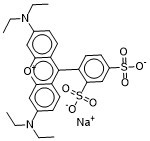
Physicochemical Properties
| Molecular Formula | C27H29N2O7S2-.NA+ |
| Molecular Weight | 580.64816 |
| Exact Mass | 580.131 |
| CAS # | 3520-42-1 |
| Related CAS # | 2609-88-3 (Parent) |
| PubChem CID | 9916275 |
| Appearance | Brown to reddish brown solid powder |
| LogP | 7.813 |
| Hydrogen Bond Donor Count | 0 |
| Hydrogen Bond Acceptor Count | 8 |
| Rotatable Bond Count | 6 |
| Heavy Atom Count | 39 |
| Complexity | 1150 |
| Defined Atom Stereocenter Count | 0 |
| InChi Key | SXQCTESRRZBPHJ-UHFFFAOYSA-M |
| InChi Code | InChI=1S/C27H30N2O7S2.Na/c1-5-28(6-2)18-9-12-21-24(15-18)36-25-16-19(29(7-3)8-4)10-13-22(25)27(21)23-14-11-20(37(30,31)32)17-26(23)38(33,34)35;/h9-17H,5-8H2,1-4H3,(H-,30,31,32,33,34,35);/q;+1/p-1 |
| Chemical Name | sodium;4-[3-(diethylamino)-6-diethylazaniumylidenexanthen-9-yl]benzene-1,3-disulfonate |
| HS Tariff Code | 2934.99.9001 |
| Storage |
Powder-20°C 3 years 4°C 2 years In solvent -80°C 6 months -20°C 1 month Note: Please store this product in a sealed and protected environment (e.g. under nitrogen), avoid exposure to moisture and light. |
| Shipping Condition | Room temperature (This product is stable at ambient temperature for a few days during ordinary shipping and time spent in Customs) |
Biological Activity
| ln Vitro |
Sulforhodamine B sodium salt (SRB) is frequently used in cytotoxicity assays, which measure cellular proteins to determine cell density, or as a membrane-impermeable analyte. Numerous screening assays have been carried out at low cost using the SRB assay to investigate cytotoxicity in cell-based investigations. The technique is based on the characteristics of SRB, which binds to proteins stoichiometrically in slightly acidic conditions and can be extracted in alkaline conditions; consequently, the quantity of bound dye can induce cell development. The four primary steps of the protocol are as follows: preparation for processing, processing for cell proliferation and selection, fixing of the cells and SRB staining, and measurements of absorbance. This assay can be used sensitively to test small high-potency molecules in adherent cells or chemotherapeutic drugs, but it is limited to manual or semi-automated screening. It is employed in the assessment of the effects of gene expression regulation (knockdown, upregulation) and the investigation of the effects of miRNA replacement on cell division [1]. 1. Linear correlation with cell number: Sulforhodamine B sodium salt (SRB) exhibits a strong linear relationship between absorbance and cell number, enabling quantitative assessment of cell proliferation. When testing HeLa, A549, and MCF-7 cells at densities ranging from 1×10³ to 1×10⁵ cells/well in 96-well plates, the correlation coefficient (R²) between absorbance (measured at 515 nm) and cell count was >0.99 for all cell lines [1] 2. High reproducibility in proliferation detection: The SRB assay showed good reproducibility. For intra-assay precision, the coefficient of variation (CV) was <5% when measuring the same cell sample (A549 cells treated with 10 μM doxorubicin) in 8 replicate wells. For inter-assay precision, the CV was <8% when repeating the assay on 3 consecutive days with the same cell batch and treatment conditions [1] 3. Compatibility with drug-induced proliferation inhibition assessment: Sulforhodamine B sodium salt effectively detects drug-induced changes in cell proliferation. For example, when MCF-7 cells were treated with 0.1–10 μM paclitaxel for 48 hours, the SRB assay detected a concentration-dependent decrease in absorbance: at 1 μM paclitaxel, the absorbance was reduced by 42% compared to the vehicle control; at 10 μM, the reduction reached 78%, consistent with the expected anti-proliferative effect [1] |
| Cell Assay |
1. Standard SRB assay for cell proliferation assessment (96-well plate format): 1) Cell seeding: Target cells (e.g., HeLa, A549) were trypsinized and resuspended in complete medium. The cell suspension was seeded into 96-well plates at a density of 5×10³ cells/well, with a final volume of 100 μL per well. The plates were incubated at 37°C in a humidified atmosphere with 5% CO₂ for 24 hours to allow cell attachment [1] 2) Drug treatment (if applicable): Test compounds (e.g., chemotherapeutic agents) were diluted to different concentrations with complete medium. The original medium in the wells was aspirated, and 100 μL of the diluted compound solution was added to each well (vehicle control wells received medium without the compound). The plates were incubated for 48–72 hours under the same culture conditions [1] 3) Cell fixation: After treatment, 50 μL of 10% (w/v) trichloroacetic acid (TCA) was added to each well (final TCA concentration: 3.33%) to fix cells. The plates were placed at 4°C for 1 hour, then washed 3 times with deionized water to remove TCA and residual medium. Plates were air-dried at room temperature for 2–4 hours [1] 4) SRB staining: A 0.4% (w/v) Sulforhodamine B sodium salt solution (dissolved in 1% acetic acid) was prepared. 100 μL of this staining solution was added to each well, and the plates were incubated at room temperature for 30 minutes. Unbound dye was removed by washing 4 times with 1% acetic acid, and plates were air-dried again [1] 5) Dye solubilization and detection: 150 μL of 10 mM Tris base solution (pH 10.5) was added to each well to solubilize the bound SRB dye. The plates were shaken on a microplate shaker for 10 minutes to ensure complete solubilization. The absorbance of each well was measured at 515 nm using a microplate reader. Cell proliferation rate or inhibition rate was calculated by comparing the absorbance of treated wells with control wells [1] 2. SRB assay for adherent and suspension cells: For suspension cells (e.g., Jurkat cells), the fixation step was modified: cells were centrifuged at 1,000 × g for 5 minutes before adding TCA, and the supernatant was aspirated to avoid cell loss. Subsequent staining, washing, and detection steps were identical to those for adherent cells [1] |
| References |
[1]. Sulforhodamine B (SRB) Assay in Cell Culture to Investigate Cell Proliferation. Bio Protoc. 2016 Nov 5;6(21). pii: e1984. |
| Additional Infomation |
Lissamine rhodamine is an organic sodium salt having 4-[3,6-bis(diethylamino)xanthenium-9-yl]benzene-1,3-disulfonate as the counterion. It has a role as a fluorochrome, a histological dye and a fluorescent probe. It contains a lissamine rhodamine anion. - Sulforhodamine B sodium salt is a water-soluble, non-fluorescent cationic dye that binds to the basic amino acid residues (e.g., lysine, arginine) of intracellular proteins via electrostatic interactions. The amount of bound dye is proportional to the total protein content of cells, which directly correlates with cell number—this is the core mechanism for its use in cell proliferation assessment [1] - Compared to other cell proliferation assays (e.g., MTT assay), the SRB assay has several advantages: the stained complex is stable at room temperature for up to 7 days (no rapid fluorescence quenching), it is not affected by cell metabolic activity (cells are fixed before staining, avoiding interference from compounds that inhibit mitochondrial enzymes), and it has a wide linear detection range (suitable for cell densities from 1×10³ to 2×10⁵ cells/well) [1] - Sulforhodamine B sodium salt is compatible with most common cell culture media and does not react with common small-molecule drugs or nanoparticles, making it widely used in high-throughput screening of anti-proliferative compounds (e.g., chemotherapeutics, targeted drugs) [1] |
Solubility Data
| Solubility (In Vitro) |
DMSO : ~62.5 mg/mL (~107.64 mM) H2O : ~50 mg/mL (~86.11 mM) |
| Solubility (In Vivo) |
Solubility in Formulation 1: 50 mg/mL (86.11 mM) in PBS (add these co-solvents sequentially from left to right, and one by one), clear solution; with sonication. (Please use freshly prepared in vivo formulations for optimal results.) |
| Preparing Stock Solutions | 1 mg | 5 mg | 10 mg | |
| 1 mM | 1.7222 mL | 8.6110 mL | 17.2221 mL | |
| 5 mM | 0.3444 mL | 1.7222 mL | 3.4444 mL | |
| 10 mM | 0.1722 mL | 0.8611 mL | 1.7222 mL |